Can You Wear Aquamarine Every Day? Hardness and Durability Explained
Yes, you can wear aquamarine every day. GIA calls it a durable gemstone for jewelry, and at 7.5 to 8 on the Mohs scale it is harder than most of what your hands touch. The catch is that the stone is rarely what fails. The setting and the cut are. A big, pale aquamarine held up on four thin prongs looks like an heirloom in the shop case, but it is far more exposed than the same stone in a low bezel.
So the honest answer has two halves. Aquamarine is tough enough for daily wear, and it is a sensible everyday gem. A well-set aquamarine can last generations. A badly set one can lose a corner in a car door, and nobody notices until the stone is loose.
How durable is aquamarine in everyday jewelry?
Aquamarine sits at 7.5 to 8 on the Mohs scale, the relative ranking of a mineral’s resistance to being scratched by another mineral. That is genuinely good. It is harder than glass, steel, and the quartz in household dust, which is why aquamarine keeps its polish longer than amethyst or citrine.
Hardness is not toughness. Toughness is resistance to breaking, chipping, and fracturing, and it is a separate property. Aquamarine is beryl, the same mineral species as emerald, but it is usually far cleaner than emerald, so it avoids most of emerald’s fragility. It has only poor cleavage and good toughness, but a thin girdle, an included area, or a sharp corner can still fail under impact even though the stone would never scratch from the same blow.
| Property | Aquamarine |
|---|---|
| Species | Beryl (same as emerald and morganite) |
| Hardness (Mohs) | 7.5-8 |
| Toughness / cleavage | Good toughness; poor (indistinct) cleavage |
| Common treatment | Heating to remove green or yellow tints; stable and permanent |
| Light stability | Color is stable in light, per GIA |
| Heat | Avoid high heat and sudden temperature changes |
| Safe cleaning | Warm soapy water always; ultrasonic and steam usually safe unless fractured or with liquid inclusions |
The factors that actually decide whether your aquamarine survives daily life:
- Cut – thin edges, pointed corners, and exposed culets (the small facet at the bottom of the stone) are the weak points.
- Inclusions – internal features can act as starting points for cracks.
- Size – a larger stone presents more surface and more leverage.
- Mounting – the setting is the single biggest variable, and the one most buyers ignore.
- Exposure – what your hands actually do all day.
If you want the broader picture of what aquamarine is, where it comes from and what it costs, the full aquamarine guide covers properties, sources, and value in more depth.
| Jewelry use | Daily-wear suitability | Main concern | Safer design choice |
|---|---|---|---|
| Pendant | Excellent | Abrasion against clothing or other jewelry | Protected bail and secure setting |
| Earrings | Excellent | Accidental impact or loss | Secure backs and protective settings |
| Bracelet | Moderate | Repeated knocks against hard surfaces | Low-profile setting |
| Engagement or dress ring | Moderate to good | Impact, edge chips, setting wear | Bezel or protective halo |
| High-profile cocktail ring | Occasional wear preferred | Direct knocks and leverage | Wear for controlled occasions |
Wearing aquamarine every day by jewelry type
The question “can you wear aquamarine every day” has a different answer depending on where the stone sits on your body. That is not a dodge. It is the whole point.
Aquamarine rings
Rings take the most punishment of any jewelry you own. Your hands hit counters, door frames, desks, shopping carts, and tools all day, and you rarely notice. Every one of those contacts is a small impact delivered straight to the stone.
The vulnerable features are specific. A high-profile cut puts the stone up where it catches on things. A thin girdle (the widest edge of the stone, where the setting usually grips) chips easily. Pointed corners on a pear or marquise shape concentrate force. An exposed culet gives impact a place to land.
Setting choice matters more than anything else here:
- Bezel settings wrap a metal rim around the entire girdle. They shield the stone’s edges and are the most practical choice for a ring worn every day.
- Halo settings protect some of the perimeter with a ring of small stones, but they do not make an elevated center stone impact-proof. The halo is protection, not armor.
- Prong settings show the stone best and are easiest to clean, but they leave the girdle exposed and the prongs themselves wear down. They need inspection every six to twelve months.
- Metal choice matters too. Sterling silver is soft, so its prongs and bezels bend and wear faster; for a ring worn daily, 14k gold or platinum holds the stone more securely. White metals also keep a pale aquamarine looking bluer.
Take the ring off for gym workouts, gardening, heavy housework, moving furniture, and any manual work with repeated impact. If you are considering this stone for a proposal, aquamarine engagement ring designs shows which settings hold up.
Aquamarine necklaces and earrings
Pendants and earrings are the safest everyday aquamarine you can buy. They hang and move rather than striking surfaces, so they receive far fewer direct blows.
The risks that remain are practical rather than gemological. A pendant can snag on a sweater and pull the chain. An earring back can work loose and drop the stone somewhere you will never find it. Perfume, hairspray, and lotion leave residue that dulls the stone and degrades the metal over time. Choose secure earring backs, a chain heavy enough for the pendant’s weight, and put the jewelry on last, after perfume and hair products have dried.
Aquamarine bracelets
Bracelets face more abrasion and impact than necklaces because your wrist strikes desks, countertops, bags, and car doors constantly. A bracelet also rubs against itself and against anything else on the arm.
Do not stack an aquamarine bracelet directly beside harder gemstones or heavy metal bangles. Sapphire, ruby, and diamond will abrade aquamarine over months of contact, and rough metal edges will do the same. Low-profile settings and smooth bezels suit frequent wear far better than exposed, high-set stones.
What most buyers get wrong about aquamarine hardness
Most people believe a hardness number tells them whether a stone is safe to wear. It does not. The Mohs scale is relative and ordinal: it tells you what will scratch what, not how a stone will survive a drop onto tile.
Diamond sits at 10 and will scratch everything. Corundum – sapphire and ruby – sits at 9 and will scratch aquamarine. Quartz sits at 7, which means aquamarine will scratch it. Your stone is harder than most household materials, but it is not immune to the harder things in a jewelry box.
A scratch and a chip are different failures. Scratches come from contact with a harder material; they are surface damage, usually minor, and often polishable. Chips and fractures come from impact, vulnerable edges, or internal characteristics; they are structural, and they can travel.
Color does not change any of this. A saturated Santa Maria-style blue is the same mineral with the same hardness as a pale stone; the deeper color affects price, not durability. Our comparison of Santa Maria aquamarine vs regular aquamarine explains what that name does and does not guarantee.
The contrarian takeaway: a slightly softer stone in a protective bezel will outlast a harder stone on tall thin prongs. Buyers compare hardness numbers because numbers are easy to compare. The setting is what actually decides.
The hidden risks that shorten an aquamarine’s life
The gem itself is rarely what fails first. The jewelry around it does.
Setting failure is the most common problem. Prongs wear at the tips, baskets bend, clasps weaken. A stone can become vulnerable while the gem itself shows no visible damage at all. A loose stone rattles slightly, or catches on fabric, or sits visibly off-center. Those are warnings, not cosmetic quirks.
Abrasion from other jewelry is the second. Aquamarine stored loose in a drawer with sapphires or diamonds will collect fine scratches on its surface.
Heat and chemicals are the third. GIA advises against heat exposure for aquamarine, so avoid sudden temperature changes and ask a jeweler to protect the stone during any soldering or resizing. Chlorine and cleaning products are hard on the alloys that hold the stone, so remove the jewelry before swimming and cleaning; our stone-by-stone guide to showering with gemstone jewelry covers the shower question specifically.
Stop wearing the piece and have it inspected if you notice:
- A stone that rattles or moves when you touch it
- A visible gap beneath a prong
- A sharp edge or new crack where there was none before
- Sudden dullness that does not clean up
- A clasp that no longer closes securely
How to choose aquamarine jewelry for daily wear
Build the decision around exposure. Ask yourself how much contact the piece will take, then choose accordingly.
- Lowest maintenance: a pendant or a pair of earrings. Fewer impacts, less abrasion, easier to replace a single component if something fails.
- Frequent hand wear: a low-profile ring with a bezel or a protective halo. Medium stone size. Sturdy shank.
- Occasional wear only: large, elevated, sharply pointed, or unusually delicate designs. Beautiful, and not for the gym.
Cut and construction decide more than carat weight. Rounded shapes and protected corners tolerate everyday contact better than sharp points. A sturdy girdle and a well-supported pavilion matter more than maximum face-up size. Color matters too, and the aquamarine color chart helps you weigh saturation against size rather than buying the biggest pale stone in the case.
Ask about treatment. Most aquamarine on the market is heated to remove greenish or yellowish tints, an accepted and permanent practice, but you should be told. Fracture filling is rare in aquamarine; if a stone has been filled, it needs gentler cleaning. Request an independent report for a valuable or unusually large stone, especially where origin or treatment affects the price.
Two phrases to distrust. “Natural” does not mean untreated. And “AAA” is not a universal grading standard – it is a seller’s opinion unless a recognized lab issued the grade. Buy from a seller who states the gemstone identity, treatments, metal purity, return policy, and whether they offer inspection or repair support.
How to care for aquamarine worn every day
Remove aquamarine before exercise, cleaning, gardening, manual work, swimming, and sleeping – anything where the jewelry might catch or take a blow. This one habit prevents most everyday damage.
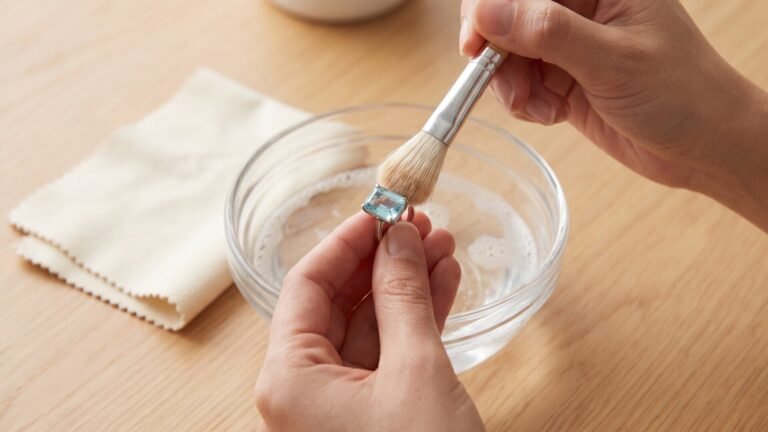
Clean it more often than you think. A pale stone shows a film of skin oil and lotion quickly, and the loss of sparkle is often mistaken for fading or wear. For cleaning, keep it simple:
- Use lukewarm water with a small amount of mild soap.
- Scrub gently with a soft brush, working around the setting and beneath the stone.
- Rinse carefully and dry with a soft, lint-free cloth.
- Clean over a bowl, or with the drain covered.
GIA describes ultrasonic and steam cleaners as usually safe for aquamarine, except for stones with fractures or liquid inclusions. Since you cannot always see those, soap and water remains the safest default, and a jeweler can check the stone before you use a machine.
Check the piece at home regularly – prongs, clasps, stone movement – and arrange professional inspection when it is valuable, heavily worn, or visibly loose. For a daily-worn ring, once a year is a reasonable rhythm. The full aquamarine care guide goes deeper on storage and long-term maintenance.
Aquamarine versus other blue stones for daily wear
Most guides compare aquamarine with one alternative at a time. If you want a blue stone you can wear every day, it helps to see the realistic options side by side, because hardness and cleavage pull in different directions.
| Stone | Mohs hardness | Cleavage / weak point | Best everyday use |
|---|---|---|---|
| Aquamarine | 7.5-8 | Poor cleavage; exposed edges | Pendant, earrings, protected ring |
| Blue topaz | 8 | Perfect cleavage; can split on a hard knock | Pendant, earrings, occasional ring |
| Blue spinel | 8 | No practical cleavage | Frequent-wear ring |
| Blue sapphire | 9 | No cleavage; very tough | Frequent-wear ring |
| Blue zircon | 6.5-7.5 | Brittle facet edges | Earrings, pendants |
| Blue tourmaline | 7-7.5 | Inclusions; can be brittle | Pendant, protected ring |
The decision rule: choose aquamarine for a soft sea-blue and the March birthstone at a moderate price, and accept a protective setting. Choose sapphire or spinel when the ring will take heavy daily wear for decades. Choose blue topaz for a lower price, knowing its perfect cleavage makes rings riskier than its hardness suggests. Keep zircon and tourmaline for pieces that avoid knocks.
Blue topaz is the comparison most shoppers actually make, because the two look similar and the price gap can be wide. Most blue topaz is irradiated and heated colorless topaz, so disclosure matters just as much. The aquamarine and topaz durability comparison breaks that down stone by stone, and choosing between aquamarine and blue topaz covers the broader buying decision.
Is aquamarine a sensible heirloom stone for daily wear?
Yes, with conditions. An aquamarine protected from avoidable impacts and maintained properly stays wearable for decades, and pendants in particular often need nothing more than a new chain. Our guide to vintage aquamarine jewelry shows how many older pieces survive.
Heirloom value depends on the whole piece, not just the gem: quality cutting, a durable mounting, repairable construction, clear treatment records, and a design that can be resized or reset later. A stone that can be moved into a new setting in thirty years is worth more than one locked into a fragile design. The hidden cost of poor construction is real; replacing a lost stone or rebuilding a worn setting can easily exceed what you saved on the cheaper piece.
- Best everyday aquamarine: earrings or a pendant with a secure setting.
- Best everyday ring: a medium-sized aquamarine in a low-profile bezel or protective halo, removed during impact-heavy tasks.
- Occasional wear: large, high-profile, sharply pointed, or unusually delicate designs.
Aquamarine is suitable for everyday jewelry. It is not a wear-it-and-forget-it stone. Its longevity comes from thoughtful design, sensible habits, and periodic inspection – not from the hardness number on the tag.
Frequently Asked Questions About Wearing Aquamarine Every Day
Does aquamarine fade in sunlight?
No. GIA describes aquamarine’s color as stable in light, and the common heat treatment is permanent. A stone that looks paler over time usually has a film of lotion or skin oil, which cleaning removes. Our guide on whether aquamarine fades in sunlight explains the details.
Why does my aquamarine look cloudy or dull?
Usually residue. Pale stones lose sparkle quickly under a film of soap, lotion or skin oil, especially on the underside where light enters. Clean it with warm soapy water and a soft brush. If it still looks hazy, a jeweler can check for surface scratches or an inclusion near the surface.
Is aquamarine a good birthstone gift for a child?
Aquamarine is durable enough for children’s pendants and stud earrings with secure screw or locking backs. Keep small jewelry away from young children, since earrings and small pendants can be a choking hazard, and choose a bezel setting so the stone survives play.
Can aquamarine go in an ultrasonic cleaner?
Usually yes, according to GIA, unless the stone has fractures or liquid inclusions, which can be hard to see. Fracture-filled stones, rare in aquamarine, should only get warm soapy water. If you are unsure, use soap and water or ask a jeweler to check first.
Can you sleep in aquamarine jewelry?
Small studs are generally fine, but rings and larger pendants are better removed. Pressure during sleep can bend prongs, stress a chain, and snag settings on bedding. Removing pieces at night also gives you a daily moment to notice a loose stone.
How often should an everyday aquamarine ring be inspected?
Check it yourself every few months for movement, loose prongs, and clasp problems, and have a jeweler inspect it about once a year if you wear it constantly. Book an inspection sooner after any hard knock, or if a prong starts catching on fabric.
Once you have decided aquamarine is right, the setting decision is short: a bezel or a secure pendant mounting, medium size, and a seller who will put the treatment disclosure in writing. For the history and symbolism behind March’s stone, see aquamarine meaning, and the wider gemstones guide covers how these standards apply across the rest of the birthstone calendar.