Does Peridot Fade in Sunlight? Color Stability Explained
Most people asking whether peridot fades in sunlight are not really asking about peridot. They are asking whether the stone they already own, or the one they are about to buy, has been quietly changing on them – and whether that change is their fault. That is the real question, and it has a better answer than the internet usually gives it.
Natural peridot is not generally classed as a highly light-sensitive gemstone. Ordinary daylight, the kind a ring or pendant sees on a commute or a summer afternoon, is not expected to bleach the color out of a sound stone. What does cause trouble is prolonged direct sun, heat, and the accumulated damage of careless storage. And a great many "faded" peridots were never faded at all. They were dirty, badly lit, or always that color to begin with.
The short version: wear it outside, don’t leave it on a windowsill for a year.
Does Peridot Fade in Sunlight?
Two different properties get tangled together here, and separating them clears up most of the confusion.
Light stability is a gemstone’s ability to hold its color under exposure to light. Heat stability is its ability to tolerate temperature without altering, cracking, or having a treatment come apart. A stone can be decently stable in one and vulnerable in the other, and the advice you need depends on which applies.
Natural peridot is generally considered reasonably stable under normal household conditions and normal jewelry wear. I have never seen a peridot go noticeably paler from being worn outdoors in daylight, and I have handled a lot of old peridot. Estate pieces from the 1960s and 1970s, worn hard and stored in boxes for decades, still read green.
What I have seen is heat do damage. Not to the color of the gem so much as to everything around it – a setting that loosened, a fracture that propagated, a treated or assembled piece that came apart at a glued or filled join. Peridot also has a reputation, gemologically, for being sensitive to sudden temperature change and to some acids, which is a separate concern from sunlight but often arrives with it. A hot car in July is a heat problem, not a light problem, and it is the more realistic risk.
So the practical rule is simple. Wearing peridot in daylight is fine. Storing it in direct sun for hours, days, or months is pointless and avoidable. The stone gets nothing from the light and the setting gets stressed by the heat.
I will not promise every stone behaves identically, because color stability depends on the individual piece – its condition, any treatment history, the setting, and how it has been treated over its life. A peridot with an existing fracture and a peridot that is clean and sound are not the same object, even if they look alike on the shelf.
Why Peridot Color Can Appear to Change Without Fading
Here is the part that saves people money. Most peridots that "changed color" did not change at all. Something about how they were being seen changed.
Lighting and color perception
Peridot is a strongly pleochroic stone in the rough, and its apparent color shifts with the light source. Under warm incandescent bulbs, a yellow-green peridot reads more yellow. Under cool overcast daylight, it goes greener and often looks brighter. Jewelry-store lighting is engineered to flatter, and it flatters some stones more than others. A peridot that looks olive at home and vivid in the shop is doing exactly what peridot does.
Dirt and surface film
This is the big one. Skin oils, hand lotion, soap residue, and dust collect on the pavilion (the underside of the stone) and in the space between the gem and the setting. A film of grime scatters light and mutes color. A green stone starts to look gray, dull, or brownish. Owners conclude the sun got to it. Usually the stone just needs washing.
Cut and setting effects
How a stone is cut changes how much color you see. A shallow pavilion can create a window – a see-through area where light passes straight through instead of reflecting back – which washes out apparent color. A deep, shadowed bezel setting can darken a stone. Yellow gold settings push peridot warmer; white metal cools it. Diamonds set alongside it make the green look more saturated by contrast.
Actual physical damage
Real change has a different signature. Abrasions and small chips scatter light at the surface. New fractures show as bright lines. Residue trapped behind the stone reads as a dark or cloudy patch. A loose stone in its setting moves and catches light differently. If cleaning does not restore the appearance, that is when you stop guessing and have someone look at it. A jeweler or qualified gemologist can tell the difference between surface wear, internal damage, and a stone that was always that shade.
If your peridot reads brown or yellow and you want the full explanation of the natural color range, why peridot sometimes looks brown or yellow covers it properly.
What Most Owners Get Wrong About Sunlight and Peridot
The first wrong assumption is that any change in appearance proves bleaching. Peridot’s natural color range runs from pure yellow-green through olive to brownish-green. A stone can look different in a different room and be the same stone. Before you accept a fading diagnosis, rule out the boring explanations.
The second is that a darker, more saturated green peridot is somehow tougher. It is not. Color saturation and durability are unrelated properties. A deep green stone and a pale one have the same hardness and the same vulnerability to impact. Buying on color intensity is a legitimate aesthetic choice; buying on the belief that darker means more durable is buying a fiction.
The third is a storage error that surprises people. A jewelry box sitting on a windowsill, or a display case in a sunlit room, creates more cumulative exposure than occasional outdoor wear ever will. That is months of daily heat cycling and direct light, plus the temperature swings that come with it. The piece you wear is handled, inspected, and put away. The piece by the window just sits there cooking.
And do not test any of this yourself. Household UV lamps, strong heat sources, and aggressive cleaning will not tell you whether the stone has changed. They will damage the jewelry and leave you with a real problem instead of a suspected one. There is no home experiment worth running on a gemstone you care about.
How to Check Whether Your Peridot Has Really Faded
Work through this in order. Most cases resolve at step two.
Document what you are comparing against. Human color memory is unreliable, and so are phone cameras – two photos taken minutes apart can differ in white balance and exposure. If you have an old photograph of the piece, use it, but compare under the same lighting, at the same angle, against the same background, with the stone equally clean. Otherwise you are comparing a memory to a current impression, which is not a comparison.
Clean it safely first. Lukewarm water, a drop of mild dish soap, a soft brush, careful rinsing, and a pat dry with a soft cloth. That is the whole method. Keep it gentle until you know the setting and any treatment – some assembled or filled pieces should not soak, and some settings trap water. If the color comes back, the sun was never the problem.
Look for non-color problems. Surface scratches, cloudy patches, new chips, visible cracks, loose prongs, or color concentrated oddly in one zone all point to damage or setting issues rather than fading. A stone that is cracked is a different conversation from a stone that is pale.
Bring in an expert when it matters. Sudden change, an uneven or cloudy appearance, a crack, an unknown treatment history, or a piece with real financial or family value all justify a professional look. Ask for treatment disclosure in writing and, for a disputed or valuable piece, a laboratory report from a respected lab. A report is an opinion on identity and treatment, not a warranty that the stone will never change – know what you are buying.
How to Protect Peridot Jewelry From Light, Heat, and Other Damage
The good news is that protecting peridot is mostly a matter of not doing careless things. It is not a fragile gemstone that needs a climate-controlled vault.
Everyday wear. Commuting, errands, a summer afternoon outdoors – all reasonable. The distinction that matters is between wearing a piece and abandoning it to the elements. Hours in direct sun is not the same as a walk to the car.
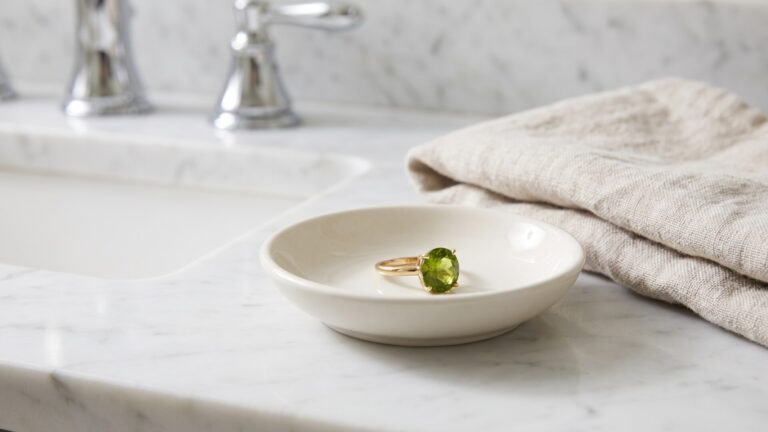
Storage. Cool, dark, dry. A fabric-lined jewelry box or an individual soft pouch, kept away from windowsills, radiators, hot attics, and cars. Individual storage also prevents peridot from being scratched by harder stones sharing the same compartment – a real risk, since peridot sits at 6.5 to 7 on the Mohs scale and quartz, sapphire, and diamond will all mark it.
Temperature and chemicals. Skip the hot tub, the sauna, and long sunbathing sessions with the piece on. Avoid harsh household chemicals, chlorine, and sudden temperature swings. Remember that the setting and any treatment may be more vulnerable than the gem itself – prongs bend, glues soften, filled fractures react.
Cleaning and maintenance. Have prongs, clasps, and bezels inspected periodically, roughly once a year for a frequently worn ring. Do not assume ultrasonic or steam cleaning is safe for every peridot piece; ask the jeweler to confirm the method first, particularly on treated or assembled jewelry. For the everyday questions – showering, sleeping, and the rest – whether peridot is safe to wear while showering or sleeping answers them directly.
Is Peridot Durable Enough for Regular Wear?
Peridot rates 6.5 to 7 on the Mohs scale, which measures scratch resistance – how hard a mineral is relative to others, with diamond at 10. That is respectable. It is not sapphire or ruby at 9, and it is not diamond. Window glass is around 5.5, so a peridot will not scratch from ordinary contact with most everyday surfaces, but it will scratch from quartz dust, from other jewelry, and from a careless knock against stone or metal.
Hardness is only one axis. Toughness – resistance to chipping and breaking – matters more for a stone that gets knocked around, and peridot is moderate there, with a tendency to develop fractures under impact. That is why the setting and the format matter more than the hardness number.
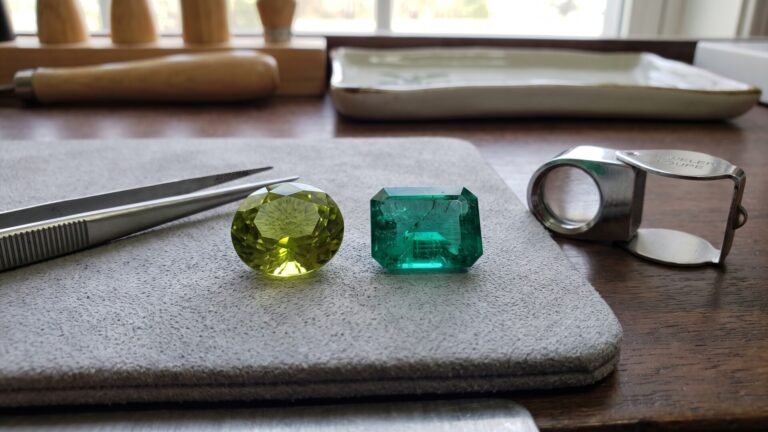
Rings and bracelets take the hits. Pendants and earrings mostly do not. A peridot ring needs a protective setting – a bezel or well-guarded prongs – and more frequent inspection than a pendant ever will. If you are weighing peridot against a harder green stone, the peridot versus emerald comparison lays out how the two differ on color and price, and durability is part of that conversation.
The long-term tradeoff is honest. A well-protected peridot, inspected and stored with a little care, can last generations and become a real heirloom. A peridot worn roughly, stored loose in a drawer with harder stones, and never inspected will accumulate chips and abrasions that cannot be undone. The stone is not the weak link. The habits are.
Here is the framework I would give anyone:
- Pendant or earrings: the right choice for frequent wear. Low impact exposure, easy to protect, and the color shows well at eye level.
- Ring: fine for occasional or careful wear, ideally with a bezel or protective prongs.
- Skip entirely: heavily exposed settings for manual work, sports, gardening, sleep, or anything involving heat and chemicals.
Buying Peridot With Color Stability in Mind
Ask what the stone actually is. "Green gemstone" is not a species. Confirm whether you are being offered natural peridot, another green stone entirely, a synthetic, or a composite assembled from more than one piece of material. The name on the tag should be specific.
Request treatment disclosure. The seller should tell you about known treatments, coatings, assembled construction, fracture filling, or anything else that affects how the piece must be cared for. If a coating is doing the work, cleaning and wear will eventually affect it. Marketing phrases like "permanent color" or "fade-proof" are not disclosure – they are a reason to ask harder questions. For a valuable purchase, get the disclosure in writing.
Judge the setting, not just the color. A slightly less saturated stone in a secure bezel will outlast a vivid stone in a fragile, exposed setting. Long-term ownership is decided by prongs and design more than by a shade difference you will stop noticing in a month.
Buy documentation for anything expensive. An independent gemological report from a respected laboratory is appropriate for a high-value or heirloom piece. Keep the receipt, photographs, and treatment information together – that paperwork is what your grandchild will need if the piece is ever appraised, insured, or sold. For origin, symbolism, and broader value context, the main peridot guide is the place to start. And if you are comparing green stones for an August birthday, peridot versus tsavorite garnet weighs the alternatives.
Can a Faded-Looking Peridot Be Repaired or Replaced?
Cleaning removes surface residue. That is the only "repair" that reverses an appearance problem, and it is worth trying first.
Genuine color alteration, internal damage, and a compromised coating cannot be cleaned back. Re-polishing can improve scratches and abrasions, but it removes material from the stone and changes its proportions, so it is a decision for a professional after evaluation – not a first resort.
Recoloring, coating, or replacing the stone is sometimes the practical answer, particularly on a piece with sentimental weight where the setting and history matter more than the original gem. If any of that is done, disclose it. A stone that has been coated or swapped and then sold or passed to heirs without a note is a problem waiting to land on someone who did not ask for it.
The decision framework I would use:
- Clean first when the change has been gradual and looks surface-based.
- Seek evaluation when the change is sudden, uneven, cloudy, or comes with cracks.
- Replace only after comparing repair cost, sentimental importance, setting quality, and how likely the piece is to be worn hard again. Replacing a stone into a setting that caused the damage just restarts the clock.
Frequently Asked Questions About Peridot Fading In Sunlight
Does peridot fade in sunlight over time?
Normal daylight exposure is not generally expected to fade natural peridot quickly. Prolonged direct sunlight and heat should still be avoided as a precaution. If a stone looks different than you remember, rule out dirt, lighting, and physical damage before accepting that it faded.
Can I wear peridot jewelry outside in the summer?
Yes, ordinary outdoor wear is usually reasonable. Remove it before prolonged sunbathing, swimming, hot-tub use, sauna visits, or any activity that exposes it to heat, chemicals, or impact.
Why does my peridot look brown or yellow in some light?
Peridot naturally ranges from yellow-green through olive to brownish-green, and different light sources, surrounding metals, dirt, cut proportions, and viewing angles all change its apparent color. None of that requires the stone to have faded.
Should I store peridot in a jewelry box near a window?
No. A cool, dark location is safer. Direct sun creates unnecessary heat and long-term exposure, and a windowsill box also exposes the piece to temperature swings. Use an individual pouch or compartment to prevent scratching.
Can heat damage peridot?
Heat can worsen existing fractures and may damage treatments, settings, or adjacent materials even where the gemstone itself does not visibly change. Avoid sudden temperature changes and strong heat sources.
Is peridot suitable for an everyday ring?
It can work for careful everyday wear, but it is less forgiving than sapphire, ruby, or diamond. A protective setting, routine inspection, and removal during manual work matter more than the hardness number suggests.
How can I tell whether a seller is making a misleading color-stability claim?
Ask for the stone’s identity, treatment disclosure, care instructions, and laboratory documentation appropriate to the price. “Fade-proof” and “permanent color” should not be accepted without documentation behind them.
The practical verdict on peridot and sunlight
Peridot is fine in daylight. It is not fine on a sunny windowsill for a year, in a hot car, or in a sauna, and those are the exposures worth actually managing. Most reports of fading turn out to be lighting, dirt, or damage, and the ones that are real tend to arrive suddenly and unevenly – which is your signal to get the piece looked at rather than to blame the sun.
Buy a well-documented stone in a secure setting, store it cool and dark, and treat it as durable jewelry rather than indestructible jewelry. That is the whole discipline, and it is not much of one.
The question that usually follows is whether peridot is the right green stone for the piece at all, or whether a harder option serves an everyday ring better. That comparison is worth making before you spend, and it is covered in the peridot versus emerald breakdown and the tsavorite garnet comparison if August is the occasion.