Ethiopian vs Australian Opal: Differences in Color and Durability
Most people who buy an Ethiopian opal ring find out what they actually bought about three weeks later, in a bathroom, when the stone goes cloudy. Not ruined – cloudy. It dries out in a few days and comes back, mostly. That is the thing the listing photograph never told them, and it is the single most useful difference between Ethiopian and Australian opal.
Here is the short answer first. If you want a stone you can wear without thinking about it, buy Australian solid opal. If you want the most dramatic color your money can buy and you will treat the piece accordingly, Ethiopian opal is a legitimate purchase, not a compromise. Neither origin is a quality grade. Body tone, brightness, pattern, structure and construction decide what the stone is worth and how long it lasts – the country on the label only tells you what to expect.
The real choice is appearance today against maintenance for the next forty years.
How Ethiopian and Australian Opals Differ at a Glance
Both are natural opal, hydrated silica with a variable water content, formed in completely different geological settings. Australian opal comes largely from sedimentary host rock in a handful of famous fields; Ethiopian material comes from volcanic-hosted deposits, most of it from the Wollo region. That geology produces different material – and, just as importantly, different commercial forms.
"Australian opal" is not one thing. Black, boulder, white, crystal and matrix opal are all sold under that flag, and they behave and price very differently. "Ethiopian opal" is not one thing either. A fine, stable, non-hydrophane specimen and a porous commercial cabochon share an origin and almost nothing else.
| Buying factor | Ethiopian opal | Australian opal | What it means for the buyer |
|---|---|---|---|
| Common appearance | Bright white, crystal, honey and darker body tones with vivid play-of-color | White, crystal, boulder and black opal, including strong dark-background color | Choose the contrast and design effect you want, not the origin |
| Color impression | Often broad, lively flashes and attractive patterning | Frequently stronger contrast, especially in black and dark boulder opal | Dark body tone makes color read as more dramatic |
| Water sensitivity | Many examples are hydrophane and can absorb liquids | Usually less prone to absorption-related appearance changes | Ethiopian opal demands stricter wear and cleaning habits |
| Durability concerns | Porosity, crazing risk, fractures, sensitivity to sudden change in some stones | Scratching, fractures and heat shock remain real; water absorption is less central | Neither is indestructible |
| Typical price positioning | Often delivers size and color for the money | Spans affordable white opal to very expensive black opal | Compare quality, not origin |
| Best jewelry use | Pendants, earrings, occasional-wear rings, protected settings | Rings, pendants, earrings and heirloom pieces depending on construction | Setting and wear pattern matter as much as origin |
If you are still building the basics, what opal is and how it is valued is the place to start before comparing origins. The rest of this article assumes you know what play-of-color is and want to know which stone to actually buy.
Color and Play-of-Color: Which Origin Looks More Dramatic?
Play-of-color is the shifting flash of spectral color inside an opal, produced by light diffracting through microscopic silica spheres arranged in a regular lattice. The size and consistency of those spheres determine which colors appear. Color quality is not judged by counting the colors you can see – it is judged by brightness, the range of hues, the pattern, and how much of the stone’s face carries color at once.
That is why two stones with identical color lists can be worth wildly different amounts.
Ethiopian opal color characteristics
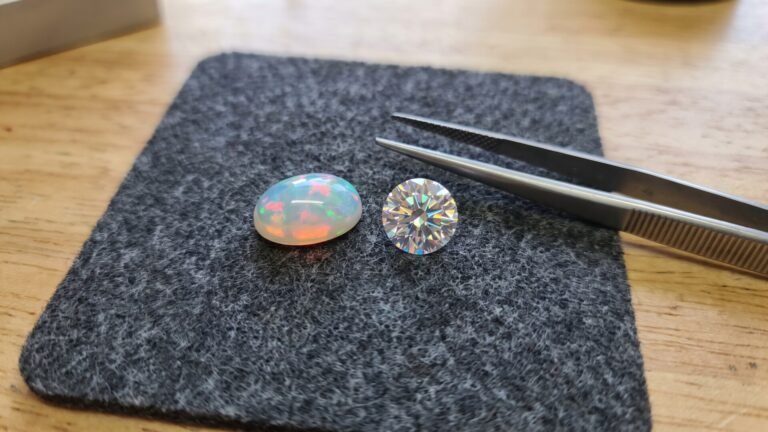
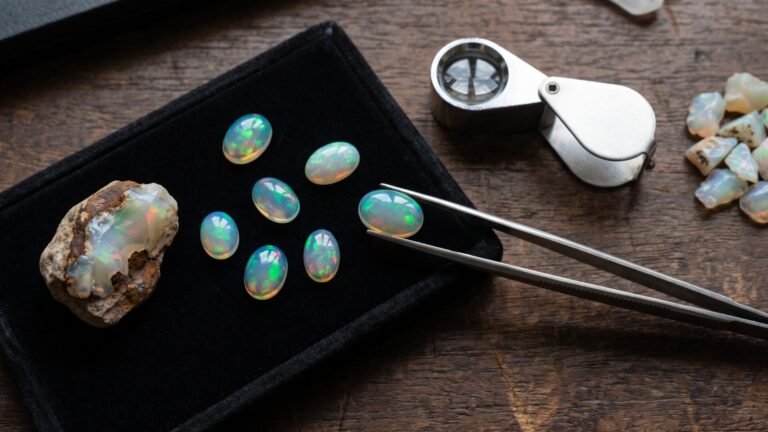
Ethiopian opal shows up in white, translucent crystal, honey, orange, and darker body tones. The characteristic look is a lively, rolling flash – broad sweeps of color that move as the stone turns, often with a pinfire pattern of tiny points rather than large solid patches.
Translucent and crystal Ethiopian material has real depth. Light passes into the stone and the color appears to sit inside it rather than on the surface. That is beautiful in a pendant and slightly less impressive in a ring, where the skin behind the stone can dull the effect.
Here is the trap. Wetting a hydrophane Ethiopian opal can temporarily intensify its appearance – darker body, stronger color. A stone photographed or displayed damp can look meaningfully better than the one that arrives in the mail. Always ask for dry images.
Australian opal color characteristics
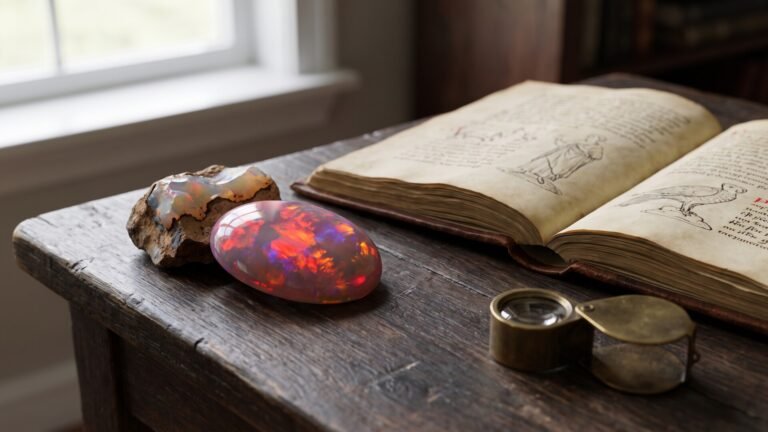
Australian opal is a family, not a look. White opal is milky and bright, often with green and blue flash. Crystal opal is transparent to translucent with color suspended inside. Boulder opal is cut with its natural ironstone backing, which gives it a dark background and a rugged character. Black opal has a genuinely dark body tone, and that is what makes its color explode.
Contrast is the whole game with black opal. A bright red flash against a near-black body reads more intensely than the same red against white. That is why fine black opal commands the prices it does – not rarity of the material in the abstract, but the visual result.
White Australian opal can be lovely and is often undervalued by buyers chasing black. It just will not give you the same drama.
What actually determines the better-looking stone
Ignore origin for a moment and evaluate in this order:
- Body tone. How dark is the background? Darker generally means more contrast.
- Brightness. How vivid is the color in ordinary indoor light, not under a jeweler’s spotlight?
- Dominant colors. Red is the most sought after, then orange, green, blue. A balanced multicolor pattern is often more wearable than one isolated red flash.
- Pattern. Harlequin, flagstone, floral, pinfire – a defined, repeating pattern adds value over random scatter.
- Coverage. How much of the face-up surface shows color, and from how many angles?
- Stability. Is the stone sound, or does it have cracks, pits, or visible crazing?
If you are interested in why opal has carried this much cultural weight for so long, the myths and legends attached to opal fire is worth a read – but keep it separate from the buying decision.
One warning that applies to every photograph you will see online: lighting, background color, wetting, camera exposure and video saturation can all exaggerate color. Ask for dry, natural-light images from several angles, and ask directly whether the stone has been treated or impregnated. A seller who dodges that question has told you something.
Durability: The Difference Buyers Feel After the Purchase
Durability in jewelry terms means resistance to scratching, fracture, heat shock, water-related change, and long-term surface wear. Opal is soft – around 5.5 to 6.5 on the Mohs hardness scale – and it is brittle. Both origins share that. What differs is how the stone reacts to the environment it lives in.
Ethiopian opal and hydrophane behavior
Hydrophane describes opal that is porous enough to absorb water and other liquids through microscopic openings in its structure. Many Ethiopian opals are hydrophane. Australian opal is generally not, or not to the same degree.
When a hydrophane stone absorbs water, it can darken, become more transparent, and show different play-of-color until it dries out. Absorption is not automatically damage – the stone usually returns to its previous appearance over hours or days. But every cycle is a risk you did not need to take, and repeated exposure to oils, lotions, perfumes and cleaning chemicals adds up.
Sudden drying, heat and rapid temperature change can contribute to crazing – a network of fine internal cracks that can reach the surface and permanently dull the stone. A stone that has been soaked and then left on a radiator is a stone asking for trouble.
Australian opal and practical durability
Australian opal is less associated with water absorption, but it is not tough. It scratches, it chips at the edges of a cabochon, it fractures under impact, and it can suffer from heat shock. A black opal ring worn daily against door frames and car doors is a bad idea regardless of where the stone came from.
There is also a construction issue buyers routinely miss. Solid opal is a single piece of natural material. A doublet is a thin slice of opal glued to a backing; a triplet adds a clear quartz or glass cap on top. Assembled stones can be beautiful and are far cheaper, but their care requirements differ, and moisture or heat can affect the glue layers. Australian material is frequently sold as doublets and triplets, so "Australian" tells you nothing about construction.
The durability verdict by jewelry type
| Jewelry type | Better default choice | Why |
|---|---|---|
| Everyday ring | Carefully selected Australian solid opal in a protective setting | Less water-related concern; impact and scratching remain |
| Occasional ring | Either, with Ethiopian opal requiring stricter care | Lower wear frequency and a protective setting reduce risk |
| Pendant | Either origin | Less impact and less contact with water than a ring |
| Earrings | Either origin | Usually shielded from heavy abrasion and impact |
| Heirloom piece | Fine Australian opal, or a verified stable Ethiopian specimen | Documentation and conservative wear matter most |
What Most Buyers Get Wrong About Origin
The most common mistake is assuming Australian opal is always better. It is not. A fine Ethiopian crystal opal with bright, broad color and a good pattern will outperform a dull, milky Australian white opal on every visual measure, and often costs less. Origin is a proxy for typical behavior, not a quality grade.
The opposite mistake is just as expensive. Ethiopian opal is not a cheap substitute for black opal. It is a different material with a different look and a different care profile. Buyers who expect a $400 Ethiopian stone to behave like a $4,000 black opal – or to hold value like one – are buying a story, not a stone.
Here is the framework I would use. Score any opal on four things: appearance, stability, disclosure, and setting. A smaller, well-cut, structurally sound stone with clear treatment disclosure beats a larger stone with spectacular color, undisclosed cracks and high water sensitivity every single time. You will still own the second one in five years. You just will not be able to wear it.
Origin belongs in the conversation. It should not be the first question you ask.
Value, Pricing, and Investment Reality
Opal pricing is genuinely variable, and any honest guide will tell you that ranges overlap heavily. What follows is positioning, not a price list.
What drives price in Ethiopian opal
Body tone, transparency, brightness, dominant color, pattern, size, cut and stability all move the number. So does whether the stone is natural, treated, or assembled. Ethiopian opal generally offers a lower entry price for vivid color and a large face-up size, which is exactly why it has become so popular.
Low prices usually reflect something: porous material, weak color, fractures, treatment, or commercial-grade cutting. Occasionally you find a genuine bargain. More often you find a stone priced to match what it is.
What drives price in Australian opal
The Australian market splits sharply. White and crystal opal sit in an accessible range. Boulder opal sits mid to high. Fine black opal with strong brightness, broad color coverage, an attractive pattern and credible provenance can command exceptional prices, because the visual result is genuinely rare.
A high price is not justified by the word "Australian" alone. Weak color, poor pattern, significant cracks or an unsuitable cut are all reasons to walk away from an expensive stone.
Price and value comparison
| Type | Typical value position | Main reason for premium | Main buyer risk |
|---|---|---|---|
| Commercial Ethiopian opal | Entry to mid-range | Large size and visible color | Hydrophane behavior, treatment, fractures |
| Fine Ethiopian opal | Mid-range to high | Bright color, attractive pattern, stability | Paying black-opal prices for a different material |
| Australian white opal | Entry to mid-range | Brightness, pattern, quality of color | Assuming Australian origin means rarity |
| Australian boulder opal | Mid-range to high | Strong color over natural ironstone backing | Uneven backing, cracks, flattering face-up photos |
| Fine Australian black opal | High to exceptional | Dark body, brightness, color coverage, provenance | Overpaying for origin without enough color quality |
On investment: buy opal jewelry because you want to wear it. Fine, documented Australian black opal has stronger collector recognition than ordinary Ethiopian material, but liquidity is thin compared with precious metals or top-tier diamonds. For any expensive stone, ask for an independent gemological report. A report tells you what the stone is. It does not promise it will appreciate.
Choosing Between Ethiopian and Australian Opal for Real-Life Wear
Recommendations are more useful than a single winner, because the right answer depends on how the piece will be worn.
Choose Ethiopian opal if
- You want vivid, playful color, a larger-looking stone, or something less common, at a moderate budget.
- The piece will mainly be a pendant, earrings, or occasional jewelry.
- You accept careful handling, avoid soaking and chemicals, and get clear disclosure about hydrophane behavior.
- The stone is natural, structurally sound, appropriately set, and backed by credible seller information.
Choose Australian opal if
- You want a more traditional purchase with less concern about water absorption.
- The piece is meant as an heirloom, an occasional ring, or a collector purchase.
- You value the contrast of black or boulder opal and will pay for actual quality rather than the label.
- The stone has a protective setting, clear treatment disclosure and documentation that supports its description.
If the purchase is a gift with meaning behind it, the history and symbolism of opal can help you choose a stone that carries the right message as well as the right look.
Match the stone to the setting
A bezel setting wraps metal around the edge of the stone and protects the most vulnerable part of a cabochon. A low-profile setting keeps the opal close to the finger, reducing the chance of a hard knock. Both reduce risk. Neither eliminates it.
For rings, insist on a protective setting. For pendants and earrings, the stone is naturally shielded from impact and abrasion, which is why opal works so well in those forms. And never accept a delicate opal in a high-contact ring design just because the listing photograph looked impressive – that is the purchase people regret.
How to Buy Without Being Misled
This is the part that saves you money. Ask these questions before you pay, and treat a vague answer as a no.
- Is it solid, a doublet, or a triplet? Assembled opal is legitimate, but it must be disclosed, and it changes both value and care.
- Is the Ethiopian stone hydrophane? Has it been impregnated or treated? Has any color enhancement been applied?
- Are there cracks, crazing, pits, filled cavities, unstable matrix, glued components or repairs? Ask for close-up images of the edges and back.
- Is there an independent gemological report? For expensive stones, particularly any claim about black opal, rarity, origin, investment value or provenance, this is not optional.
- What is the return policy? Color, transparency and pattern look different in person. You need a window to send it back.
Be skeptical of phrases like "investment grade," "museum quality," "rare Ethiopian black opal," or "waterproof opal." Each is either meaningless or misleading unless the seller explains it and provides evidence. "Waterproof" in particular is a word that should never appear in an opal listing.
Before you commit, view the dry stone, inspect it under neutral light, compare several angles, verify the construction, check the treatment disclosure and assess the setting. Any one of those failing is a reason to walk.
Care and Long-Term Ownership
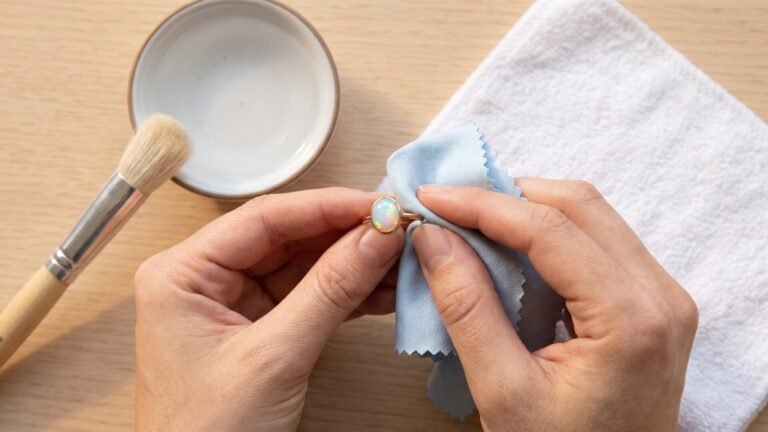
General care is simple. Wipe with a soft, slightly damp cloth when appropriate. Avoid ultrasonic and steam cleaners entirely. Keep opal away from harsh chemicals, prolonged soaking and extreme heat.
For hydrophane Ethiopian opal, go further. Protect it from unnecessary water, oils, perfumes, lotions and cleaning solutions. Take the ring off before washing your hands, showering, or doing dishes. That is not fussiness – it is the difference between a stone that looks the same in ten years and one that does not.
Store opal separately from harder gems so it does not get scratched, and keep it away from heaters, hot cars and rapid temperature changes. If the stone is a doublet, triplet, treated, or has visible cracks, consult a jeweler before using anything beyond gentle surface wiping. how to clean an opal ring safely when crazing is a risk covers the detailed method.
The heirloom perspective matters here. Keep the original report, the invoice, the treatment disclosure and the care instructions with the jewelry. When the piece passes to someone else, those documents are the difference between a stone they understand and a stone they are afraid to wear.
Final Verdict: Which Opal Should You Buy?
Best for lower-maintenance ownership: a well-selected Australian solid opal, especially for a ring or a piece meant to last. Less water sensitivity, established recognition, and a clearer long-term care profile.
Best for vivid color at an accessible entry point: a natural Ethiopian opal with clear hydrophane and treatment disclosure, set as a pendant, earrings, or a protected occasional-wear ring.
Best for dramatic contrast and collector appeal: fine Australian black opal – provided brightness, pattern, color coverage, structure and documentation justify the premium.
The value principle underneath all of it: buy the best, most stable, most clearly disclosed stone your budget allows, rather than paying automatically for a country of origin. If brilliance is what you are really after and durability is a concern, how opal compares to moissanite for fire and shine is a fair comparison to make before you spend.
Frequently Asked Questions About Ethiopian Vs Australian Opal
Is Ethiopian opal better than Australian opal?
Neither origin is universally better. Ethiopian opal often offers vivid color and larger-looking stones for the money, while Australian opal is generally favored for lower water sensitivity, collector recognition and heirloom appeal. Judge the individual stone.
Which opal is more durable for everyday wear?
Australian opal is usually the safer default, because many Ethiopian opals are hydrophane. But no opal resists scratching and impact the way sapphire or diamond does. Setting design and jewelry type can matter as much as origin.
Does Ethiopian opal fade or lose its color?
Water exposure can temporarily change the appearance of hydrophane opal. Permanent fading, cracking or damage is more often linked to structure, treatment, heat, chemicals or environmental stress. Ask for treatment and stability disclosures before buying.
Is Australian black opal always more valuable than Ethiopian opal?
Fine Australian black opal can command a significant premium, but origin alone does not set value. Brightness, color coverage, pattern, body tone, condition, size and documentation have to support the price.
Can Ethiopian opal be worn in a ring?
Yes, with conditions: occasional wear, a protective setting, and careful avoidance of soaking, chemicals, impact and temperature extremes. A pendant or earrings are generally lower-risk choices for a porous stone.
How can I tell whether an opal is a doublet or triplet?
The seller should disclose it. Ask for side and back photographs, have a jeweler inspect the visible layers with a loupe, and get an independent opinion on any costly purchase.
Should I buy an opal marketed as waterproof?
Treat the claim skeptically. Ask whether the stone is hydrophane, treated, assembled or sealed, and request written care instructions. “Waterproof” is not a substitute for a gemological description.
If you take one thing into the store, take this: ask what happens to the stone when it gets wet, and make the seller answer in plain language. The answer tells you more about what you are buying than the country on the tag ever will.