How to Clean a Tanzanite Ring
I learned the hard way, at a kitchen sink, with a tanzanite ring I had no business owning at that age. I had cleaned a diamond ring that morning and it came up like new, so I did the same thing that evening: hot water, a squirt of dish soap, a scrub with an old toothbrush. The stone went cloudy along one edge and a small chip appeared at a prong. Nobody had ever told me tanzanite was not diamond, and I had spent enough time around jewelry to have known better.
So here is the answer, plainly. Clean tanzanite with lukewarm water, a few drops of mild soap, a very soft brush, and a lint-free cloth. That is the whole method. Ultrasonic cleaners, steam cleaners, hot water, bleach, chlorine, ammonia, and anything abrasive should stay away from the stone unless a qualified jeweler has actually looked at your piece and confirmed it is suitable. The same rules apply whether you are cleaning a tanzanite necklace, a pendant, a pair of earrings, or a ring, because the stone does not know what kind of jewelry it is set in.
Why Tanzanite Requires Gentler Cleaning
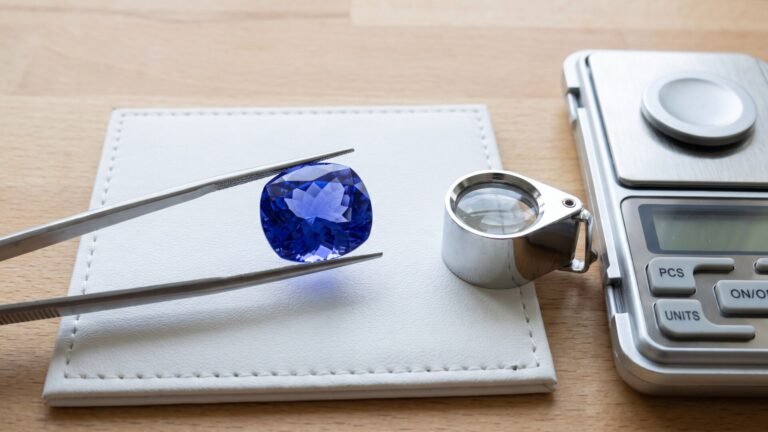
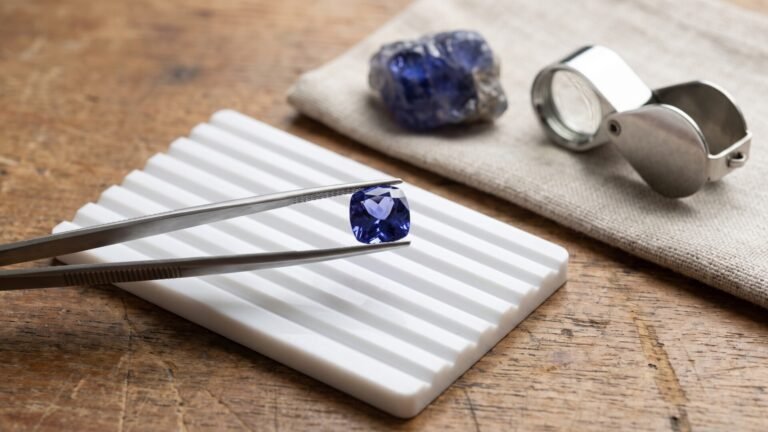
Tanzanite sits between 6 and 7 on the Mohs hardness scale, which is a relative ranking of scratch resistance – talc is 1, diamond is 10, and a stone’s position tells you what it can be scratched by, not how tough it is. That distinction matters more than most buyers realize. Hardness measures resistance to scratching. Toughness measures resistance to breaking, chipping, and cleaving. A stone can be reasonably hard and still be fragile.
Tanzanite is not a fragile stone in the way that, say, opal is, but it is softer than diamond and sapphire by a wide margin, and it has a direction in which it cleaves more easily. That combination makes it vulnerable in two specific ways during cleaning. First, grit and dust trapped around the setting can abrade the stone’s surface if you scrub without rinsing it away first. Second, careless pressure near a prong can chip an edge that was already under stress.
A ring takes more punishment than any other piece. It sits on a hand that opens doors, reaches into pockets, gets slathered in lotion, and washes dishes. Soap residue, hand oils, sunscreen, and household cleaners all collect on the underside of the stone, where you cannot see the buildup until the ring starts to look dull. A necklace or pendant mostly collects skin oils and perfume, and it spends much of its life under clothing, which is gentler.
One more thing worth knowing: tanzanite is pleochroic, meaning it shows different colors when viewed from different directions – typically blue, violet, and a brownish-purple depending on the angle. This is not something ordinary cleaning changes. But it is a good reason to look at your stone from several angles after cleaning, because a genuine change in color or a new dull patch is a signal to have the piece examined rather than cleaned harder.
The Safest Way to Clean a Tanzanite Ring at Home
The method itself is simple. The care is in the preparation and the handling, not in the chemistry.
Prepare the ring and cleaning area
Work in a small bowl, not a sink. Place a folded towel beneath the bowl so a dropped ring lands on something soft, and if you insist on using a sink, close the drain first. I have watched a customer lose a stone down a drain, and it is not a cheap lesson.
Gather four things: lukewarm water, a few drops of mild unscented dish soap, a very soft baby toothbrush or a purpose-made soft jewelry brush, and a lint-free microfiber cloth.
Before the ring touches water, inspect it. Look for prongs that have lifted away from the stone, a stone that rattles when you tap the ring gently against your palm, claws that are worn or bent, or a side stone that has shifted. If any of those are present, do not clean the ring at home. Take it to a jeweler. Cleaning a loose setting is how stones get lost.
Wash without pressure
Soak the ring briefly in the lukewarm soapy water – a minute or two is plenty. Prolonged soaking does not clean any better, and it gives water more time to work into places it should not sit.
Brush lightly around the underside of the stone and the setting, using short strokes. The underside is where most of the residue hides, but it is also where the prongs are, and pushing a brush into a compromised prong is exactly how a stone comes loose. Let the brush do the work. Do not press the bristles against the exposed face of the tanzanite.
Rinse, dry, and inspect
Rinse in a separate bowl of clean lukewarm water. This removes soap residue, which is what causes the dull film people mistake for damage.
Pat dry with a soft lint-free cloth and let the ring air-dry completely before it goes back in storage. Then hold it under good light and look closely: any remaining film, any loose stone, any chipped edge, any change in how the setting sits. This inspection is arguably more valuable than the cleaning itself.
For a tanzanite necklace, the method is the same with one adjustment. Support the pendant and chain in the bowl rather than dangling the necklace by the chain, and do not pull or stretch the chain while cleaning. Check the clasp afterward – a clasp that has been weakened will not announce itself until it fails.
Cleaning Methods to Avoid
This is where most damage happens, and it is worth scanning the whole table before you clean anything.
| Cleaning method | Recommendation | Why it matters |
|---|---|---|
| Lukewarm water and mild soap | Generally safe for routine cleaning | Removes oils and residue without aggressive chemicals |
| Soft brush | Use gently | Reaches the setting without abrading the stone |
| Ultrasonic cleaner | Avoid unless a qualified jeweler approves it | Vibration may worsen existing fractures or damage a vulnerable setting |
| Steam cleaner | Avoid at home | Heat and pressure can stress the stone or setting |
| Hot or boiling water | Avoid | Sudden or excessive heat can stress the gemstone and jewelry |
| Bleach, chlorine, ammonia, strong solvents | Avoid | Chemicals may damage treatments, alloys, or adjacent materials |
| Toothpaste, baking soda, polishing powder, abrasive cloths | Avoid | Abrasives can scratch tanzanite or leave an uneven finish |
"Jewelry cleaner" is not a universal category, and this is the single most expensive misunderstanding in the aisle. Formulas vary enormously. A dip that is fine for gold or diamond may be entirely wrong for a treated or softer colored gemstone, and the label often does not say so. Read what the product actually claims before it touches your ring.
Separate cleaning the stone from polishing the metal. Metal-polishing compounds are abrasive by design – that is how they remove tarnish and fine scratches from gold – and they should never contact the tanzanite. A jeweler may use specialized equipment safely in a controlled setting. That does not make the consumer version of the same machine safe in your bathroom. If you want the broader picture on which stones tolerate ultrasonic cleaning, which gemstones are safe to clean with an ultrasonic cleaner lays it out stone by stone.
What Most Owners Get Wrong About Tanzanite Care
The soap is rarely the problem. The handling is.
Scrubbing too hard, cleaning over a hard countertop, or brushing a setting that was already loose does far more damage than any mild detergent. People treat cleaning as a scrubbing task when it is really a soaking-and-patting task.
The second mistake is assuming a short ultrasonic cycle is harmless because the ring looks intact. It may be. It may also have an internal fracture or a weakened prong that you cannot see, and the vibration finds it. "It looked fine before" is the sentence I heard most often from people holding a stone in two pieces.
Everyday exposure does quiet damage too. Perfume, lotion, hairspray, chlorine, and household cleaners build up around settings and can affect some treated stones over time. Minimize the exposure rather than trying to clean it off later – how perfume, lotion and hairspray damage gemstones covers what each one actually does.
How Often to Clean a Tanzanite Ring
Clean it when it needs it, not on a rigid schedule. When the stone loses its brightness or you can see film around the setting, that is your signal. A ring worn daily will need surface cleaning more often than a necklace that spends most of its life under a collar, but more frequent cleaning is not better cleaning. Excessive soaking and repeated handling add risk without adding shine.
Routine cleaning and professional inspection are different things, and you need both. Book an inspection when the stone moves, a prong catches on fabric, the ring has taken a knock, or the setting looks worn. A jeweler will check the prongs and tighten anything that has shifted – something you cannot do at the kitchen table.
The best ownership habit is prevention. Take the ring off before cleaning the house, gardening, exercising, swimming, bathing, or working with tools. Every one of those removes a reason to clean aggressively later.
When Professional Cleaning Is the Better Choice
Some pieces should never be cleaned at home. Antique and heirloom rings, stones that are visibly loose, chipped tanzanite, damaged prongs, complex settings with small side stones, and any jewelry whose treatment history you do not know – all of these go to a jeweler.
When you hand it over, ask specific questions. Has the stone been treated? Which cleaning method will be used? Will the prongs be checked? Does anything need repair before cleaning? A good jeweler answers all four without flinching.
Be wary of anyone who says "all gemstones are safe in the ultrasonic cleaner." That is a convenience, not a fact. The method has to be assessed for the specific stone, setting, and condition. Tanzanite is not diamond, and it is not sapphire, and treating it as though it were is how stones get damaged by people who meant well.
Protecting Tanzanite Between Cleanings
Storage causes more scratches than cleaning does. Store tanzanite separately from harder stones – diamond, sapphire, and ruby will all scratch it without any effort at all. A soft-lined compartment or an individual fabric pouch solves this for a few dollars. Fasten chains before storing so they do not tangle, and place rings where prongs cannot catch on fabric or knock against other jewelry. how to store birthstone jewelry without scratching it has the full method.
Daily wear matters just as much. Remove tanzanite before showering, swimming, using chemicals, applying beauty products, or doing physical work. If you are unsure whether a given stone should get wet at all, whether you can shower with gemstone jewelry answers it stone by stone.
Choosing Safe Cleaning Supplies
The basic kit is cheap: a small soft jewelry brush, mild unscented dish soap, a lint-free microfiber cloth, and a shallow bowl. You probably own three of the four already. [Affiliate: Browse soft jewelry brushes] and [Affiliate: microfiber jewelry cloths] cover the two you may not.
When you shop, watch for these in the listings: abrasive polishing cloths marketed as safe for all gemstones, strong chemical dips, generic ultrasonic devices, and formulas that never state which gemstones they suit. If a product will not tell you what it is compatible with, assume it is not compatible with tanzanite.
A simple framework for deciding what to buy:
- Best value: mild soap, a soft brush, and a clean cloth. This handles routine cleaning for the life of the ring.
- Best for frequent jewelry owners: a labeled gemstone-care kit, used strictly according to its instructions and only if it names tanzanite as suitable.
- Best for valuable or heirloom tanzanite: professional cleaning and inspection, not a machine. [Affiliate: Compare gemstone-safe cleaning kits] if you want to see what is actually on the market.
If you want a broader method that covers other pieces in your collection, how to clean gemstone jewelry at home without professional equipment walks through it while keeping these tanzanite-specific warnings in place.
How Cleaning Relates to Tanzanite Value and Long-Term Wear
Cleaning does not increase the intrinsic value of tanzanite. It restores surface appearance and, more usefully, helps you notice setting damage before it becomes expensive. A stone that looks dull may simply be dirty – or it may have a worn prong letting it sit loose. Cleaning is how you tell the difference.
That matters for the long view. A tanzanite ring preserved through gentle cleaning, safe storage, and periodic inspection is far more likely to still be wearable when it passes to someone else. Chips and scratches are permanent. Dirt is not.
If you see a chip, a scratch, a color change you cannot explain, or you have questions about treatment, that is a job for a jeweler or gemologist, not a stronger cleaner. For the fuller picture on tanzanite’s properties, treatments, and value, tanzanite meaning, properties, uses and value is the place to start. And keep cleaning separate from valuation – an appraisal or lab report matters for insurance or sale, but neither replaces routine care.
Frequently Asked Questions About Cleaning A Tanzanite Necklace
Can I clean a tanzanite ring with dish soap?
Yes. Use a small amount of mild, unscented dish soap diluted in lukewarm water, clean with a very soft brush, rinse carefully, and dry with a lint-free cloth. Avoid strong detergents, bleach, and anything with abrasive additives.
Can I clean a tanzanite necklace the same way as a ring?
Usually, yes, but support the pendant and chain carefully so the chain does not tangle or pull against the clasp. A bowl is safer than a sink, and inspect the necklace for loose stones and clasp damage before it goes near water.
Is an ultrasonic cleaner safe for tanzanite?
It should not be treated as automatically safe. Ultrasonic vibration may worsen an existing fracture, affect a vulnerable setting, or create problems that were not visible beforehand. Ask a qualified jeweler to assess the specific piece first.
Can tanzanite go in hot water?
Avoid hot or boiling water. Lukewarm water is the safer choice, because excessive heat and sudden temperature changes can stress the gemstone or its setting.
Can toothpaste remove marks from tanzanite?
No. Toothpaste is abrasive and may scratch tanzanite or damage the finish of the setting. Use mild soap, water, and a soft brush instead.
How can I tell whether my tanzanite ring needs professional cleaning?
Professional help is appropriate if the stone moves, a prong catches on fabric, the ring has been dropped, the stone appears chipped, or the treatment history is unknown. A jeweler can clean the piece while checking whether it needs repair.
Should I remove my tanzanite ring before showering?
Removing it is the safer habit. Soap residue builds up around the setting, and repeated exposure to water, products, and accidental impacts creates more risk than routine gentle cleaning prevents.
The Bottom Line on Cleaning Tanzanite
The safest routine is the boring one: brief cleaning with lukewarm water, mild soap, a very soft brush, and a soft cloth. Tanzanite is not diamond and it is not sapphire, so ultrasonic cleaners, steam, harsh chemicals, abrasives, and hot water are poor default choices no matter how many people tell you otherwise.
If you take nothing else from this, take the inspection habit. Look at your ring before it goes in the water and again after it comes out. That is how you catch a loose prong before it costs you a stone.
You do not need a machine, a specialty dip, or an expensive kit to keep a tanzanite ring looking the way it did the day you bought it. You need lukewarm water, a drop of soap, a soft brush, a cloth, and the patience to be gentle. That is enough. If your ring is an heirloom, or the setting has any movement in it at all, spend the money on a jeweler’s inspection instead of a gadget – that is the purchase that actually protects the stone for whoever wears it next.