How to Clean an Emerald Ring Safely
Picture the ring in 2060. Your granddaughter has it on her finger at her wedding, and the emerald is the same green it was the day you bought it, because nobody in between soaked it overnight, ran it through an ultrasonic bath, or dried it on a radiator. Now picture the other version. The same ring, four decades earlier, comes out of a steamer with a hairline fracture webbing across the table and a dull, milky patch where the oil used to be.
Emeralds do not clean like diamonds, and the assumption that they do is the most expensive mistake in home jewelry care. The safe default is lukewarm water, a drop of mild soap, and a very soft brush, dried gently. That is the whole method. Everything else in this article is about the reasons it has to be that gentle.
Why Emerald Rings Need More Care Than Diamond Rings
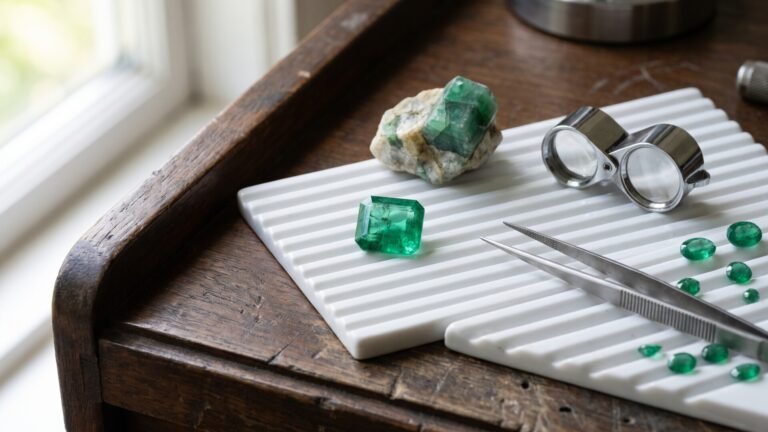
A diamond is a single crystal with a Mohs hardness of 10 and nothing inside it but more diamond. An emerald is beryl, hardness 7.5 to 8, and almost every emerald on the market has something inside it. Gemologists call the internal garden of inclusions a jardin – French for garden – and it is not a flaw in the way a buyer usually means it. It is the signature of the stone’s origin, and it is the reason emeralds are usually oiled or filled rather than left alone.
Fracture filling is the treatment of filling surface-reaching fractures with a material such as oil or resin to improve apparent clarity. The emerald trade has done this for centuries; it is standard, legal, and disclosed in most serious markets. What it means for you is that some of the material inside your stone is not stone. It can be affected by heat, solvents, vibration, and prolonged soaking in ways a diamond never is.
The contrarian point
A cloudy emerald does not automatically need stronger cleaning. The dullness is often surface residue from hand cream and soap, which gentle cleaning will lift. But if the cloudiness is internal – a filled fracture that has dried out, a change in the filler, or a natural inclusion catching the light – no cleaner on earth will fix it, and the aggressive attempt may make it worse. The right instinct when an emerald looks tired is less, not more.
For the fuller picture on emerald properties, treatments, and what drives value, the Emerald: Meaning, Properties, Uses & Value guide covers the ground this article assumes.
The Safest Method for Cleaning an Emerald Ring at Home
This is the routine I would use on my own ring, and the one I would tell a customer to use without hesitation. It takes about five minutes.
Gather the right supplies
You need very little:
- A shallow bowl
- Lukewarm water
- A small amount of mild dish soap
- A soft microfiber cloth
- An unused soft-bristled toothbrush or a dedicated jewelry brush
"Mild" is doing real work in that list. Avoid anything containing bleach, ammonia, chlorine, abrasives, strong degreasers, or an unknown jewelry-cleaning chemical. Unscented basic dish soap is the standard, and a drop is enough. If the label reads like a chemistry set, leave it in the cupboard.
Work over a bowl, never directly over an open sink, and put a folded towel underneath. A dropped ring that bounces off a countertop is a chipped emerald and a bent prong; a dropped ring that lands on a towel is a scare.
Follow the cleaning steps
Inspect first, before anything gets wet. Look for a loose stone, a bent prong, a damaged setting, or visible filler at a surface-reaching fracture. If the stone shifts when you press it gently with a fingertip, stop and read the section below on when to see a jeweler.
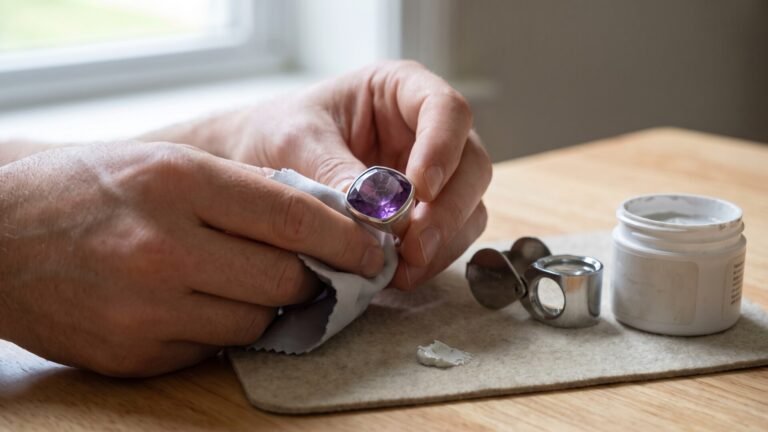
Soak briefly. A minute or two in lukewarm soapy water is plenty. You are loosening surface residue, not marinating the stone.
Brush gently. Use the soft brush on the underside of the setting and the gallery – the open structure beneath the stone where lotion, soap, and skin cells collect. That is where the dirt actually lives. Do not scrub the emerald itself aggressively; a light pass over the surface is all it needs.
Rinse in a separate bowl of clean lukewarm water. Not under the tap. Running water plus a slippery ring plus a drain is how stones get lost.
Pat dry with a soft lint-free cloth and let it air-dry fully before you store it or wear it. Moisture trapped under the setting is a problem you cannot see until it becomes one.
Know the stopping points
Stop immediately if the stone moves, the setting catches on fabric, a fracture looks more visible than it did, or a surface film seems to be lifting. Those are not cleaning problems. They are inspection problems.
Do not use cotton swabs or sharp tools to dig beneath the prongs. Trapped debris under a setting is a reason to see a professional, not an invitation to pry. I have watched a customer turn a routine cleaning into a lost stone with a pin, and I have never forgotten the look on their face.
Routine cleaning should restore surface brightness. It will not change the emerald’s inherent color or clarity, and any product claiming otherwise is selling you something that does not exist.
If you want a broader walkthrough of the same method across other stones, How to Clean Gemstone Jewelry at Home Without Professional Equipment covers the general routine this article narrows for emerald.
Cleaning Methods and Products to Avoid
The single most useful thing I can give you here is a risk table, because the dangerous advice usually arrives as a confident one-liner.
| Method or product | Why it is risky for emerald rings | Safer alternative |
|---|---|---|
| Ultrasonic cleaner | Vibration can worsen fractures or affect treated emeralds and loose settings | Gentle hand cleaning |
| Steam cleaner | Heat and pressure may stress the stone, treatment, or setting | Lukewarm water and mild soap |
| Hot water or sudden temperature changes | Thermal shock may aggravate fractures or stress a treated stone | Stable lukewarm water |
| Ammonia, bleach, chlorine, or strong solvents | May harm treatments, metals, or adjacent materials | Mild, diluted soap |
| Abrasive powders, toothpaste, or polishing compounds | Can scratch metal and abrade vulnerable surfaces or fillers | Soft cloth and soft brush |
| Hair dryers, radiators, or direct sunlight for drying | Heat may affect fracture-filling materials and can stress the setting | Pat drying and natural air-drying |
| Sharp picks or pins | Can scratch the setting, disturb fillers, or loosen stones | Professional inspection |
The common advice to run all fine jewelry through an ultrasonic cleaner is not wrong for diamonds, sapphires, or rubies. It simply does not transfer to emerald jewelry, and the reason is the treatment and the fractures, not the brand of machine.
There is a second distinction that trips people up: cleaning the metal and cleaning the gemstone are different jobs. A product safe for gold or platinum may still be unsuitable for a treated emerald sitting in it. Read the label for what it does to the stone, not what it does to the setting.
For the wider question of which stones can take an ultrasonic bath, Which Gemstones Are Safe to Clean With an Ultrasonic Cleaner? sets out the categories properly. And because heat is its own hazard, How to Protect Gemstone Jewelry From Heat and Temperature Changes is worth reading before you reach for anything warm.
How Treatment, Setting, and Ring Condition Change the Routine
The routine above is the default. What changes it is what is actually in your ring.
Treatment status
Ask, plainly, whether the emerald is untreated, oil-treated, resin-filled, or otherwise clarity enhanced. A reputable seller should disclose known treatments in writing, and on a valuable stone that disclosure should appear on the invoice or the laboratory report. If you bought the ring secondhand or inherited it, you may not know – and "I don’t know" is a perfectly good reason to keep home cleaning minimal and let a jeweler look at it.
An emerald with significant surface-reaching fractures, visible filler, or an uncertain treatment history should get the lightest possible home care and periodic professional inspection. It is not fragile in the way glass is fragile. It is simply a stone whose vulnerabilities are already partly filled with something that is not emerald.
Setting type
A secure bezel – a rim of metal running all the way around the stone’s edge – protects the emerald’s vulnerable edges but can trap residue in the recess. It usually needs a soft brush more than it needs soaking.
Prongs are the opposite problem. They expose more of the stone and hold it with less metal, which means a loose prong turns routine brushing into a lost-stone risk. Check them every time you clean. If a prong has moved, stop.
Condition
A ring with a loose stone, a chipped edge, a damaged prong, or newly visible filler goes to a qualified jeweler before it gets cleaned. Cleaning a compromised setting is how a repair becomes a replacement.
What Most People Get Wrong About Cleaning Emerald Rings
Most emerald damage I have seen did not come from neglect. It came from someone doing a thorough job.
"If soap and water are safe, soaking overnight is safer." No. Prolonged soaking is unnecessary and can let water into weakened areas, affect some treatments, and complicate drying around the setting. Minutes, not hours.
"A cloudy emerald needs a stronger cleaner." Cloudiness can be surface residue, internal characteristics, treatment behavior, or damage. Stronger chemicals cannot solve an internal clarity issue, and they can absolutely make a treated one worse.
"A diamond jewelry cleaner is automatically safe." Products marketed for diamonds often rely on solvents, ammonia, ultrasonic use, or instructions that are wrong for emeralds. "Jewelry safe" on a label means safe for some jewelry. It does not mean safe for yours.
"A professional cleaning guarantees safety." It does not, unless the person doing it knows what is in the stone. Tell the jeweler the treatment history, or that you do not know it, and ask them to inspect before any steam, ultrasonic equipment, or chemical cleaner comes near it. A good jeweler will appreciate the question. A rushed one will not.
When Professional Cleaning Is the Better Choice
Some rings should not be cleaned at home at all, and it is worth being blunt about which. Take it to a professional if the ring is antique, inherited, insured as a significant asset, of unknown treatment status, visibly fractured, or has had setting repairs.
Before you authorize any work, ask four questions:
- Will the emerald be cleaned by hand?
- Will steam or ultrasound be used at any point?
- Will you inspect the setting and prongs?
- Will the treatment disclosure and condition be recorded?
The useful professional services are unglamorous: prong and setting inspection, gentle hand cleaning, a treatment-aware assessment, and written documentation of condition for valuable or heirloom pieces. That documentation is what an insurer and a future owner will want.
And a warning. Walk away from any jeweler who promises to remove internal inclusions, restore untreated clarity through cleaning, or refuses to explain the method they intend to use. Inclusions are inside the stone. Cleaning happens on the outside. Anyone blurring that line is either uninformed or hoping you are.
Preventing Emerald Rings From Becoming Dirty or Damaged
The cheapest cleaning is the cleaning you do not have to do.
Remove the ring before applying lotion, sunscreen, perfume, hairspray, cleaning products, or cosmetics. Residue collects around the setting, and chemical exposure can affect treatments or the metal itself. Can Gemstones Be Damaged by Perfume, Lotion and Hairspray? explains what those products actually do over time.
Skip wearing it for dishwashing, swimming, gardening, exercise with impact, housework, and anything involving heat or sudden temperature changes. If you want the short version on routine water exposure, Can You Wear Gemstone Rings While Washing Your Hands? answers it directly.
Store the ring separately, in a soft-lined compartment or pouch, with enough room that it does not touch harder jewelry. An emerald stored loose in a box with a diamond will lose that argument. How to Store Birthstone Jewelry Without Scratching or Damaging It covers the wider storage picture.
Then set a rhythm that fits how you actually wear it: wipe the ring after wear, clean gently when you can see residue, and arrange professional inspection based on wear, setting condition, and value rather than a calendar. A ring worn daily deserves a look once a year. A ring worn twice a year does not.
Choosing Safe Cleaning Supplies Without Overspending
Here is the part the counter never tells you: the expensive kit is not the safe kit. It is the well-packaged one.
A shallow bowl, mild unscented dish soap, a soft microfiber cloth, and a very soft brush will cost you very little and do everything the routine above requires. If you would rather buy dedicated supplies, [Affiliate: shop a gentle jewelry-care collection] for a soft brush and lint-free cloth – and read the instructions for what they exclude, not what they claim to cover. Be wary of any product advertising ultrasonic use, abrasive polishing, or universal gemstone compatibility without stated limitations.
For an expensive or inherited ring, the most valuable thing you can buy is not a stronger cleaner. It is an hour of a qualified jeweler’s time.
| Care choice | Best for | Main advantage | Main limitation |
|---|---|---|---|
| Basic hand-cleaning kit | Routine surface residue | Low cost and low risk when used correctly | Cannot diagnose damage or treatment problems |
| Branded gemstone-cleaning kit | Buyers who want packaged supplies | Convenient instructions and presentation | Formulas vary; “jewelry safe” does not mean emerald safe |
| Professional hand cleaning | Valuable, antique, treated, or uncertain rings | Cleaning plus condition assessment | Costs more and requires treatment disclosure |
| Ultrasonic or steam cleaning | Only when a qualified professional confirms suitability | Efficient for some jewelry types | Generally inappropriate as a default for emerald rings |
Frequently Asked Questions About Cleaning Emerald Rings
Can you clean an emerald ring with soap and water?
Yes. Gentle hand cleaning with lukewarm water and a small amount of mild soap is the safest general method for many emerald rings. Keep the soak brief, avoid vigorous brushing, and get professional advice when treatment status or condition is uncertain.
Can an emerald ring go in an ultrasonic cleaner?
It should not go in one by default. Vibration can worsen fractures, affect treated emeralds, or expose weaknesses in the setting. A qualified jeweler should assess the specific stone before an ultrasonic cleaner is used on it.
Is vinegar safe for cleaning emerald jewelry?
Vinegar is not a recommended default cleaner for emerald rings. Its acidity offers no benefit over mild soap and water and may create unnecessary risk for treatments, nearby materials, or the metal setting.
Why does my emerald still look cloudy after cleaning?
Surface residue may not be the cause. Internal inclusions, fracture filling, treatment changes, surface-reaching fractures, or damage can all affect appearance, and stronger cleaning will not correct any of them.
How often should an emerald ring be cleaned?
Wipe it after wear and use gentle hand cleaning when residue becomes visible. The need for professional cleaning depends on wear, setting condition, value, and treatment history rather than a fixed schedule.
Can I wear an emerald ring while washing my hands?
Occasional handwashing is generally less concerning than prolonged exposure to chemicals, heat, or repeated soaking, but removing the ring reduces soap buildup and protects a vulnerable setting.
What should I do if my emerald becomes loose after cleaning?
Stop wearing the ring and do not try to tighten the setting at home. Place it in a soft container and take it to a qualified jeweler, because continued wear could end with the stone on the floor.
The Cheaper Truth
Almost nobody needs to spend money to clean an emerald ring. A bowl from the kitchen, a drop of dish soap, a soft brush, and a cloth will do the job for years, and the discipline to skip the ultrasonic machine is worth more than any product on the market.
The reader who genuinely needs to spend more is the one holding a ring they cannot fully account for – antique, inherited, heavily treated, visibly fractured, or insured for real money. For that person, a jeweler’s inspection is not an upsell. It is the cheapest insurance available.
Whichever group you are in, keep the paperwork. Store the treatment disclosure and any condition report with the ring, because in forty years the person wearing it will want to know what is inside the stone before they clean it.