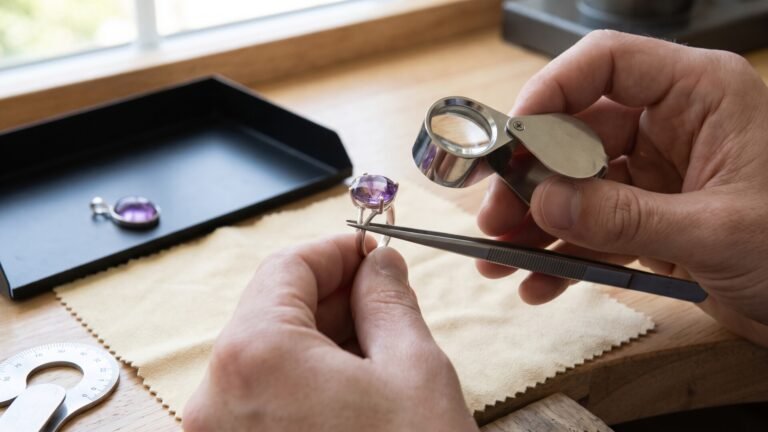
Can Amethyst Get Wet? What Happens When It Comes Into Contact With Water?
Yes, amethyst can get wet. Brief contact with clean, room-temperature water will not hurt solid amethyst, because quartz does not dissolve, soften or absorb water. What water does damage, slowly, is everything around the stone: the prongs, the solder, the plating, the glue and the elastic cord. A ring worn in the shower for years usually comes out with a perfectly good stone and a tired, tarnished, residue-packed setting.
So “can amethyst get wet” is not one question. It is five: what kind of water, for how long, at what temperature, whether the stone has been treated, and what it is mounted in. A splash at the sink is not a catastrophe. A ring that lives in the shower and the pool is a different story, and it is the setting, not the gem, that pays for it.
Can Amethyst Get Wet?
Amethyst is the purple variety of quartz (silicon dioxide), with a Mohs hardness of 7, no cleavage and good toughness. The Mohs scale ranks minerals by scratch resistance, from talc at 1 to diamond at 10. A 7 means amethyst will scratch window glass and will not be scratched by a copper coin. It says nothing about water, heat, chemicals, or impact.
That distinction matters because it is where most care advice goes wrong. Hardness is a scratch rating. It is not a waterproof rating. What makes amethyst water-safe is different: quartz is chemically stable and essentially non-porous, so water has nothing to dissolve and nowhere to soak in. That is why it appears on most “safe to get wet” crystal lists, unlike water-sensitive minerals such as selenite or malachite.
A finished ring containing amethyst is rarely waterproof, though, because it is not just a stone. It is a stone plus prongs plus a shank plus solder joints plus, sometimes, adhesive and a rhodium plating. Water finds the gaps. The useful question is: what is wet, for how long, and what else is in the piece.
| Type of exposure | Risk to solid amethyst | Practical advice |
|---|---|---|
| Brief contact with clean water | Low | Dry with a soft cloth |
| Hand washing or light splashes | Low | Fine, but do not leave jewelry damp |
| Long soaking | Low for the stone, moderate for settings | Avoid as a routine |
| Hot water or sudden temperature changes | Higher | Avoid thermal shock |
| Chlorinated or salt water | Moderate to high for jewelry | Remove jewelry first |
| Household cleaners | High | Keep away; rinse spills promptly |
| Dyed or fracture-filled material | Uncertain | Follow seller or gemologist guidance |
Water Risk Depends on How the Piece Is Made
Most guides answer this question for “amethyst” as if every piece were a loose crystal. In practice, the construction decides what water will do. Use this as a quick check before deciding whether a piece can stay on.
| Construction | What water affects | Verdict |
|---|---|---|
| Loose stone, tumbled stone or crystal point | Nothing in the quartz; mineral spots if left to dry | Rinse freely, dry well |
| Solid gold or platinum, bezel set | Soap film behind the stone | Most tolerant jewelry format |
| Sterling silver, prong set | Faster tarnish, residue in prongs | Remove for showers and swimming |
| Gold-plated or vermeil | Plating wears through sooner | Keep dry as much as possible |
| Beaded bracelet on stretch cord | Elastic weakens and snaps | Take off before any water |
| Glued pieces, doublets, repairs | Adhesive can loosen | Keep dry; no soaking |
| Geode or cluster on a glued base | Base adhesive, painted or dyed exterior | Dust or wipe; do not submerge |
The pattern is simple: the closer a piece is to plain quartz, the more water it tolerates. Every material added around the stone adds a weak point, and those weak points are almost never mentioned on a product page.
What Happens When Amethyst Comes Into Contact With Water?
Short-term contact with clean water
Nothing dramatic. Clean, cool or lukewarm water on untreated, solid amethyst produces no visible change. The polish may look slightly different while the surface is wet and will look normal again once dry.
The real action is happening around the stone. Water collects at the base of prongs, under the girdle of a bezel-set stone, and inside the hollow back of a pendant. It sits there after you have dried the visible surfaces. That trapped moisture is what begins to work on solder, on plated finishes, and on the fine dust that accumulates in any setting worn regularly.
Dry the piece after contact rather than dropping it wet into a jewelry box. A soft cloth and some time open to the air are enough, and this one habit prevents most water-related wear.
Prolonged soaking and repeated exposure
Repeated soaking is where the slow damage lives. Not in the quartz, which can sit in water for a week and come out looking identical. In everything else.
- Soap residue builds up behind the stone and dulls the way light enters it.
- Sterling silver tarnishes faster in damp storage, and the tarnish creeps under the setting where you cannot reach it.
- Some adhesives used in assembled or repaired pieces soften with prolonged moisture.
- Plated finishes wear through faster when they stay wet.
- Poorly sealed settings can corrode or discolor.
Water alone will not make quality amethyst dissolve or lose its color. Those claims circulate online, and none of them is true of solid quartz. But a loose crystal tolerates occasional rinsing far better than a ring with a delicate setting or a porous companion stone, and that gap is where the money goes.
Heat, cold, and thermal shock
Thermal shock is stress caused by a sudden temperature change, and it is the water-related risk worth actually worrying about. GIA’s care guidance notes that sudden temperature changes can fracture amethyst. A stone warm from your hand going into cold water, or a cold ring hitting hot dishwater, expands and contracts unevenly, and inclusions or existing fractures are where cracks start.
Very hot water, steam, ice water, hot tubs and saunas are all more concerning than ordinary room-temperature water. Heat also affects treatments, adhesives, and surrounding materials in ways that are invisible until something moves.
GIA advises against steam cleaning amethyst. Ultrasonic cleaners are generally safe for solid, untreated amethyst, but not for dyed or fracture-filled stones, and not for pieces with glued accents, so ask a jeweler if you are unsure of the construction.
Which Types of Water Should You Avoid?
Clean tap water is not the enemy. Nearly everything else deserves a second thought.
Chlorine comes first. Pool and hot tub water is treated with it precisely because it breaks down organic material, and it does the same slow work on gold alloys, plating, and the fine surfaces inside a setting. Salt water is corrosive to sterling and to many alloys, and it carries sand that abrades. Sunscreen, lotion, and hair products leave films that trap grit and dull polish. Soap residue collects in every crevice.
Shower water is a different risk from pool water, and conflating them is a common mistake. A shower is not chemically aggressive. The problem is repetition plus heat plus soap plus the fact that a slippery ring on a soapy finger is easy to drop down a drain. If you are working out what to take off before a shower across your whole jewelry box, our stone-by-stone guide to showering with gemstone jewelry covers pearls, opals, emeralds and the rest.
| Water or liquid | Main concern | Recommended approach |
|---|---|---|
| Clean tap water | Minimal risk to solid amethyst | Brief contact is fine |
| Shower water | Heat, soap, shampoo, repetition | Remove jewelry before showering |
| Pool or hot tub water | Chlorine, heat, setting damage | Remove jewelry before swimming |
| Ocean water | Salt, sand, impact, lost jewelry | Remove jewelry before entering |
| Bath water | Heat, salts, oils, products | Keep amethyst jewelry out |
| Cleaning solutions | Chemical and treatment damage | Never use without checking |
| Rainwater | Low; dirt may remain | Dry the piece afterward |
Mineral-rich water deserves a mention because it is marketed heavily to crystal buyers. Spring water, “moon water” and salt baths are popular in crystal communities as cleansing rituals; our guide to the healing properties of amethyst explains where these traditions come from and what science does and does not support. Physically, salt is abrasive and corrosive, and mineral deposits dry into visible films on a polished surface, so a stone left in a salt bath will need a fresh-water rinse afterward whatever the intention behind it.
One drying rule from crystal communities is worth keeping for a physical reason: do not leave amethyst on a sunny windowsill to dry. Water does not make it more light-sensitive, but repeated long sun exposure can fade some stones over time, as explained in does amethyst fade in sunlight. Dry it indoors instead.
Is It Safe to Wear Amethyst Jewelry in Water?
Rings
Rings take more abuse than any other format. They are on the hand, and the hand is in the world: dishwater, door handles, gym equipment, garden soil, the bottom of a bag. A ring also collects soap residue in a way a pendant never will, because it is on the hand you wash many times a day.
Take amethyst rings off before showering, swimming, washing dishes, bathing, or using household chemicals. Not because the amethyst will dissolve, but because the setting, prongs, shank, and any adhesive components will fail long before the quartz does, and a failed prong means a lost stone.
If you want to wear an amethyst ring every day, the construction matters more than the stone. A bezel setting protects the edges and holds the stone with a continuous rim of metal rather than four points. A low profile catches less. A solid precious-metal band outlasts plating. For the fuller picture, whether you can wear amethyst every day covers durability and scratching in more depth.
Necklaces and pendants
Pendants are the forgiving format. They sit against the chest, away from most impacts, and they do not go into the dishwater. For someone who wants low-maintenance amethyst, a pendant is the natural first choice.
The vulnerabilities are still there. Chains tarnish, clasps trap residue, and a pendant with glued components or a plated chain deserves more caution than a solid one. Remove it before swimming, bathing, and before applying lotion or perfume, because a clasp that is repeatedly wetted and never fully dried will eventually weaken.
Earrings and bracelets
Earrings meet hair products, sweat, shampoo, and cosmetics, and they are the piece people most often forget they are wearing. Studs and small drops in a secure setting are about as trouble-free as amethyst gets. Wipe them after an accidental splash and store them dry.
Bracelets are the opposite. They swing, they knock against desks and counters, and they are on the wrist during every hand wash. Beaded amethyst bracelets on stretch cord are the most water-sensitive amethyst jewelry of all: the beads are fine, but repeated wetting ages the elastic until it snaps, usually somewhere you cannot collect the beads. Take them off for washing and restring them when the cord looks slack.
If you are choosing a format now, the best amethyst earrings and necklaces compares constructions with this maintenance question in mind.
How to Clean Wet or Dirty Amethyst Safely
GIA’s standard advice is that amethyst can be safely cleaned with warm soapy water. Lukewarm water, a drop of mild soap, a soft lint-free cloth or a very soft brush. Work gently around the setting, rinse briefly, and dry thoroughly before storing.
For loose amethyst, that is the whole procedure. Rinse, blot, air dry. There is no setting to trap water, so the risk is minimal.
For mounted jewelry, the work is in the details. Use a soft brush to lift residue from the space between the stone and the prongs, where soap collects. Do not force a brush under a prong to “get it clean” – that is how prongs loosen. Blot rather than rub, and let the piece sit open to the air for an hour before it goes back in the box.
What to avoid is a longer list than what to use:
- Bleach and chlorine-based cleaners
- Ammonia-based jewelry dips and strong alkaline cleaners, which GIA lists as able to damage amethyst
- Abrasive powders and toothpaste, which will dull polish and scratch soft metals over time
- Rough brushes, including an old toothbrush that has stiffened
- Boiling water and steam
For a fuller procedure, including how to handle tarnish around a setting, how to safely clean amethyst without damaging the polish goes step by step. If years of wear have already hazed the surface, removing scratches from amethyst jewelry explains what a jeweler’s re-polish can and cannot fix.
What to do after accidental water exposure
Blot gently. Do not rub aggressively at a wet stone, particularly around the setting, where a loosened prong can catch a cloth and bend.
Then inspect. Look for prongs that have moved, cloudy patches that do not clear as the piece dries, white residue in the crevices, cracks that were not there before, or a stone that rocks slightly when you touch it. Any of those means a jeweler’s inspection, sooner rather than later.
Let the piece dry fully before it goes into a fabric-lined box or pouch. A damp ring sealed in a closed box is the ideal environment for tarnish, and tarnish under a setting is a bench job, not a home fix. If the piece was exposed to chemicals or high heat, get it inspected regardless of how it looks.
What Most Buyers Get Wrong About Amethyst and Water
The first error is believing that hardness protects a whole piece. It does not. A Mohs 7 stone set in four thin prongs on a plated band is a fragile object, and the fragility has nothing to do with the gem’s scratch resistance.
The second error is trusting the words “natural” and “untreated” as though they were a water rating. A natural amethyst can still be set with adhesive, paired with a porous accent stone such as turquoise or pearl, or mounted on a plated chain. None of that is disclosed by the word “natural.”
The third is the one that costs people real money: treatment and assembly disclosure. Amethyst is commonly heated to adjust color, and heat treatment is stable and does not change how the stone handles water. Dyed quartz sold as amethyst, fracture-filled stones and assembled doublets are different: dye can bleed in harsh cleaners, a filled fracture can cloud, and a doublet’s glue layer can separate.
Ask the seller three questions before you buy:
- Is the stone treated, and how?
- Is it solid, or assembled from more than one piece?
- Is there any adhesive, coating, or plating on the piece?
A seller who cannot answer those clearly is telling you something useful. If a stone’s appearance seems unusual for the price, how to spot fake amethyst is worth reading before you spend.
Which Care Routine Fits How You Wear Amethyst?
The occasional jewelry wearer. A well-set pendant or a pair of studs, removed before bathing and swimming, will look the same in a decade as it does today. This is the lowest-maintenance way to own amethyst.
The daily-wear buyer. Prioritize secure settings, solid precious-metal construction, and a design a jeweler can inspect and tighten. Bezel over prongs, solid bands over plated. Build the habit of taking it off for dishes and showers now rather than after the first lost stone.
The crystal collector. Rinse loose points and tumbled stones freely, dry them indoors, and avoid extreme heat. Treat geodes and clusters on glued or painted bases as dust-and-wipe pieces rather than ones to wash under the tap.
The gift buyer. Include care instructions. Do not assume the recipient knows that a loose crystal and a ring have different rules.
The hidden cost of careless water exposure is not the stone. It is the replacement chain, the replating, the loose stone reset, the snapped bracelet. Those repairs routinely cost more than years of careful cleaning. If you are shopping with that in mind, amethyst jewelry pieces for every budget shows what is available at each price level, and the full guide to amethyst’s meaning, properties, and value covers the stone itself, from February birthstone facts to price per carat.
Frequently Asked Questions About Amethyst Getting Wet
Is amethyst porous?
No. Solid amethyst is quartz, which is essentially non-porous, so water cannot soak into the stone. Porous-looking material, such as rough clusters with crusts or dyed beads, can hold dirt or bleed dye, which is why those pieces need gentler handling than a polished gem.
Does water fade amethyst?
No. Clean water does not change amethyst’s color. The things that can fade some amethyst are prolonged strong light and very high heat, which is why drying a stone on a sunny windowsill is a bad habit even though the water itself is harmless.
Can I wear amethyst in a hot tub or sauna?
Better not. Hot tubs combine heat with chlorine or bromine, which wear on settings and plating, and stepping from hot water into cool air risks thermal shock. Saunas add dry heat that loosens adhesives. Leave amethyst jewelry in a dry place outside.
Can I put amethyst in drinking water or a crystal water bottle?
Quartz is chemically stable and is not known to release harmful substances into water, so solid amethyst is among the safer crystals for this use. Use a polished, undyed stone kept in a sealed chamber, since raw clusters can carry dust, glue or dye. Crystal water is a belief practice, not a health treatment.
Can amethyst go in an ultrasonic cleaner?
GIA describes ultrasonic cleaning as generally safe for amethyst, but not for dyed or fracture-filled stones. Glued accents, beaded strands and fragile settings are at risk too, so if you do not know how a piece was made, use warm soapy water instead or ask a jeweler.
How often should amethyst jewelry be inspected?
Once a year for pieces worn regularly, and immediately after any exposure to chemicals, high heat, or a hard knock. A jeweler can check prongs and tighten a setting in minutes, which is far cheaper than replacing a lost stone.
Storing Amethyst After It Gets Wet
Brief contact is fine, the setting is the vulnerable part, and taking the piece off before swimming, showering, and cleaning will save you more money than any product on the market. The question that follows is usually about storage.
A dry, fabric-lined box, kept away from direct sun and heat, with pieces stored separately so they do not scratch each other, is the whole answer. Amethyst is a 7 on the Mohs scale, which means it will scratch softer stones and metals sitting loose beside it, and harder gems such as sapphire and diamond will scratch it in turn.
Do that, and the ring you buy this year can still be wearable for the next generation. For care advice on the rest of the February birthstone’s relatives and every other stone, the complete gemstones guide is the place to continue. The stone will outlast all of us. The setting only lasts if you dry it.