Can Gemstones Be Damaged by Perfume, Lotion and Hairspray?
I’ll admit something that costs me nothing now and would have cost me my job then: for years, when a customer asked whether perfume would hurt her pearls, I gave the answer that closed the sale. "Just be careful." That is not an answer. It is a shrug dressed as reassurance.
Here is the honest version. Perfume, lotion, and hairspray will not shatter a gemstone on contact. Very few stones fail after one exposure. But repeated contact leaves residue that dulls a polished surface, and on the wrong materials, that residue becomes absorption, discoloration, or a damaged treatment that no polishing cloth will fix. The risk is not the spray. It is the habit.
The habit is easy to change. Apply everything first. Jewelry goes on last.
What Perfume, Lotion and Hairspray Actually Do to Gemstones
Two different things happen when a beauty product meets a gemstone, and buyers tend to collapse them into one. The first is immediate chemical attack. The second is slow contamination. Most of what you will encounter in daily life is the second.
A film of perfume, hairspray, or lotion sits on the surface of a stone and does two things: it scatters light that should have bounced back out of the pavilion, and it holds dust. A stone under a film looks cloudy and tired. The structure underneath is often perfectly fine. I have cleaned decades-old rings that looked like they had been sandblasted and watched them come back to full life in ten minutes of careful work. That is residue, not damage.
Damage is different. It means the material itself has changed: a porous stone has absorbed a liquid and darkened, a coating has lifted, a fracture filler has clouded, an organic surface has etched. That kind of change does not wipe off.
The chemistry matters less than the exposure pattern. Alcohol, fragrance compounds, oils, solvents, and propellants vary in aggressiveness, but the deciding factors are how porous the material is, whether it has been treated, how the piece is assembled, and how many times the same stone gets sprayed. A single droplet on a sapphire is nothing. The same droplet, every morning for eight years, on a fracture-filled emerald is a different story.
One detail almost nobody mentions: the metal and setting often fail before the stone. Residue collects around prongs and under bezels, mixes with skin oils and dust, and hardens into a grime that hides loose prongs and hairline cracks. You stop being able to inspect the piece because you cannot see it. That is how a stone gets lost.
Which Gemstones Are Most Vulnerable?
Hardness is the wrong lens here, and I will come back to why. The right lens is porosity – the tendency of a material to absorb liquids into tiny spaces – plus treatment and assembly.
| Gemstone or material | Risk from beauty-product exposure | Main concern | Safer handling |
|---|---|---|---|
| Pearls | High | Organic nacre loses luster and suffers surface damage from acids, alcohol, cosmetics | Products first, pearls on last; wipe gently |
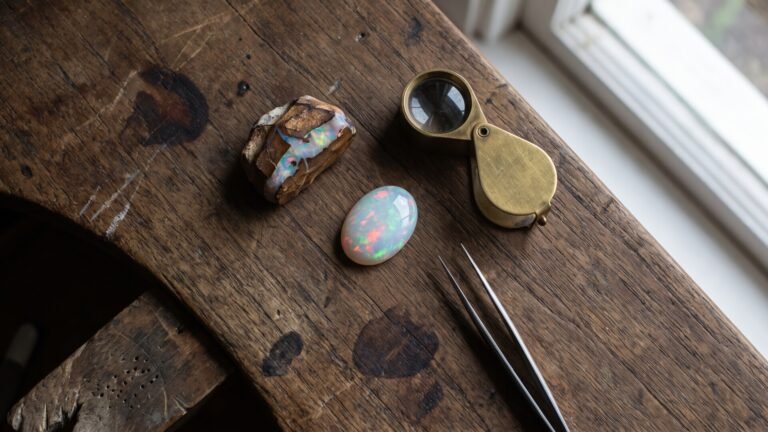
| Opal | High | Porous or assembled opals absorb liquids; crazing and treatment damage worsen with chemicals | Keep away from sprays, solvents, prolonged residue |
| Turquoise | High | Porous and often treated; oils and chemicals discolor or darken it | Avoid direct contact; gentle cleaning only |
| Emerald | Moderate to high | Fracture-filled emeralds are vulnerable to solvents and heat | Avoid sprays and unknown cleaners |
| Amber and organic gems | High | Soft organic material reacts to solvents, alcohol, heat, abrasion | Remove before applying anything |
| Tanzanite | Moderate | Lower durability and treatment sensitivity | Prevent residue; avoid harsh chemicals |
| Amethyst, citrine, quartz | Low to moderate | Usually tolerate incidental exposure; residue and heat still matter | Wipe promptly; avoid prolonged contact |
| Sapphire and ruby | Low for the stone | Durable corundum collects residue; filled or treated stones need care | Keep clean; verify treatments |
| Diamond | Low for the stone | Oils kill brilliance; settings and treatments are more vulnerable | Clean regularly, appropriately |
| Gold, silver, plated settings | Moderate | Tarnish, discoloration, plating wear | Products first; wipe metal after wear |
Read that table as a handling guide, not a guarantee. The same named gemstone can behave in opposite ways depending on what has been done to it. A natural, untreated emerald with no filling is a reasonably tough stone. A heavily fracture-filled emerald is a different material in practical terms, and the filler is the part that reacts. An assembled opal – a thin slice of precious opal backed with a darker material – has a bond line that solvents can reach.
This is why I tell people to treat the name on the label as the start of the question, not the answer. If you own pearls and want the fuller picture on water exposure and daily wear, whether a pearl bracelet can go in the shower covers the same logic for a different hazard. For the broader properties behind each of these materials, the main gemstone guide is the place to start.
How Each Product Creates a Different Risk
Perfume and fragrance sprays
Direct spraying is the problem. A fine mist settling through the air around you is not. The difference between those two is the difference between a necklace that stays bright for thirty years and one that goes cloudy in five.
Perfume applied to the wrist and then allowed to dry before a bracelet goes on is close to harmless. Perfume sprayed at the base of the throat while a pendant hangs there wets the stone, the setting, and the chain, every single morning. The chain matters too – fragrance residue accelerates tarnish on silver and dulls gold over time.
There is a second-order problem. Residue makes a stone look dull, the owner assumes the stone is damaged, and then over-cleans it. That is where real harm enters. I have seen a pearl necklace ruined by a well-intentioned soak in an attempt to remove perfume film that would have wiped off.
Lotion, sunscreen and oils
Lotion is the quiet one. It does not look aggressive, and it is the product I find most often packed into the underside of rings.
The reason is mechanical. Lotion spreads, it stays tacky for a while, and it collects dust and skin cells. Around prongs, under bezels, behind earring backs, and in the gap beneath a ring’s gallery, it forms a paste that hardens. Sunscreen and heavily fragranced body products do the same, and sunscreen adds the complication of being applied in quantity and reapplied through the day.
That hardened paste is not just cosmetic. It conceals. A prong that has worn thin under a layer of grime looks fine until the stone is gone. I have watched a customer lose a diamond because the buildup around the setting had been hiding a crack in the prong for months.
Take rings and bracelets off before thick creams. Wait until the product has absorbed before putting them back on.
Hairspray and styling products
Hairspray is the worst offender for earrings and necklaces, and it is entirely avoidable. It deposits a hard film that bonds to a polished surface, and it does so in a focused, repeated way – the same earring, the same spot, every morning.
The propellant is not the issue. The deposited product is. Repeated direct deposition builds a lacquer that dulls a stone and stiffens around settings.
The dangerous part comes afterward. People try to scrape hardened hairspray off with a fingernail, a toothpick, or a kitchen knife. That scratches softer gems and lifts plating. Do not do it. Finish your hair, then put the jewelry on, and the problem never exists.
What Most Wearers Get Wrong About "Chemical Damage"
Four assumptions cause most of the trouble I see, and each one has a correction.
Mistake: hardness is the safety test. The Mohs scale measures resistance to scratching. That is all it measures. It says nothing about porosity, fracture stability, treatment sensitivity, or resistance to solvents. A stone can be hard and chemically fragile at the same time. the hardness scale explained properly covers why the number is narrower than the marketing suggests.
Mistake: one exposure means permanent damage. Usually it does not. Most incidents leave removable surface residue. The trap is that repeated exposure plus unsuitable cleaning turns a minor problem into a serious one.
Mistake: every stone cleans the same way. A durable untreated sapphire and a pearl have almost nothing in common in the cleaning department. Neither does a diamond and a fracture-filled emerald.
Mistake: the gemstone is the only thing at risk. Residue and chemicals reach settings, plating, adhesives, coatings, and fracture fillers. Sometimes those fail first.
Here is the rule I would give anyone standing at a counter:
- If the stone is porous, organic, assembled, coated, fracture-filled, or treatment-sensitive, prevent direct contact.
- If the stone is durable and untreated, incidental contact is usually not alarming, but remove the residue.
- If you do not know the treatment or construction, treat the piece as delicate until a qualified jeweler identifies it.
That third line covers more jewelry than anyone likes to admit.
How to Prevent Perfume Damage to Gemstones
The whole routine fits in one sentence: beauty products first, jewelry last.
Shower. Apply lotion and sunscreen. Spray perfume. Finish your hair. Wash or dry your hands. Then put on the gemstone jewelry. That sequence removes almost every risk in this article without requiring you to remember which stone is which.
A few specifics worth building into the habit:
- Remove rings and bracelets before applying lotion or hair products, especially pieces with open backs, delicate prongs, or porous stones.
- Store pieces separately in a dry, soft-lined compartment. Residue transfers between jewelry, and harder stones scratch softer ones in a shared box.
- Keep a soft, lint-free cloth for a gentle wipe after wear. Do not use abrasive polishing cloths on pearls, opals, plated finishes, or anything you have not identified.
- Put jewelry on after you are dressed, not before. Clothing, hair products, and perfume all happen first.
The remove-before checklist is short and worth memorizing:
- Applying hairspray or styling products
- Using thick lotion, sunscreen, oils, or self-tanner
- Cleaning with household chemicals
- Swimming, bathing, or using a hot tub
- Handling a stone whose treatment or identity is unknown
That last item is doing a lot of work. If you inherited a ring and nobody can tell you what the stone is or what was done to it, it belongs on the list until a jeweler has looked at it. The same exposure logic applies to water and soap, which the shower guide for gemstone jewelry walks through stone by stone.
How to Clean Residue Without Making the Problem Worse
There is no universal cleaning recipe, and any article that gives you one is guessing about your jewelry. What follows is triage.
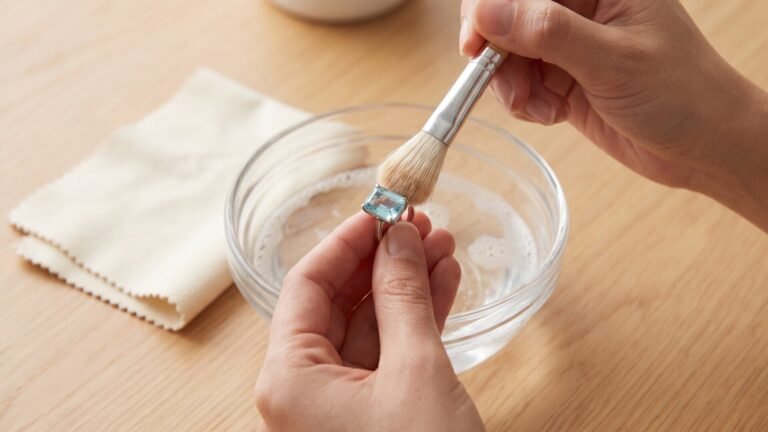
For durable, non-porous stones with known construction – an untreated sapphire, a diamond, a ruby with disclosed treatments – lukewarm water, a drop of mild soap, and a very soft brush are usually fine, but only when the jeweler or manufacturer confirms the method suits that piece.
For pearls, opals, turquoise, emeralds, amber, and any treated or assembled stone, use a slightly damp soft cloth and get professional advice before anything wetter. Soaking and brushing are how these pieces get ruined. If you wear amethyst, cleaning amethyst without dulling the polish shows how stone-specific the method has to be. Opal owners should read cleaning an opal ring with crazing risk before touching it with anything. Aquamarine has its own rules too – caring for aquamarine is the gentle version.
Do not use household solvents, bleach, acetone, alcohol-based cleaners, ultrasonic cleaners, or steam unless a qualified jeweler has confirmed the specific stone and treatment can take it. Alcohol is not a safe default. It attacks pearls, opals, turquoise, treated emeralds, coatings, fillers, adhesives, and plated finishes.
| What you notice | Likely explanation | Next step |
|---|---|---|
| Dull but unchanged color | Surface film from lotion, perfume, hairspray | Use the approved gentle method |
| Darkening or uneven color | Absorption, treatment reaction, residue in pores | Stop experimenting; see a professional |
| Sticky area around a stone | Product buildup or compromised filler | Avoid solvents; have it inspected |
| Loose stone after cleaning | Setting or prong problem | Stop wearing; have the setting checked |
| Fine cracks or crazing | Possible material or treatment damage | No soaking, steaming, or home polishing |
Persistent cloudiness, color change, sticky residue, a loose stone, damaged plating, surface cracks, or exposure to an unknown chemical all mean the same thing: stop and get it looked at.
Which Option Still Makes Sense in Three Years?
Care advice becomes a buying decision the moment you think in years rather than days. The question is not which stone is prettiest. It is which stone will still look right after a thousand mornings of the same routine.
If you wear perfume, lotion, and hairspray daily and have no intention of adopting a strict ritual, buy durable, non-porous stones in secure settings. Untreated sapphire, ruby, and diamond are the forgiving choices. They still collect residue and still need cleaning, but they will not absorb your perfume or lose a coating to it. A secure setting – well-made prongs, a closed back where appropriate – protects the stone as much as the material does.
If you are buying an heirloom or a sentimental piece, a pearl, opal, emerald, turquoise, or amber can be a wonderful choice. It just comes with a condition: the owner has to accept more careful wear. That is a fair trade for a stone with real character. It is an unfair trade if nobody told them.
The hidden cost of a high-maintenance stone is real. Professional cleaning, treatment-specific repairs, replacement of damaged coatings or fillers, and the emotional cost of altering a family piece all add up over decades. None of it shows on the price tag.
Before you buy, ask for written treatment information and care instructions – especially for emeralds, opals, pearls, turquoise, and anything described as coated, filled, impregnated, assembled, or composite. A seller who cannot or will not provide that in writing is telling you something.
The verdict by buyer type:
- Low-maintenance daily wear: durable, non-porous stones with disclosed treatments and secure settings.
- Beauty with a careful owner: pearls, opals, emeralds, turquoise, and other sensitive materials.
- Unknown jewelry: stop exposing it to products, clean only with a soft dry cloth, and get a professional identification and care recommendation.
Frequently Asked Questions About Perfume Damage To Gemstones
Can perfume permanently damage gemstones?
It can, but usually through repetition rather than a single spray. Perfume often leaves removable residue on durable stones. Repeated direct exposure can contribute to discoloration, lost luster, treatment damage, and problems with porous or organic gems. The risk depends on the stone and what has been done to it.
Is it safe to spray perfume while wearing a gemstone necklace?
Put the necklace on after the perfume has dried. Direct liquid spray is more concerning than ambient fragrance, particularly for pearls, opals, turquoise, emeralds, and treated stones.
Can hairspray make gemstones cloudy?
Yes. Hairspray leaves a film that reduces brilliance and traps dust. Cloudiness from residue can usually be removed, but harsh removal attempts damage softer stones, coatings, fillers, and settings.
Does lotion damage diamond or sapphire jewelry?
Lotion mostly causes buildup and reduced sparkle rather than chemical damage to an untreated diamond or sapphire. It collects around the setting, though, and makes both inspection and cleaning harder.
Can I clean perfume residue with rubbing alcohol?
Do not assume alcohol is safe. It can affect pearls, opals, turquoise, treated emeralds, coatings, fillers, adhesives, and plated finishes. Use the method suited to the specific stone, or ask a qualified jeweler.
What gemstone is safest for someone who uses beauty products every day?
Durable, non-porous stones such as untreated sapphire, ruby, and diamond are generally more forgiving. No gemstone jewelry should be deliberately sprayed or coated with perfume, hairspray, or lotion.
Does lab-grown change any of this?
Not much. A lab-grown sapphire or diamond has the same chemical structure and the same porosity as its natural counterpart, so the care rules are identical. What changes the risk is treatment and assembly, not origin.
The next question most people ask is whether they should stop wearing the piece altogether. Usually no. A ring worn with a routine is safer than a ring worn occasionally and cleaned badly.
If you want the number that actually decides this, it is not the Mohs hardness – it is how often the stone meets the spray. Change the sequence, and the piece outlives you.