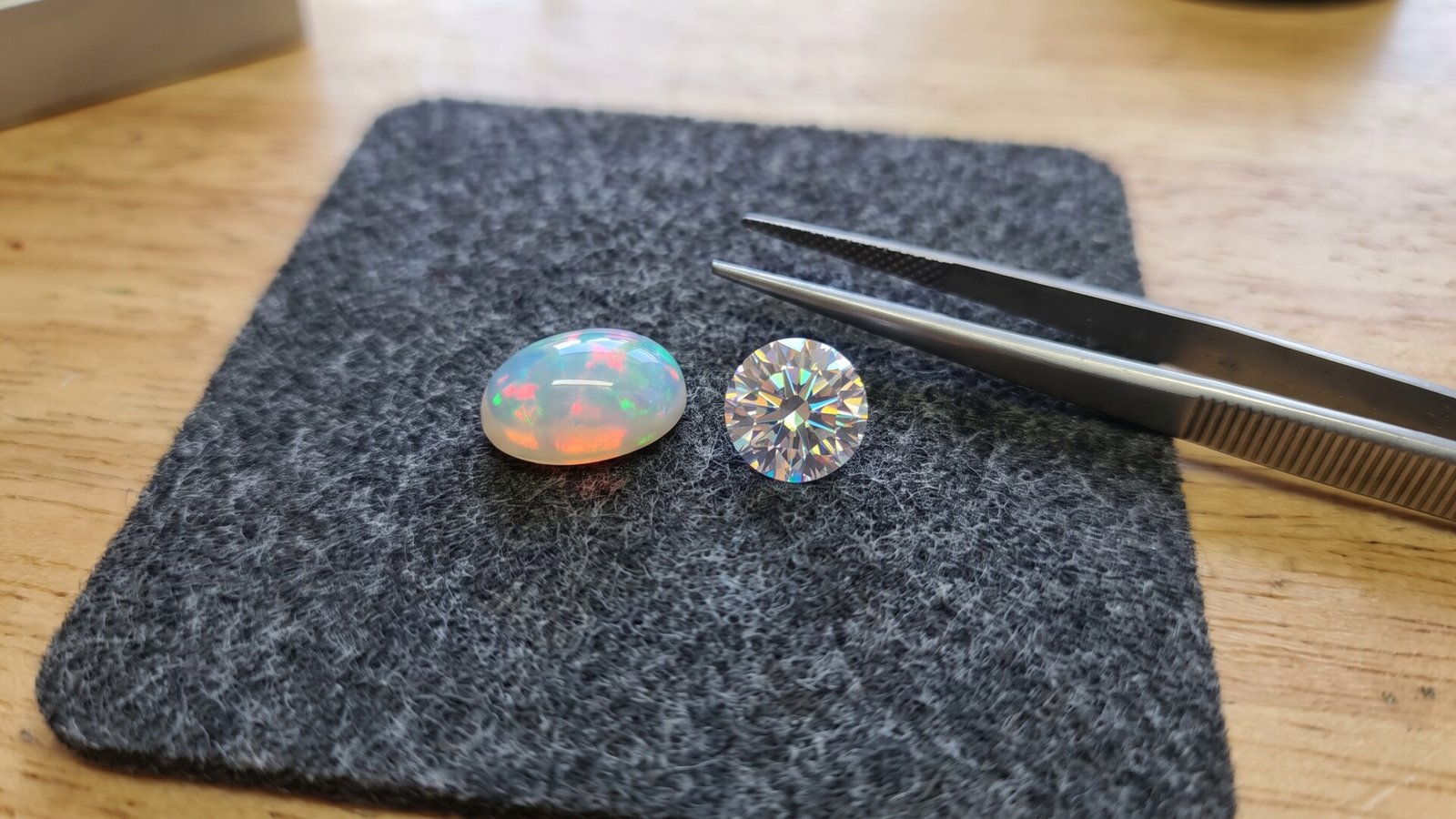
Opal vs Moissanite for fire and shine
I have a confession to make. When I first started collecting gemstones, I thought “fire” was just a marketing term. I remember standing in a dimly lit jewelry store, holding a ring under a fluorescent bulb, completely unable to see what the salesperson was so excited about. It took me years—and more than a few disappointing purchases—to truly understand what makes a gemstone come alive.
Today, I want to talk about two stones that couldn’t be more different in how they capture light: opal and moissanite. One is ancient, organic, and utterly unpredictable. The other is a modern marvel of precision engineering. Both are stunning. Both have their devoted followers. And both have taught me lessons I wish I’d known sooner.
The jewelry world has shifted dramatically in recent years. Moissanite has emerged as a serious contender to diamonds, while opals have seen a renaissance among designers who crave something genuinely unique. According to the Gemological Institute of America, consumer interest in alternative gemstones has grown steadily over the past decade. People want stones that tell a story—not just a status symbol.
In this article, I’ll walk you through everything I’ve learned about opal and moissanite. We’ll compare their fire, their shine, their durability, their price, and what you should actually look for when buying. By the end, you’ll know exactly which stone fits your life and your heart.
Understanding Opals and Moissanites
Overview of Opal
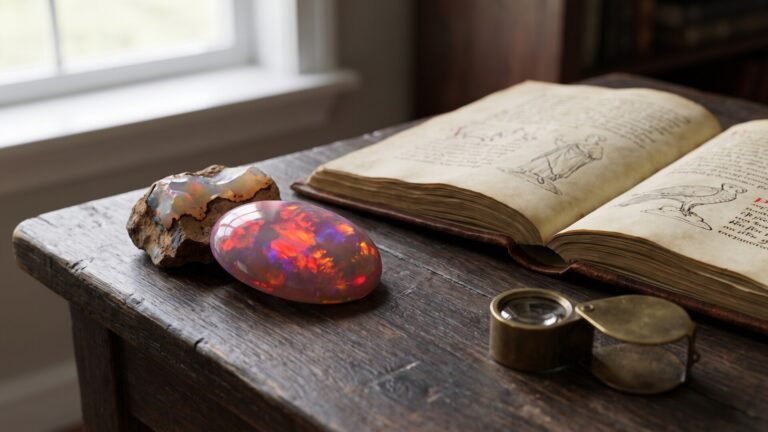
Let me tell you about the first time I held a real opal. I was in a small shop in Australia, and the owner—a weathered man with hands stained by decades of mining—placed a rough piece of black opal in my palm. It looked like a gray pebble. Then he turned it slightly, and the entire surface exploded into a universe of color. I gasped. I’m not exaggerating.
Opal is silica dioxide, but that clinical description does nothing to capture its magic. Unlike most gemstones, which are crystalline, opal is amorphous—it has no organized internal structure. Instead, it’s composed of microscopic silica spheres arranged in a grid. When light passes through these spheres, it diffracts, splitting into the spectral colors you see as the stone moves. This phenomenon is called “play-of-color,” and it’s what makes opal unlike any other gemstone on Earth.
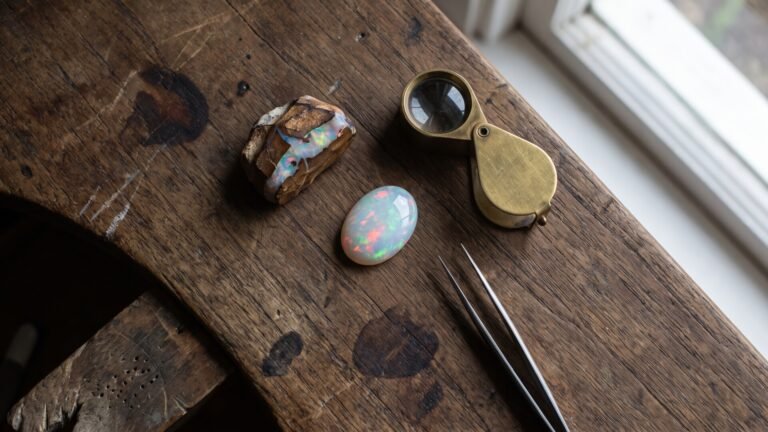
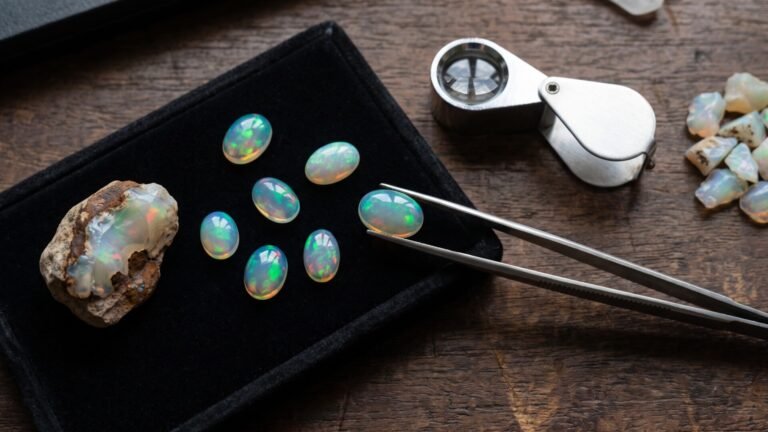
There are several types of opal, and each has its own personality. Black opal, found primarily in Lightning Ridge, Australia, has a dark body tone that makes the colors appear vivid and dramatic. White opal, from South Australia, has a lighter background and a softer, more ethereal look. Boulder opal, from Queensland, is cut with the host rock still attached, creating natural, organic shapes. Crystal opal is translucent to transparent, with colors that seem to float inside the stone. Fire opal, from Mexico, is a whole different story—it’s transparent with warm orange and red tones, but it rarely shows play-of-color.
The thing that still surprises me about opals is how no two are alike. You can buy ten opals from the same mine, and each one will have a completely different pattern, color combination, and intensity. That’s both the joy and the challenge of owning one.
Overview of Moissanite
Moissanite entered my life much later, and I’ll be honest—I was skeptical. A stone that looks like a diamond but costs a fraction of the price? It sounded too good to be true.
Moissanite is silicon carbide, a mineral first discovered in 1893 by Henri Moissan in a meteor crater in Arizona. Naturally occurring moissanite is incredibly rare—so rare that virtually all moissanite on the market today is lab-created. And that’s a good thing, because it means we get consistent quality without the ethical baggage of mining.
What makes moissanite special is its optical properties. Its refractive index is higher than diamond’s—2.65 to 2.69 versus diamond’s 2.42. That means it bends light more dramatically, creating more brilliance and sparkle. Its dispersion, or fire, is also higher: 0.104 compared to diamond’s 0.044. In plain English, moissanite throws more rainbows than almost any other gemstone.
I remember the first time I saw a well-cut moissanite next to a diamond. The moissanite was brighter, more colorful, and frankly, more eye-catching. Some people love that. Others find it “too flashy.” That’s a matter of personal taste, and I respect both opinions.
Moissanite is graded similarly to diamonds, using the 4 Cs: cut, color, clarity, and carat weight. Most commercial moissanite is near-colorless (D-E-F range) and internally flawless, which means you get a lot of bang for your buck.
Fire and Shine: What Do They Mean?
Defining Fire in Gemstones
Here’s where things get technical, but I promise to keep it simple. “Fire” in gemstones refers to the dispersion of white light into its spectral colors—think of the rainbows you see when light passes through a prism. Every transparent gemstone has some level of dispersion, but some are much better at it than others.
For opal, fire is a completely different story. Opal doesn’t have dispersion in the traditional sense. Its “fire” comes from diffraction, not dispersion. The silica spheres inside the stone act like a natural diffraction grating, splitting light into colors as it passes through. That’s why opal shows patches of color rather than the pinpoint flashes you see in diamond or moissanite.
For moissanite, fire is all about dispersion. The stone’s crystal structure splits white light into its component colors as it enters and exits the stone. A well-cut moissanite will show distinct flashes of red, blue, green, and yellow as it moves. The effect is more dramatic than diamond, and some people find it breathtaking.
Understanding Shine and Brilliance
Shine is different from fire. Shine—or brilliance—is the amount of white light reflected back to your eye from the stone’s surface and interior. It’s what makes a stone look bright and lively even under low light.
Opal’s brilliance is subtle. Because it’s not transparent, it doesn’t reflect light the way a faceted stone does. Instead, it has a soft, milky glow that shifts and changes as you move it. The play-of-color adds visual interest, but the overall effect is more like a painting than a spotlight.
Moissanite, on the other hand, is all about brilliance. Its high refractive index means it captures and reflects light with remarkable efficiency. A well-cut moissanite will appear brighter than a diamond of the same size, and it will maintain that brightness even in dim lighting. If you want a stone that catches every eye in the room, moissanite delivers.
Opal vs Moissanite: A Detailed Comparison
Color and Appearance
Opal offers an infinite palette. You can find opals with every color of the rainbow, and sometimes all of them in a single stone. The play-of-color can be broad flashes, pinpoint dots, or intricate patterns like harlequin or floral. The body tone—the background color of the stone—adds another dimension. A black opal with bright red and blue patches is a completely different experience from a white opal with soft green and pink.
Moissanite is more limited in color. Most commercial moissanite is colorless or near-colorless, though you can find stones in yellow, green, and gray. The appeal of moissanite is its neutrality—it goes with everything and doesn’t compete with other colors in your outfit or jewelry.
Fire and Sparkle
This is where the two stones diverge most dramatically. Opal’s fire is organic and unpredictable. It doesn’t sparkle in the traditional sense—it glows. The colors shift and pulse as you move the stone, creating a living, breathing effect. I’ve seen opals that look completely different under natural light, indoor light, and candlelight. That’s part of their charm.
Moissanite’s fire is precise and abundant. It throws rainbows with every movement. Under direct light, a moissanite can look like a disco ball, with flashes of color shooting in every direction. Some people find this dazzling. Others find it distracting. I’ve had customers tell me they love the “extra sparkle,” and others who say it looks “too artificial.”
Here’s what I’ve learned: if you want a stone that changes and surprises you, choose opal. If you want consistent, reliable brilliance, choose moissanite.
Durability and Maintenance
I’ve made mistakes with opals. I once wore a ring with a precious opal while gardening. It didn’t end well.
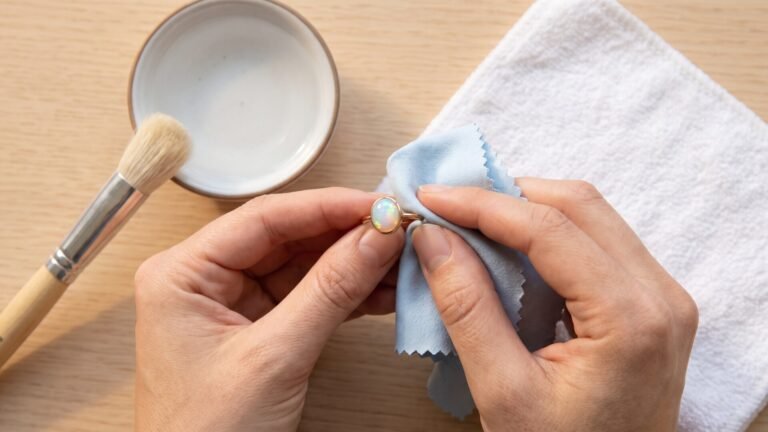
Opal is soft—5.5 to 6.5 on the Mohs scale of hardness. That makes it vulnerable to scratches, chips, and cracks. It’s also sensitive to temperature changes and can crack if exposed to sudden heat or cold. And because opal contains water (typically 5-10% by weight), it can “craze” or develop internal cracks if it dries out too quickly.
Moissanite is much tougher. At 9.25 on the Mohs scale, it’s second only to diamond. It resists scratching, chipping, and breaking. It’s also stable under heat and chemicals, so you don’t have to worry about damaging it during cleaning or daily wear.
The bottom line: moissanite is a better choice for an engagement ring or any piece you’ll wear daily. Opal is better for special occasions, earrings, pendants, or rings you’ll wear carefully.
Pricing Comparison
Price Ranges for Opal
Opal pricing is notoriously variable. A low-quality white opal might cost $10 per carat. A top-quality black opal with bright red and blue play-of-color can fetch $10,000 per carat or more. The factors that drive price include:
- Body tone: Black opal is the most valuable, followed by dark, then light.
- Play-of-color: Bright, saturated colors with broad flashes are most desirable.
- Pattern: Harlequin, rolling flash, and broad flash patterns command premium prices.
- Clarity: Fewer inclusions and cracks mean higher value.
- Origin: Australian opals generally command higher prices than Ethiopian or Mexican.
Price Ranges for Moissanite
Moissanite pricing is more predictable. A 1-carat equivalent moissanite typically costs $300-$600. A 2-carat equivalent runs $600-$1,200. The factors that affect price include:
- Size: Larger stones cost more, but the price per carat decreases as size increases.
- Color: Colorless (D-E-F) costs more than near-colorless (G-H-I).
- Cut: Precision cuts like hearts and arrows or crushed ice command higher prices.
- Brand: Some brands charge a premium for their specific cutting technology.
Comparative Pricing Table
| Quality Level | Opal (per carat) | Moissanite (per carat equivalent) |
|---|---|---|
| Low | $10 – $50 | $150 – $300 |
| Medium | $50 – $500 | $300 – $600 |
| High | $500 – $5,000 | $600 – $1,200 |
| Premium | $5,000 – $10,000+ | $1,200 – $2,000 |
Buying Considerations
What to Look for When Buying Opal
I’ve been burned by opals. Literally—I once bought an Ethiopian opal that looked gorgeous in the store, only to have it develop internal cracks after a few months. Here’s what I’ve learned:
First, understand the type. Ethiopian opals are beautiful but more prone to crazing than Australian opals. If you want a stone that will last, invest in Australian black opal or boulder opal.
Second, look at the play-of-color under different lighting. A stone that looks amazing under store lights might look dull in natural light. Ask to see it outside or under a daylight bulb.
Third, check for cracks. Use a loupe or magnifying glass. Even tiny cracks can worsen over time.
Fourth, ask about treatment. Some opals are treated with sugar, smoke, or resin to enhance color. Treated stones are less valuable and less stable.
Finally, buy from a reputable dealer. I can’t stress this enough. Opal is easy to fake, and I’ve seen doublets and triplets (thin slices of opal glued to a backing) sold as solid stones.
What to Look for When Buying Moissanite
Moissanite is easier to buy, but there are still pitfalls. The most common mistake I see is people buying moissanite that’s too yellow. Look for stones graded D-E-F for the best color.
Cut is crucial. A poorly cut moissanite will look dull and lifeless, regardless of its other qualities. Look for stones with excellent symmetry and polish. Hearts and arrows cuts are a good benchmark for quality.
Clarity is less of a concern because most lab-grown moissanite is internally flawless. But check for any visible inclusions or cloudy areas.
Size is another consideration. Moissanite is about 15% lighter than diamond, so a 1-carat moissanite will look slightly larger than a 1-carat diamond. If you’re buying a specific carat weight, keep that in mind.
Finally, don’t fall for the “forever one” or “supreme” marketing terms. These are brand names, not quality grades. Compare the actual 4 Cs, not the marketing slogans.
Real-Life Applications: Jewelry Trends
Popular Jewelry Styles Featuring Opal
Opal has seen a renaissance in recent years, especially in bohemian and vintage-inspired designs. I’ve noticed several trends:
- Opal engagement rings: More couples are choosing opals for their unique beauty and personal meaning. The “moonstone and opal” trend is particularly strong.
- Opal pendants: Simple bezel-set opals on delicate chains are everywhere. They’re elegant, understated, and let the stone speak for itself.
- Opal earrings: Drop earrings with small opals are popular for their subtle color and movement.
- Mixed gemstone jewelry: Opals paired with diamonds, sapphires, or colored gemstones create stunning contrast.
Celebrities like Emma Stone and Kate Winslet have worn opals on the red carpet, and designers like Dior and Cartier have featured opals in their collections. The stone’s organic, otherworldly beauty appeals to those who want something truly unique.
Popular Jewelry Styles Featuring Moissanite
Moissanite has become a go-to for engagement rings, especially among couples who want a diamond look without the diamond price. Trends include:
- Solitaire engagement rings: Classic and timeless, with a single moissanite in a prong or bezel setting.
- Halo settings: A center moissanite surrounded by smaller moissanites or diamonds for maximum sparkle.
- Three-stone rings: Representing past, present, and future, with moissanites in graduated sizes.
- Vintage-inspired designs: Milgrain, filigree, and other antique details paired with moissanite’s modern brilliance.
Celebrities like Lady Gaga and Meghan Markle have worn moissanite jewelry, and brands like Charles & Colvard and [Affiliate: MoissaniteCo] have built entire businesses around it.
Environmental and Ethical Considerations
Sustainability of Opal Mining
Opal mining has a mixed environmental record. In Australia, most opal mining is small-scale and uses minimal machinery, which reduces its environmental footprint. However, the process can still disturb fragile desert ecosystems. In Ethiopia, mining has expanded rapidly, leading to concerns about land degradation and water use.
Ethically, opal mining is generally better than many other gemstone mining operations. Most Australian opal mines are family-owned, and workers are paid fair wages. However, buyers should ask about the origin of their stones and choose dealers who source responsibly.
Sustainability of Moissanite Production
Lab-grown moissanite has a clear environmental advantage. It requires no mining, no habitat destruction, and no displacement of communities. The energy used in production is significant, but many manufacturers are transitioning to renewable energy sources.
Ethically, moissanite is virtually conflict-free. Because it’s created in a controlled environment, there’s no risk of funding armed conflicts or exploiting workers. For buyers who prioritize ethical sourcing, moissanite is an excellent choice.
Conclusion
I’ve spent years learning to appreciate both opal and moissanite. They represent two different philosophies of beauty. Opal is nature’s accident—unpredictable, organic, and deeply personal. Moissanite is human ingenuity at its best—precise, reliable, and dazzling.
If you’re choosing between them, think about your lifestyle first. Do you need a stone that can handle daily wear? Choose moissanite. Do you want a piece that changes and surprises you? Choose opal.
Think about your values. Do you prioritize ethical sourcing and environmental sustainability? Moissanite is the clear winner. Do you value natural rarity and the story of a stone formed over millions of years? Opal has that in abundance.
And finally, think about your heart. Which stone makes you smile when you look at it? Which one do you want to pass down to someone who hasn’t been born yet? That’s the stone you should choose.
I still own both. My moissanite ring is my everyday companion—it sparkles through dishwashing, typing, and everything in between. My opal pendant comes out for special occasions, when I want to feel connected to something ancient and mysterious. Both have their place. Both are beautiful.
Frequently Asked Questions About Opal Vs Moissanite
What is the main difference between opal and moissanite in terms of fire?
Opal’s fire comes from diffraction, creating broad patches of shifting color that appear to move within the stone. Moissanite’s fire comes from dispersion, producing sharp, pinpoint flashes of rainbow colors that sparkle with every movement. Opal’s fire is organic and unpredictable; moissanite’s is precise and abundant.
How do durability and maintenance differ between opal and moissanite?
Opal is soft (5.5-6.5 Mohs) and requires gentle care. It can scratch, chip, and crack easily. Avoid exposure to heat, chemicals, and sudden temperature changes. Moissanite is very hard (9.25 Mohs) and durable. It resists scratches and damage and can be cleaned with standard jewelry cleaners. Moissanite is suitable for daily wear; opal is better for occasional use.
Is opal a good choice for everyday jewelry?
Generally, no. Opal is too soft and delicate for daily wear, especially in rings. It’s better suited for earrings, pendants, or rings worn on special occasions. If you want an opal for everyday use, consider a protective setting like a bezel, and be prepared for potential damage over time.
How does the price of opal compare to moissanite?
Opal prices vary wildly, from $10 per carat for low-quality white opal to $10,000+ per carat for premium black opal. Moissanite is more predictable, ranging from $150 to $2,000 per carat equivalent depending on size and quality. For a given budget, moissanite offers more consistency and size for the price.
What should I consider when choosing an opal or moissanite for an engagement ring?
Consider durability first. Moissanite is much more practical for daily wear. If you choose opal, use a protective setting like a bezel, and plan to remove the ring during activities that could damage it. Also consider your partner’s lifestyle and personal style. Moissanite offers classic sparkle; opal offers unique, artistic beauty.
Are there any ethical concerns related to opal and moissanite?
Opal mining is generally small-scale but can disturb ecosystems, especially in Ethiopia. Most Australian opal mines are family-owned with fair labor practices. Moissanite is lab-grown, eliminating mining impacts and conflict concerns. For ethical buyers, moissanite is the clearer choice, but responsibly sourced opals are also available from reputable dealers.