Padparadscha Sapphire vs Pink Sapphire: How to Tell the Difference
I was at a trade table in Bangkok once when a dealer slid a parcel across the cloth and said, "pink-orange, very nice, padparadscha." No report. No origin. Just the word, delivered like it was a fact of nature. The buyer next to me – a nice guy, buying for his wife’s fortieth – reached for his loupe. He did not reach for his checkbook, which told me he had learned something most people learn too late. The word "padparadscha" is not a color description. It is a claim that a lab either backs up or does not.
That is the whole game here. A padparadscha sapphire and a pink sapphire can look almost identical in a photograph, especially under the warm lights and heavy editing that every jewelry listing uses. The real difference lives in a narrow band of pink-and-orange balance, in treatment history, and in whether an independent laboratory will put its name to the designation. Get that wrong and you overpay for a story.
The Fastest Way to Tell Padparadscha and Pink Sapphire Apart
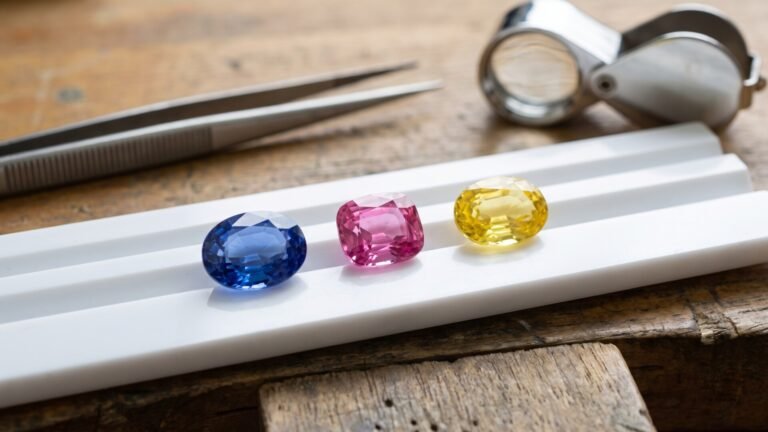
Look for orange visibly mixed with pink. That is the short answer. A padparadscha should read as a blend – salmon, peach-pink, the color of a sunset just before it goes red. A pink sapphire stays predominantly pink, even when it carries a peach or purple modifier. If you squint and the stone turns into "just pink," you are probably looking at a pink sapphire.
The trouble is that photographs lie, and they lie in predictable ways. White balance shifts the whole image. Jewelry-store lighting runs warm, which pushes a pink stone toward orange. A rose-gold setting reflects pink back into the stone. Surrounding diamonds make everything look cooler and brighter. And digital enhancement – a small saturation bump, a slight hue shift – is common enough that you should assume it happened.
Three terms will carry you through every conversation you have about this:
- Hue is the basic color family – pink, orange, red, blue.
- Tone is how light or dark the stone appears.
- Saturation is the strength or intensity of the color.
Padparadscha is a hue question first. It is asking whether the stone genuinely sits between pink and orange. Tone and saturation decide whether that balance is beautiful or muddy. A stone can technically show both colors and still be brownish, grayish, too dark, or so saturated it looks like a different gem entirely. The full sapphire color spectrum explains how these three variables interact across every sapphire color, and it is worth reading before you go shopping.
There is no single, universally agreed visual line between a pale orangey-pink sapphire and a true padparadscha. That is not a failure of the trade; it is the nature of a color continuum. What carries weight is the laboratory report and accepted trade usage, which is why the next section matters more than any at-home test.
| Factor | Padparadscha sapphire | Pink sapphire |
|---|---|---|
| Dominant appearance | Pink and orange together | Pink, sometimes with peach or purple modifiers |
| Typical visual impression | Soft sunset, salmon, lotus, peach-pink | Rose, bubblegum, magenta, hot pink, blush |
| Rarity | Exceptionally rare in fine natural quality | Wider range of availability |
| Treatment concern | Major; heat and beryllium diffusion affect naming and value | Important, but the color name is rarely disputed |
| Certification importance | Extremely high for valuable stones | Important for expensive or investment stones |
| Typical buyer | Collector or rarity-focused buyer | Buyer seeking pink color and broader value |
What Actually Defines a Padparadscha Sapphire
The word comes from the Sinhalese term for the lotus blossom, and the traditional image is a soft pink-orange flower at dawn. That is a lovely association and a terrible buying guide. Treat "padparadscha" as a trade color name with a contested boundary, not a guaranteed technical grade you can trust on sight.
A genuine padparadscha has a real pink-orange balance. Not a pink sapphire with a weak peach modifier. Not an orange sapphire with a pink overtone. Not a heated stone whose color was pushed into the zone. And definitely not a diffusion-treated sapphire dressed up with a prestige name. Each of those can look convincing in a photo and fail the standard in a lab.
Tone and saturation do the heavy lifting on beauty. The classic padparadscha is light to medium in tone, with moderate saturation – delicate, not neon. A stone that technically shows pink and orange but is overly brownish, too dark, too gray, or so saturated it reads as orange has missed the point of the color. Buyers who chase the word sometimes end up with an ugly stone that has a good name. That is the worst trade in the gem business.
Laboratories differ in how they phrase things. Some will use "padparadscha" directly on the report. Others describe the color more cautiously – "pinkish orange" or "orange-pink" – without committing to the designation. Neither approach is wrong; they are applying their own standards to a genuinely hard call. Your job is to read the full report, not the retailer’s headline. If the listing says "padparadscha" and the report says "pinkish orange sapphire," you have learned something important about the price you should pay.
The foundational guide to sapphire properties and value covers hardness, durability, and the general value framework that applies to every sapphire color, and it is the right place to start if you want the broader context before narrowing to this comparison.
Why the color boundary is difficult
Pink, peach, orange-pink, and orange form a continuum, not four boxes. Stones fall all along it, and the boundaries are drawn by human judgment.
Lighting makes it worse. Daylight, incandescent bulbs, and LED all render the same sapphire differently. A stone can look convincingly padparadscha at noon and plainly pink at eight in the evening. Inclusions and color zoning – uneven distribution of color within the stone – can push the perceived hue in one direction on one side and another direction elsewhere. Cut proportions and pavilion depth change how light travels through the stone and therefore what color reaches your eye.
And a seller calling a stone "padparadscha" is not the same as a laboratory confirming it. That sentence is the one to tape to your phone before you shop.
How Pink Sapphire Differs in Appearance and Value
Pink sapphire covers an enormous range. At one end you have pale blush and soft rose. In the middle, a clean even pink. At the top, vivid hot pink and purplish pink that can be genuinely spectacular. The buying process is far more predictable than padparadscha’s, because nobody is arguing about whether the color name is legitimate. It is pink. The question is whether it is an attractive pink.
Here is the thing the prestige name obscures: a vivid, well-cut, lively pink sapphire is a more desirable object than a weak or brownish padparadscha. I have seen buyers pay a premium for a muddy stone because the label said padparadscha, when a cleaner pink at half the price would have looked better on the hand every day for forty years. Judge the stone, then the name.
Color in sapphire comes from trace elements – chromium, iron, and others – but chemistry alone does not determine beauty or market value. Two stones with similar trace-element profiles can look completely different because of cut, clarity, and how the color distributes through the rough. Do not let anyone sell you on chemistry as a proxy for how the stone looks.
Pink sapphire value rests on a short list:
- Color strength and evenness across the stone
- Clarity and transparency
- Cut quality and face-up appearance
- Natural versus laboratory-grown origin
- Treatment disclosure
- Origin claims, when a reputable report supports them
The sapphire color guide comparing blue, pink, and yellow places pink sapphire in the wider market so you can see how it prices against its siblings. For most buyers, pink sapphire is the more rational purchase – broader supply, easier verification, and no premium paid for a contested word.
The Tests That Help – and the Ones That Do Not
You can do real work yourself before you spend money. None of it will prove origin or treatment, but it will stop you from buying a stone you do not actually like.
View the sapphire in multiple lighting environments. Neutral daylight near a window is the honest test. Then indoor light. Watch whether the pink-orange balance holds or collapses into ordinary pink. A true padparadscha should keep some orange presence across lighting conditions; a pink sapphire with a peach modifier will tend to lose it indoors.
Inspect face-up, then tilt the stone at different angles. Look for uneven color zoning, overly dark areas, windowing – a washed-out see-through zone in the middle of the stone where light leaks through instead of reflecting back – and any dull or brownish cast. A well-cut sapphire should be bright and lively across the face, not just in one spot.
Now the limits, stated plainly. Visual inspection cannot prove natural origin. It cannot prove treatment status. It cannot tell you whether a laboratory will accept the padparadscha designation. Anyone who claims otherwise is selling confidence, not gemology. The authenticity tests you can do at home walk through what a buyer can reasonably check without equipment, and they are worth knowing – as long as you understand where their authority stops.
Common claims to reject
- "It is padparadscha because it is expensive." Price is not a designation.
- "It must be natural because it has inclusions." Laboratory-grown stones can have inclusions too.
- "It is untreated because the seller says it is eye-clean." Cleanliness says nothing about treatment.
- "It is padparadscha because the certificate is from the retailer." A seller’s own paperwork is marketing, not verification.
- "A pink-orange color automatically qualifies regardless of treatment." Treatment history affects both the designation and the value.
If a jeweler offers to scratch-test your stone, leave. Sapphire is hard, but a scratch test tells you almost nothing useful and can damage the stone or its setting. It is a party trick, not a gemological method.
What professional testing can establish
A recognized gemological laboratory can assess whether the stone is natural or laboratory-grown, identify detectable treatments, describe the color in its own terms, and offer an opinion on the padparadscha designation under its standards. That is a meaningful body of evidence – and it is the only evidence that should justify a padparadscha premium.
Get an independent report for any significant purchase. Independent means a laboratory with no financial stake in the sale, such as GIA or another established gemological lab – not the retailer’s in-house certificate. If you are still working out whether a stone is natural at all, the guide to spotting real versus synthetic sapphire covers the distinction in detail.
A report is not a guarantee of future value. Laboratory opinions can differ, particularly near the pink-orange boundary, and a report describes a stone on a date; it does not predict the market. What it does is give you a defensible starting point and something to hand down with the stone.
Treatments, Origin, and Certification: Where the Money Is Won or Lost
Heat treatment is common in sapphire, and it is not automatically a problem. What matters is that you know exactly what the report says. Standard heat is one thing. Significant residue in fractures, flux-related indications, or another enhancement is a different conversation entirely, with a different price.
Beryllium diffusion deserves special scrutiny in orange and padparadscha-like sapphires. Diffusion treatment can introduce color into a stone that did not have it, and it has been used to create pink-orange stones that would otherwise be unremarkable. Do not assume a desirable color proves an untreated or traditionally heated stone. Assume nothing and read the treatment statement in full.
Watch the wording on "no indications of heating." That phrase means the laboratory found no evidence of heat treatment by its methods. It is not a universal proof that the stone has never been treated in any way at any point. Read what the report actually says rather than what you hope it says.
Origin reports matter, especially here. Sri Lanka – often called Ceylon in the trade – is strongly associated with padparadscha sapphire, and a Ceylon origin claim carries romantic weight. But origin alone does not establish authenticity, beauty, or value. A Ceylon padparadscha can still be badly cut, weakly colored, or heavily treated. The comparison of Montana and Ceylon sapphire origins explains how origin affects sapphire value in practice, and it is a useful corrective to origin mythology.
Origin determinations can also come back inconclusive. That is normal and not a red flag by itself – but it should not be treated as a substitute for evaluating color, treatment, cut, and documentation.
Certification checklist
- Confirm the report identifies the stone as natural sapphire, not laboratory-grown sapphire or an imitation.
- Check the color description and whether the laboratory actually uses the padparadscha designation.
- Read the treatment statement in full, word for word.
- Check whether the report includes an origin determination and whether it is conclusive or inconclusive.
- Match the report number to the stone and verify it through the issuing laboratory directly.
- Prefer a respected independent laboratory over an in-house seller certificate.
That checklist is the difference between buying a gemstone and buying a sentence.
How Much More Does Padparadscha Cost Than Pink Sapphire?
There is no fixed multiplier. Anyone who quotes you one is simplifying past the point of usefulness. A fine pink sapphire can cost more than a poor padparadscha, and prices swing widely on size, color, treatment, clarity, origin, cut, and documentation.
Here is rough market framing, and treat it as framing rather than a price list. Commercial pink sapphires are often accessible in smaller sizes and treated qualities – a few hundred dollars a carat is common at the low end, and you can find wearable stones for modest money. Fine untreated or lightly treated pink sapphires climb substantially, particularly for vivid color and good transparency. Fine padparadscha sapphires command a premium because of rarity, collector interest, and the difficulty of proving the designation. Exceptional untreated stones with strong color and respected documentation can run into the high thousands per carat or more, depending on the market and the stone.
| Buying factor | Pink sapphire | Padparadscha sapphire |
|---|---|---|
| Entry-level availability | Usually broader | Limited |
| Premium driver | Vivid color, clarity, size, treatment | Color balance, rarity, treatment status, certification |
| Risk of misleading marketing | Moderate | High |
| Value of origin report | Helpful for expensive stones | Often especially important |
| Resale appeal | Depends heavily on beauty and price paid | Strongest for rare, well-documented stones |
| Best value strategy | Buy attractive color, not prestige wording | Buy the report and color together, not the label |
A retail listing using "padparadscha" without a credible report may reflect marketing inflation rather than gemological value. That is where the money is lost – not in the stone, but in the word attached to it.
And consider this honestly: a report-backed, attractive heated padparadscha may be a better purchase than an allegedly untreated stone with weak color and a persuasive story. Treatment disclosure you can verify beats an unverifiable claim every time.
What Most Buyers Get Wrong
They buy the name before judging the color. Padparadscha is a prestige word, and prestige overpowers ordinary buying judgment. The stone still has to be attractive face-up, evenly colored, lively, and well cut. If it is not, the name is doing all the work and you are paying for it.
They assume untreated is always better. Treatment is accepted in the market when it is disclosed. An untreated stone with muddy or weak color may be less desirable than a well-cut heated stone with clear disclosure and a fair price. Untreated is a virtue only when the stone is worth being untreated.
They compare carat weight instead of face-up size. Sapphire is dense, and cutters sometimes leave a deep pavilion to save weight. A deep stone can look noticeably smaller than its carat weight suggests. Compare face-up dimensions, not just the number on the tag.
They trust a warm photograph. Request neutral-light images, video, a return period, and the complete laboratory report before purchasing. A seller who will not provide these is telling you something.
They pay an origin premium without proof. A claimed Sri Lankan origin should be supported by a report, and even then, origin should remain secondary to color and treatment. You are buying a stone, not a passport.
Which Sapphire Makes More Sense for Different Buyers?
Choose pink sapphire if you want a clearly recognizable pink color, more design flexibility, a broader range of budgets, or a stone for regular wear without paying a rarity premium. It is the practical choice for most people, and there is no shame in it.
Choose padparadscha if you specifically want the pink-orange color, you accept a more complex certification process, and you are willing to pay for rarity only when the stone is independently documented. The buyer who wants the real thing and can verify it is the buyer this color was made for.
Choose a peach or salmon sapphire without the padparadscha label if the color is beautiful but the premium designation is not supported. This is often the most rational value choice in the entire category – you get the look without paying for a word.
Avoid both if the seller will not disclose treatment, will not provide a return policy, uses only a retailer certificate, or refuses independent verification. No color is worth those terms.
Decision framework
- Color-first buyer: Choose the stone that looks best in neutral daylight, even if it carries the less prestigious name.
- Collector buyer: Prioritize natural origin, credible laboratory documentation, strong color balance, and a defensible treatment history.
- Gift buyer: Choose pink sapphire when the recipient’s preferred color is known; choose padparadscha only when the recipient values rarity and the documentation is strong.
- Heirloom buyer: Favor excellent cut, durable setting design, complete documentation, and a reputable seller over a larger but poorly documented stone.
If the choice is being made for symbolic reasons – a birthstone, an anniversary, a memorial – the history and symbolism of sapphire gives the tradition behind the stone without pretending it changes the gemology.
Buying Checklist for a Padparadscha or Pink Sapphire
Work through this in order. It will not make you an expert, but it will keep you out of the worst outcomes.
- Request the full laboratory report before discussing whether the price is fair.
- Confirm whether the stone is natural, laboratory-grown, or an imitation.
- Ask exactly what treatment has been detected or cannot be ruled out.
- Compare color under daylight and indoor lighting, and inspect for gray, brown, overly dark, or uneven areas.
- Evaluate cut quality through brightness, symmetry, windowing, extinction, and overall face-up appeal.
- Confirm the seller’s return policy and whether the stone may be independently examined.
- Ask whether the setting suits sapphire’s hardness and whether the design protects the stone from impact.
- Keep the report, receipt, treatment disclosure, photographs, and appraisal records together for insurance or resale.
Sapphire is durable – it sits at 9 on the Mohs hardness scale, second only to diamond among common gemstones – but durable is not indestructible. A high setting with exposed edges can chip. A bezel or a low-profile setting protects a stone that will be worn daily. When you are ready to look at finished pieces, [Affiliate: browse sapphire engagement ring collections with pink and peach options] and pay attention to the setting before the stone size.
Frequently Asked Questions About Padparadscha Sapphire Vs Pink Sapphire
Is padparadscha sapphire more valuable than pink sapphire?
Often, but not automatically. A fine, natural, well-documented padparadscha can command a significant premium. A poorly colored or weakly documented stone may be worth less than a vivid, attractive pink sapphire. Value follows the stone, not the label.
Can a pink sapphire turn into a padparadscha sapphire?
Not through ordinary wear. A stone may be treated or marketed differently, but its final designation depends on its observed color, treatment history, and the standards of the evaluating laboratory. The color does not change on your finger.
Is every pink-orange sapphire a padparadscha?
No. The pink-orange balance, tone, saturation, treatment history, and laboratory interpretation all matter. A peach or salmon sapphire may be beautiful without meeting a laboratory’s criteria for the designation.
Should I buy a padparadscha sapphire without a certificate?
For a low-cost decorative stone, you may accept more risk. For any purchase carrying a substantial padparadscha premium, an independent laboratory report is strongly advisable, because the name itself materially affects what you are paying.
Are heated padparadscha sapphires worth buying?
They can be, provided the treatment is clearly disclosed and the price reflects it. Beauty, stability, cut, and documentation matter more than an automatic assumption that untreated is always superior.
Which is better for an engagement ring, pink sapphire or padparadscha?
Either can work, because sapphire is a durable jewelry gemstone. The setting and daily-wear habits matter more than the color name. Pink sapphire is usually easier to source across budgets; padparadscha offers a rarer color but demands more careful verification.
Can padparadscha sapphire fade?
Stable, properly disclosed sapphire color is generally suitable for jewelry. Ask about treatment, because some treatments carry different durability and care considerations, and let the laboratory report and the seller’s disclosure guide how you care for the stone.
Does a GIA report guarantee the stone is padparadscha?
A report from a respected independent laboratory gives you that laboratory’s opinion under its own standards. It is strong evidence, not an absolute guarantee, and different laboratories can reach different conclusions near the color boundary. Read the full report rather than the headline.
The Better Buy Depends on the Evidence
Pink sapphire is the simpler, more budget-flexible choice, and for most buyers it is the right one. Padparadscha is the specialist choice for someone who wants that rare pink-orange color and can verify the designation with independent documentation. Neither is a mistake. Paying a padparadscha premium for color wording alone is.
Judge in this order: color appeal, treatment disclosure, laboratory documentation, cut quality, price, then origin story. That sequence keeps the prestige word in its proper place – last, where it belongs.
A well-documented, genuinely beautiful sapphire will still be meaningful in forty years, when someone who is not yet born wears it and asks what it is. The answer will be easy if the paperwork is good. A more prestigious-sounding stone with an uncertain identity is a harder thing to hand down, because the question it raises has no clean answer. Buy the stone you can defend, not the word you can repeat.