How to Store Birthstone Jewelry Without Scratching or Damaging It
A scratched amethyst is the most common repair I used to see, and it almost never happened while the ring was being worn. It happened in a drawer. A woman would bring in her mother’s amethyst ring, or a pendant she’d worn once at a christening, and there it was – a fine white network of scuffs across the table of the stone. She’d assume she’d knocked it against a doorframe. Nine times out of ten, it had been sitting against a diamond, or a gold chain, or the edge of a metal divider, quietly grinding away for a year.
The safest way to store birthstone jewelry is to give every piece its own soft, enclosed space, keep it dry, and keep it out of light and heat. Everything else – boxes, pouches, trays – is just a way of achieving that.
That is the whole answer, and it is not complicated. What makes storing birthstone jewelry genuinely difficult is that the right method changes with the stone, not with the price tag. A $400 opal needs more careful handling than a $4,000 diamond, and a jewelry box built for one will damage the other. Once you understand which of your pieces are the aggressors and which are the victims, the storage decisions make themselves.
Why birthstone jewelry gets damaged in storage
Two words get used interchangeably in jewelry stores and should not be: hardness and toughness. Hardness is resistance to scratching. Toughness is resistance to chipping and breaking. They are different properties, and a stone can be excellent at one and poor at the other.
The Mohs scale is the usual reference for hardness – a ranking from 1 (talc) to 10 (diamond) of what will scratch what. It is a useful shorthand and a terrible complete durability score. Diamond sits at 10, which means nothing on earth scratches it except another diamond. Emerald sits around 7.5 to 8, which sounds close until you learn emerald is brittle and full of inclusions, and a sharp knock can take a corner off. How the Mohs hardness scale actually works is worth reading if you want the full picture, because the number on its own will mislead you.
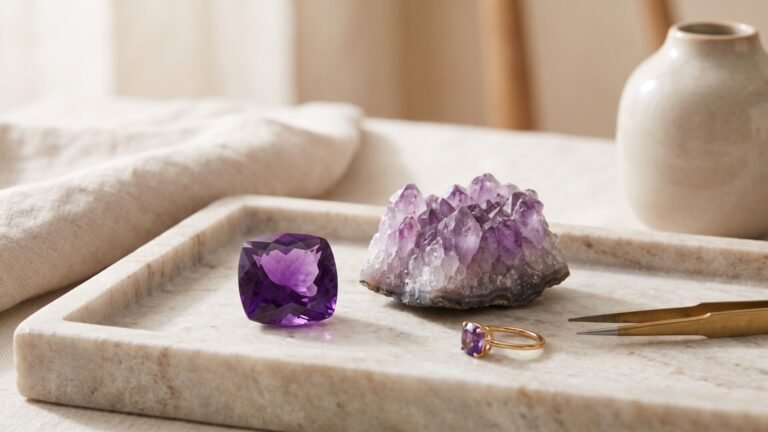
Now think about what happens in a drawer. A diamond ring and an amethyst ring share a compartment. Every time the drawer opens and closes, they shift. Diamond, at 10, cuts into amethyst, at 7, with no effort at all. Neither stone looks damaged from the outside. The amethyst just accumulates a dull haze of scratches over months until the polish is gone.
The other storage mistakes are just as ordinary:
- Loose pieces rubbing against each other in a bowl or a single compartment
- Chains left unfastened, knotting into themselves and kinking
- Rings stacked on a holder so their settings press together
- Stones resting against metal dividers or the hard edge of a tray
- Jewelry put away damp, or still carrying lotion, perfume, and skin oils
Then there is the damage you cannot see. A stone can look perfect while the setting around it fails. Repeated contact bends prongs. A bezel loosens. A small accent stone works its way out of its seat and disappears into the lining of a box, and you do not notice until the day you go to wear it. Most lost stones I dealt with were not knocked out in daily wear. They were already loose, and storage finished the job.
Sunlight, heat, and humidity do their own quiet work. Some stones fade in prolonged direct sun. Silver and brass tarnish faster in humid air. Treatments – fracture filling, coating, dyeing – can be affected by heat, moisture, and chemical exposure. And a closed container in a warm bathroom is a small humid environment that punishes metal and setting alike.
Birthstone storage risk by material
| Birthstone or material | Main storage concern | Safer storage method | Extra caution |
|---|---|---|---|
| Diamond, sapphire, ruby | Scratching other jewelry; chipped edges if knocked | Individual compartments or pouches | Keep away from softer stones |
| Emerald | Brittleness, inclusions, treatment sensitivity | Soft individual pouch or compartment | Avoid pressure and temperature extremes |
| Opal | Dehydration, cracking or crazing, scratching | Soft pouch in stable indoor conditions | Avoid dry heat, direct sun, and contact with harder stones |
| Pearl | Scratching, abrasion, humidity changes, surface damage | Breathable soft pouch or lined compartment | Do not seal in airtight plastic for long-term storage |
| Amethyst, citrine, topaz, aquamarine | Scratches, impact damage, possible color fading in some stones | Separate fabric-lined compartments | Protect from prolonged direct sunlight and hard contact |
| Peridot, garnet, tanzanite, tourmaline | Scratching, chipping, or pressure damage depending on cut and setting | Individual compartments with padding | Avoid loose storage and crowded trays |
Match the storage method to the birthstone
If you take one idea from this article, take this one: sort your jewelry by how vulnerable each piece is, not by which month it belongs to. The full guide to gemstone types and properties is a good place to go deeper on why the differences exist, but the practical rules are simpler than the gemology.
Hard, durable stones still need separation
Diamond, sapphire, and ruby are the tough crowd. They resist scratching, they tolerate daily wear, and they will survive almost anything you do to them. That is exactly why they are dangerous to everything else in the box.
Store each of them in its own compartment, on its own ring roll, or in an individual pouch. Never in a shared bowl. A diamond’s durability does not protect it from chipped corners if it is knocked against a hard surface, and it does not protect its prongs from bending when three rings are jammed into one slot. Hard stones need separation for the sake of their neighbors, and padding for the sake of their settings.
Softer and more fragile stones need extra protection
Opal, pearl, moonstone, turquoise, and much emerald jewelry belong in a different category entirely. These are the pieces that should never be allowed to touch a harder gem or a rough metal edge.
Opal is the one that surprises people. It contains water within its structure, and it does not like rapid changes – dry heat, direct sun, or a radiator can contribute to crazing, the fine cracking that ruins an opal permanently. What makes opal vulnerable and how it is valued covers this in more depth, and it is worth reading before you store an opal heirloom. A soft pouch in a stable indoor drawer is the right home.
Pearl is softer still, and it is organic. It scratches, it dulls, and it dislikes both dryness and airtight confinement. Pearl properties, value, and care explains why a breathable pouch or a lined compartment is better than sealed plastic, and why pearls should never sit under heavier pieces where their surface can be compressed and abraded.
For all of these, a soft pouch beats a bare plastic slot or a rigid compartment with hard edges. The fabric absorbs small movements instead of transmitting them.
Treated and light-sensitive stones require controlled conditions
Treatment disclosure matters for storage, and almost nobody thinks about it at the point of purchase. A fracture-filled emerald, a coated topaz, a dyed stone – each may respond differently to heat, moisture, chemicals, and pressure than its untreated equivalent. If you do not know what has been done to your stone, you cannot know what will harm it.
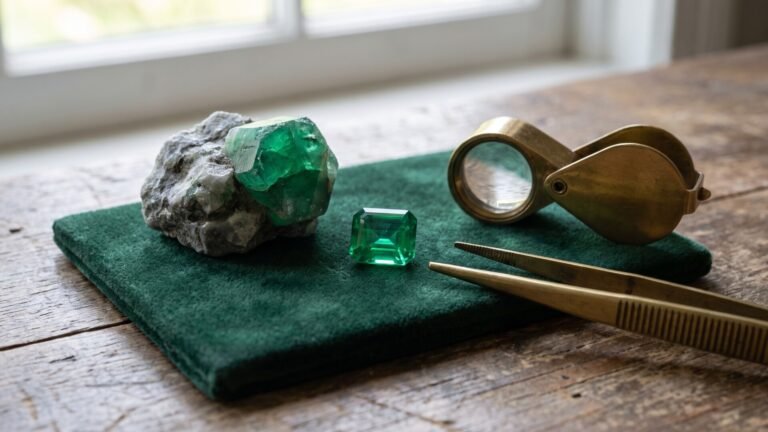
Emerald is the classic case. Most emeralds on the market have been treated in some way, and their inclusions make them sensitive to pressure and temperature extremes. Emerald’s inclusions, treatments, and value is the place to understand what you own before you decide how to keep it.
Store color-sensitive stones away from windows, radiators, and heating vents. Amethyst, citrine, topaz, and aquamarine can all lose color with prolonged direct sun exposure, and a sunny windowsill is the worst place in the house for them. If the treatment on a valuable stone is unknown, ask the seller or check the gemological report. A lab report will usually state treatments, and that information should travel with the piece.
The best storage containers for birthstone jewelry
The container matters less than what happens inside it. But the right container makes the right behavior easy, and the wrong one makes it nearly impossible.
Jewelry box with divided compartments
A fabric-lined jewelry box with real divisions is the best all-purpose answer for a mixed birthstone collection. Look for separate ring rolls, padded sections, necklace hooks, a soft interior lining, a lid that closes securely, and enough depth that stones do not press against the lid when it shuts.
The depth point gets missed constantly. A box that is beautiful and shallow will compress tall rings and pendants against the lid, which is exactly the pressure that loosens stones over time.
One warning about capacity: an overcrowded box creates the same rubbing and tangling as a junk drawer. Empty space is not wasted space in jewelry storage – it is the thing preventing contact. If you find yourself forcing a lid closed, the box is too small.
Individual soft pouches
For delicate pieces, travel, heirloom jewelry, and anything that should not touch another stone, individual pouches are hard to beat. Cotton, linen, microfiber, and jewelry-specific storage fabrics all work. Avoid rough fabric, loose fibers that can wrap around prongs, and dyed materials that might transfer color onto a light stone or a silver surface.
A pouch is not automatically safe. Pile twenty of them into a bag under weight and you have recreated the problem. Store pouches side by side in a drawer, not compressed together, and keep them somewhere dry.
Stackable trays and drawer organizers
Modular trays suit larger collections and anyone who wants to see what they own without leaving pieces loose on a dresser. Choose trays with soft, non-abrasive lining and fixed dividers – bare wood, untreated metal, and hard plastic will all mark jewelry.
The trade-off is real. Open trays are convenient for the pieces you wear weekly, but they offer less protection from dust, humidity, sunlight, and the occasional careless hand. Use them inside a drawer, not on top of a dresser by a window.
Travel cases
A compact travel case with separate zipped sections, ring rolls, and chain holders is the right tool for a trip. It is not the right tool for permanent storage. Jewelry left compressed in a travel case for months stays compressed, tangled, and exposed to whatever humidity the case traps.
The buying criterion is simple: the case should hold each piece securely without forcing stones against the interior or against one another. If you have to shove to close it, it is the wrong case for that trip.
What to avoid
Some storage choices are popular and wrong:
- Jewelry bowls and open dishes, where everything touches everything
- Ordinary plastic sandwich bags for long-term storage – airtight, non-breathable, and prone to trapping moisture
- Unlined wooden boxes, which can off-gas and abrade
- Loose velvet bags piled together in a drawer
- Bathroom cabinets and countertops near steam
- Open displays on a sunny windowsill
Anti-tarnish strips can help with silver and some base metals. They do not replace individual separation, and they do nothing for gemstone-specific risks. And skip the cotton-filled medicine bottle and the tissue-paper jewelry box your purchase came in – neither is designed for storage, and both can abrade a polished surface.
How to store rings, necklaces, earrings, and bracelets
Rings
Store rings upright in individual ring rolls or separated slots so stones do not strike the settings next to them. Stacking rings is the single most common cause of metal-on-metal rubbing, abrasion beneath settings, and slow pressure on prongs.
For rings set with opal, pearl, emerald, or another vulnerable stone, use a soft compartment with enough clearance that the stone never touches the divider. If the ring is tall, lay it flat in a padded section instead of forcing it into a roll.
Necklaces and chains
Hang chains from hooks or thread them through a chain slot to prevent knots and kinks. For short-term storage, close the clasp before placing the necklace in its compartment – an open clasp catches on everything – but do not wrap the chain tightly around a holder. Tight coiling strains links and work-hardens the metal over time.
Delicate chains do best in an individual pouch with a built-in loop, or in a case designed to keep the chain straight. A knotted fine chain is not a disaster, but unpicking one without bending it is a job for patience most people do not have at seven in the morning.
Earrings
Store earrings as pairs in pierced earring cards, small compartments, or soft slots, so posts and backs do not scratch nearby stones. Keep heavier earrings away from delicate pieces – their weight crushes and presses whatever is beneath them.
Check backs and posts before storage. A loose back will vanish into a lined box and take the pair with it, and a bent post is much easier to fix before it has been forced through an earring hole a dozen more times.
Bracelets and watches with birthstones
Store bracelets flat or in padded compartments rather than coiled tightly around hard holders. Keep gemstone bracelets from rubbing against metal charms, watch cases, and other bracelets.
Elastic gemstone bracelets deserve their own space. The elastic stretches, individual beads loosen, and hard bead-to-bead contact creates failure points that are easy to miss until the bracelet breaks. Store them flat, separately, and check the elastic periodically.
What most buyers get wrong about jewelry storage
The most expensive piece in the box is not automatically the one that needs the best storage. A diamond ring worth five figures will shrug off a crowded drawer. A vintage opal pendant worth a fraction of that will not. Sentimental, old, and fragile pieces are frequently more vulnerable than valuable but durable ones, and they are the ones people store worst.
The second mistake is organizing by birth month. It feels tidy – January here, June there – but it groups a garnet with a pearl because they happen to share a birthday month, and those two have nothing in common in storage terms. Sort by hardness, fragility, treatment, and how often you wear the piece.
The third is over-cleaning before storage. Soaking, ultrasonic cleaning, and aggressive brushing can damage certain stones and settings, and jewelry should never go into a box wet. I have seen more damage done by enthusiastic cleaning than by neglect.
A simple sorting system solves most of this:
- Daily-wear pieces: easy access without crowding
- Delicate stones: individual pouches, stable conditions
- Heirloom and high-value pieces: individual compartments, secure and discreet
- Travel jewelry: a padded case with separate closures
A practical sorting framework
| Category | Storage priority | Recommended setup |
|---|---|---|
| Daily-wear jewelry | Easy access without crowding | Small lined tray or divided box |
| Delicate or porous stones | Prevent abrasion, moisture swings, and pressure | Individual soft pouches in a stable drawer |
| Heirloom and high-value pieces | Protection, documentation, and security | Individual compartments in a secure, discreet box |
| Travel jewelry | Prevent movement and tangling | Padded travel case with separate closures |
How to prepare birthstone jewelry before putting it away
Wipe off cosmetics, lotion, perfume, sweat, and surface dirt with a soft cloth appropriate to the stone before storage. Do not assume one cleaning method works for everything in the box – a cloth that is fine for a diamond may be too abrasive for a pearl.
If you want to understand which stones are harmed by water-based cleaning, Which birthstones should never be exposed to water is the reference to check first. And if you are wondering whether your perfume habit is doing damage, How perfume, lotion, and hairspray affect gemstones answers that directly.
Jewelry must be completely dry before it goes into a pouch or closed box. Trapped moisture tarnishes metal, dulls pearl nacre, and can affect treatments. Leave pieces out on a cloth for an hour if you have any doubt.
Inspect before long-term storage: clasps, prongs, bezels, earring backs, chain links. A minor fault caught now is a repair. Caught later, it is a lost stone and a search through carpet.
Finally, photograph valuable or sentimental pieces and keep purchase records, treatment information, appraisals, and insurance documentation somewhere separate from the jewelry box. If the box is ever lost or stolen, that file is the difference between a claim and a loss.
When not to clean before storage
Do not automatically reach for the ultrasonic cleaner, the steam cleaner, or a household solution because a piece looks dull. Opal, pearl, emerald, turquoise, moonstone, and most treated stones need a more conservative approach, and some should never see an ultrasonic tank. Which gemstones are safe to clean with an ultrasonic cleaner will tell you which of your pieces qualify before you switch the machine on.
Take a loose, fractured, heavily included, treated, antique, or badly mounted piece to a jeweler rather than cleaning it yourself. Professional cleaning costs less than replacing a stone.
Where to store the jewelry in the home
Choose a cool, dry, stable indoor location. Away from bathrooms, kitchens, windows, radiators, and heating vents. Away from anywhere with repeated temperature or humidity swings.
A bedroom drawer or a closet shelf is almost always safer than a bathroom cabinet, even though the bathroom is where most people instinctively put jewelry. Steam from showers, humidity that never quite clears, and the daily cosmetics routine all work against you.
Keep valuable pieces discreet. The container should not be obvious from outside the home, and it should not be visible through a window. That is security, not decoration.
For heirloom jewelry, find a spot that is accessible to you but protected from children, pets, spills, and the kind of accidental clear-out that happens when someone mistakes a small box for clutter. If you are the custodian of a piece meant to pass down, the storage location is part of the inheritance.
Building a birthstone jewelry storage system on different budgets
Best low-cost setup
Individual soft pouches, a small fabric-lined compartment tray, earring cards, and a few necklace hooks will cover the minimum effective system, usually for well under $75 total. Separation and dryness matter far more than decorative materials or a luxury label.
Avoid improvised solutions with abrasive fabric, airtight plastic for long-term pearl storage, and containers with rough edges or loose fibers. Cheap is fine. Careless is not.
Best mid-range setup
A structured jewelry box with ring rolls, divided sections, necklace hooks, and a soft interior handles a mixed birthstone collection well. Expect to spend somewhere in the $40 to $200 range depending on size and materials.
Choose modular storage over maximum capacity. A box that can grow with the collection lets you add pieces without forcing them into crowded compartments. Look for a secure closure, and pick an opaque or shaded construction if the box will sit in a room with strong daylight.
Best premium or heirloom setup
A high-quality fabric-lined jewelry cabinet, a lockable jewelry box, or a custom drawer insert makes sense for valuable or multi-generational collections. Premium storage is justified by organization, security, protection from contact, and long-term accessibility – not by leather, branding, or how it looks on a dresser.
Confirm the interior materials, the closure quality, the warranty, and whether the product is actually intended for jewelry rather than general accessories. A beautiful box lined with something abrasive is worse than a plain one lined with soft cotton.
Storage options comparison
| Storage option | Approximate price range | Best for | Main advantage | Main drawback |
|---|---|---|---|---|
| Individual soft pouches | $10-$40 for a set | Delicate pieces and travel | Excellent separation | Less visibility and organization |
| Small divided tray | $20-$75 | Small daily-wear collection | Affordable access and separation | Limited capacity |
| Fabric-lined jewelry box | $40-$200 | Mixed birthstone collections | Balanced protection and organization | Can become overcrowded |
| Travel jewelry case | $20-$100 | Trips and temporary storage | Controls movement and tangling | Not ideal for permanent storage |
| Lockable jewelry cabinet or premium box | $150-$800 or more | Heirlooms and larger collections | Security and long-term organization | Cost and space requirements |
Prices are approximate and move with materials, size, hardware, and security features. [Affiliate: Browse fabric-lined jewelry boxes with divided compartments] is a reasonable place to start comparing, and [Affiliate: See individual gemstone storage pouches] covers the cheap half of the system.
The hidden cost of choosing the wrong storage
A scratched stone, damaged polish, bent prong, or lost earring almost always costs more to repair than the storage solution that would have prevented it. Repolishing a stone means removing material, and some stones cannot be repolished at all without visible loss. Replacing a matched earring is often impossible. Rebuilding a worn setting is skilled labor.
The non-financial cost is worse. Missing sentimental pieces, broken birthstone gifts, and jewelry that becomes too inconvenient to wear because it is tangled or buried – those do not show up on a repair invoice, but they are the real loss.
Think in cost per use. A modest organizer used daily for ten years costs pennies a week. An attractive box that crowds your pieces and hides the ones you actually wear provides less practical value no matter what it cost.
The verdict is straightforward: prioritize individual separation, appropriate lining, stable conditions, and access before you consider luxury branding or decorative design.
A simple storage routine that protects jewelry for years
The routine takes about a minute a night, and it is the whole game:
- Remove jewelry after wear, before you change clothes or start the evening routine.
- Wipe it appropriately for the stone – soft dry cloth for most, slightly damp for a few, nothing abrasive.
- Let it dry fully before it goes anywhere closed.
- Close clasps and fasten chains.
- Check settings, backs, and links with a quick glance and a gentle touch.
- Return each piece to its assigned space – the same space every time.
Once a month or at the change of seasons, do a fuller check: loose stones, tarnish, broken clasps, damaged pouches, and compartments that have quietly become overcrowded. Book a professional inspection for valuable or frequently worn pieces, especially if a stone moves, a prong catches fabric, or a clasp no longer closes securely.
That routine is what preserves not just the appearance of a birthstone piece but its ability to be worn, and eventually handed on.
Frequently Asked Questions About Storing Birthstone Jewelry
Can I store all of my birthstone jewelry in one jewelry box?
Only if the box has enough divided, lined compartments to keep pieces from touching. Loose storage in one shared compartment increases scratching, tangling, and setting damage – and a crowded box is worse than two modest ones.
Should birthstone jewelry be stored in plastic bags?
A soft individual pouch or a jewelry-specific bag can work for short-term protection. Ordinary airtight plastic is not ideal for every stone or for long-term storage. Pearls and some delicate materials benefit from breathable storage and stable conditions, and plastic can trap moisture against metal.
What birthstones should never touch other jewelry?
Pearl, opal, turquoise, moonstone, and much emerald jewelry need especially careful separation. But the reverse is also true: diamonds, sapphires, and rubies can scratch neighboring pieces despite their own durability, so they should be separated too.
Is it safe to store jewelry in the bathroom?
Not for long-term storage. Steam, humidity, temperature changes, and cosmetics all contribute to tarnish, surface damage, and deterioration of some stones and settings. A bedroom drawer is a better home for almost everything.
How should I store an opal or pearl birthstone?
A soft individual pouch or lined compartment in a stable, dry indoor location, away from direct sunlight, heat, and harder jewelry. Pearl storage should allow some breathability rather than prolonged airtight confinement, and opal should avoid dry heat and rapid temperature changes.
Should I clean birthstone jewelry before storing it?
Remove surface residue and let the piece dry completely. Do not use one cleaning method for every stone. Delicate, treated, porous, antique, or damaged jewelry may need professional advice before you touch it with anything.
Is a jewelry box or individual pouch better?
A divided, fabric-lined jewelry box is better for an organized collection. Individual pouches are better for delicate, heirloom, or travel pieces. The strongest system usually combines both – a box for structure, pouches for the vulnerable pieces inside it.
How often should I check stored jewelry?
A quick check each time you put a piece away, and a fuller inspection monthly or seasonally. Look for loose stones, tarnish, broken clasps, damaged pouches, and overcrowding. Valuable or frequently worn pieces deserve a professional inspection once a year.
Conclusion
Ten years from now, the birthstone ring you are storing tonight will either be a piece someone is delighted to inherit or a piece that needs repolishing, re-setting, or replacing. The difference will not be how much it cost. It will be whether it spent those years touching other jewelry, sitting in humidity, or drying out in the sun.
Store each piece separately, dry, shaded, and in a soft-lined compartment or pouch suited to its material. Choose divided compartments for everyday collections, individual pouches for fragile or sentimental pieces, and secure premium storage for valuable heirlooms. That is the whole system, and it costs less than the first repair it prevents.