How to tell if a Ruby is heat treated or natural
I have a confession to make.
The first ruby I ever bought was a mistake.
I was young, maybe twenty-two. I had saved for months. The jeweler in the tiny Bangkok shop held it up to the light and it blazed like a drop of summer sunset. He told me it was “natural, untreated.” I believed him. I didn’t ask for a certificate. I didn’t know to ask.
Six years later, I sold it to a dealer in New York. He looked at it through his loupe for about three seconds. Then he handed it back and said, “Heat treated. Nice stone, but not what you paid for.”
I lost hundreds of dollars. More importantly, I lost my trust in my own judgment.
That moment changed everything. I decided I would never be fooled again. I studied. I read every GIA bulletin I could find. I spent hours in gem labs, looking at inclusions under microscopes. I made friends with gemologists who patiently answered my endless questions.
Now I can look at a ruby and tell you, with reasonable certainty, whether it’s been heated. And I want to share what I’ve learned with you.
Because here’s the thing: rubies are among the most treasured gemstones on earth. They’ve been called the “king of gems” for centuries. But the market is full of stones that have been altered by heat. Some of those stones are beautiful and valuable in their own right. Others are sold deceptively, with buyers paying natural prices for treated goods.
This article is about how to tell the difference. It’s about protecting yourself. And it’s about understanding that heat treatment isn’t evil — but secrecy is.
Let’s start at the beginning.
Understanding Ruby
Origin of Rubies
Rubies have been coveted for thousands of years. The ancient Hindus called them ratnaraj, meaning “king of precious stones.” In Sanskrit, they were known as padmaraga — “one with the color of a lotus.” Pliny the Elder wrote about them in his Natural History. Royalty across Asia and Europe wore them as talismans for protection and passion.
The most famous source of rubies is Myanmar, formerly Burma. The Mogok region produced stones of a deep, pigeon-blood red that became the benchmark for quality. But rubies also come from Thailand, Sri Lanka, Madagascar, Mozambique, Tanzania, and even Afghanistan.
Each source produces rubies with slightly different characteristics. Burmese rubies often have a strong red fluorescence under UV light. Thai rubies tend to be darker, with a brownish undertone. Mozambique rubies, which now dominate the market, are often brighter and more saturated.
But here’s the critical point: rubies from any source can be heat treated. And the treatment can dramatically change their appearance.
Characteristics of Natural Rubies
A natural ruby is a gem-quality variety of the mineral corundum, colored by trace amounts of chromium. The more chromium, the deeper the red. But rubies are rarely perfect. They almost always contain inclusions — tiny crystals, silk (fine rutile needles), or fractures.
These inclusions are not flaws. They are fingerprints. They tell the story of how the ruby formed deep in the earth, under intense heat and pressure.
Natural rubies with no inclusions are incredibly rare. A clean, untreated ruby of even one carat can sell for tens of thousands of dollars. Most natural rubies have visible inclusions. And that’s okay. It’s what makes them real.
Color is the most important factor in a ruby’s value. The ideal is a vivid, slightly bluish red called “pigeon’s blood.” But even top-quality natural rubies often have secondary hues of purple or orange.
Clarity is next. Inclusions that are visible to the naked eye reduce value. But inclusions that are only visible under magnification are acceptable — even expected.
Cut and carat weight also matter. But for rubies, color and clarity are king.
Heat Treatment Explained
Definition of Heat Treatment
Heat treatment is exactly what it sounds like: a ruby is heated to high temperatures — usually between 1,500 and 1,800 degrees Celsius — to alter its color and clarity.
The process is ancient. Pliny mentioned it. The Romans used it. But modern heat treatment is far more controlled. Rubies are heated in furnaces with precise temperature ramps and cooling rates. Sometimes fluxes (like borax) are added to help dissolve inclusions.
The goal is simple: improve the stone’s appearance.
Heat treatment can:
- Remove or reduce “silk” (the fine rutile needles that can make a ruby look hazy)
- Improve color by dissolving certain inclusions or altering the oxidation state of chromium
- Heal fractures, making them less visible
In some cases, heat treatment can turn a dull, purplish ruby into a vivid red. It can make a cloudy stone transparent.
But it’s still a treatment. The stone has been changed.
Why Heat Treatment is Common
Here’s the reality: untreated, top-quality rubies are astronomically rare. The vast majority of rubies mined today have some degree of imperfection. Without heat treatment, many of them would be unsalable — or at least, unsalable at a price that makes mining worthwhile.
Heat treatment is the industry standard. According to the Gemological Institute of America (GIA), an estimated 95% of all rubies on the market have been heat treated. It is so common that many jewelers consider it an expected part of the supply chain.
The economics are simple. A heat-treated ruby can look almost as good as a natural one, but costs a fraction of the price. For most buyers, that’s a fair trade.
But the problem arises when a treated ruby is sold as untreated — or when the buyer doesn’t know they’re buying a treated stone.
Identifying Heat Treated vs. Natural Rubies
This is where everything gets interesting. And where you need to pay attention.
Visual Indicators
Let me be honest with you: visual identification is difficult. Even experienced gemologists can struggle. But there are clues.
Color intensity and saturation. Heat-treated rubies often have a more uniform, “perfect” color. Natural rubies may have slight color zoning — patches of lighter and darker red. If a ruby looks too perfect, be suspicious.
Clarity and inclusions. This is the big one. Natural rubies almost always have inclusions. Heat treatment can dissolve or alter these inclusions.
Look for:
- Silk: Natural rubies often have fine rutile needles (silk). Heat treatment can dissolve these needles, leaving behind a “ghost” or remnant pattern. If you see silk that looks broken, melted, or partially dissolved, the stone has likely been heated.
- Fractures: Heat treatment can heal fractures, but the healed areas often show a “glassy” or “flow-like” appearance. If you see fractures that look like they’ve been filled with glass, that’s a red flag.
- Inclusion halos: When inclusions are heated, they can develop a “halo” of tiny fractures around them. This is a classic sign of heat treatment.
- Bubbles: If you see gas bubbles inside the ruby, that’s a sign of flux-healing, a more aggressive treatment.
Fluorescence. Many rubies fluoresce under UV light. Burmese rubies often fluoresce strongly. But heat treatment can reduce or alter fluorescence. If a ruby doesn’t fluoresce as expected for its origin, it may have been heated.
Professional Assessment
Here’s the truth: you cannot reliably identify heat treatment with the naked eye. Even a jeweler’s loupe is not enough.
You need a certificate from a reputable gemological laboratory.
The most trusted labs include:
- GIA (Gemological Institute of America) — the gold standard
- AGL (American Gemological Laboratories) — excellent for colored stones
- SSEF (Swiss Gemmological Institute) — highly respected
- Gübelin Gem Lab — top-tier, especially for high-value stones
- Lotus Gemology — specialized in colored stones
These labs use advanced equipment: spectrometers, microscopes, and sometimes even laser ablation mass spectrometry to detect trace elements and treatment residues.
A certificate from a reputable lab will state whether the ruby has been heat treated. Some will even specify the type of treatment.
If a seller cannot provide a certificate from one of these labs, be very, very careful.
Tools for Identification
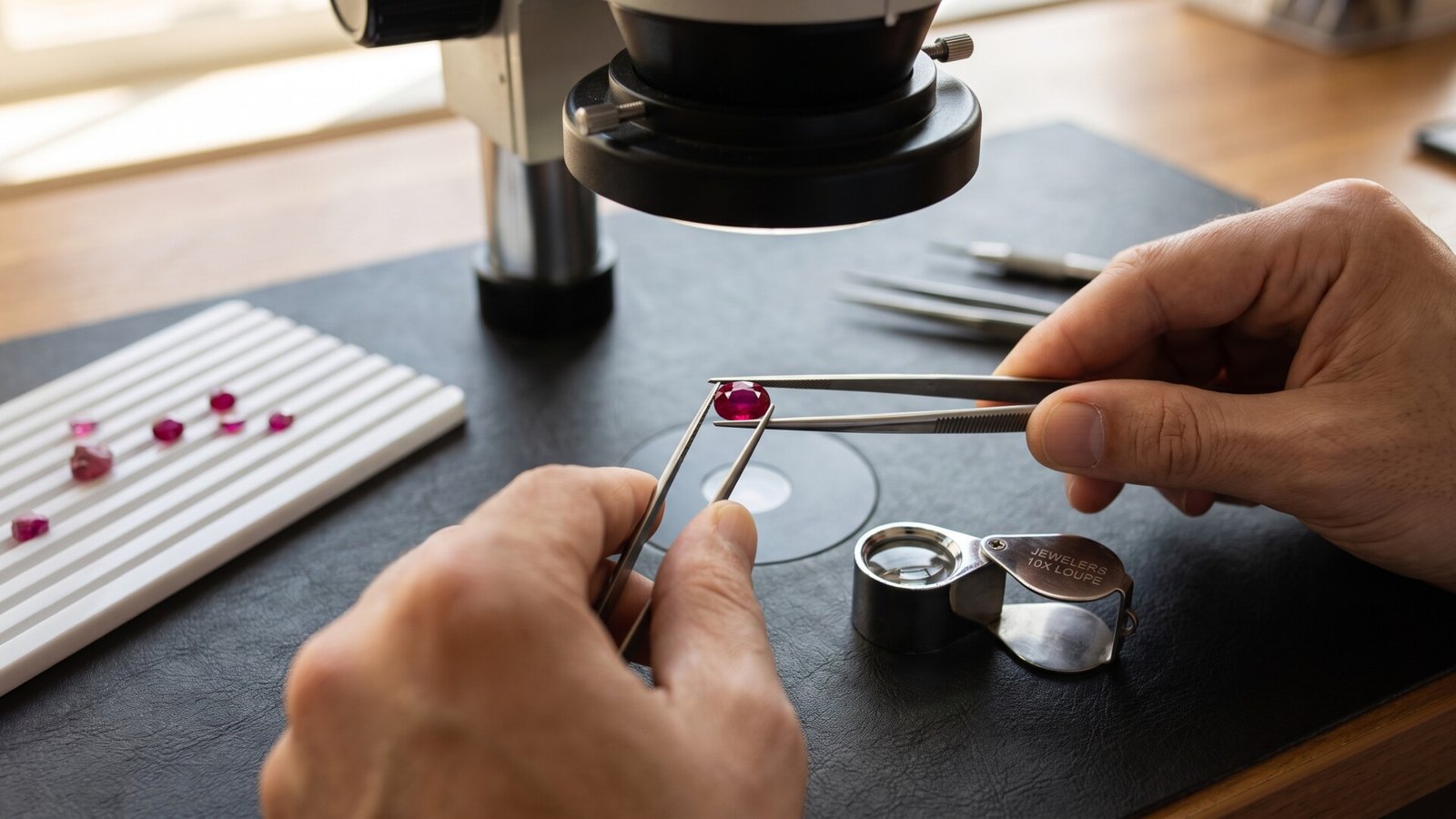
For amateurs, the best tool is a good jeweler’s loupe — at least 10x magnification. Look for the signs I mentioned above. But remember: you are not a gemologist. Your loupe can help you spot red flags, but it cannot give you a definitive answer.
For professionals, the tools are more advanced:
- Microscope — for detailed inclusion analysis
- Spectrometer — for chemical analysis
- UV lamp — for fluorescence testing
- Refractometer — for measuring refractive index (though this doesn’t directly detect treatment)
If you’re serious about buying rubies, invest in a good loupe and a UV light. But never rely on them alone.
Common Misconceptions About Heat Treatment
Let me clear up some myths.
Myth 1: Heat treatment is always bad. No. Heat treatment can improve a stone’s appearance and make it more affordable. Many people happily own heat-treated rubies. The problem is when it’s not disclosed.
Myth 2: Heat-treated rubies have no value. Wrong. A well-done, heat-treated ruby can still be beautiful and valuable. But it will never be as valuable as a comparable untreated stone.
Myth 3: You can always tell by looking. False. Some heat treatments are so subtle that even experts need advanced equipment to detect them.
Myth 4: All rubies are heat treated. No. Untreated rubies exist, but they are rare and expensive. If a ruby is sold as “untreated,” demand proof.
Myth 5: Heat treatment is permanent. Mostly true. Heat treatment is generally stable under normal wear. But extreme conditions (like a jeweler’s torch) can damage a heat-treated stone.
Buying Considerations
What to Look for When Buying a Ruby
Certification. This is non-negotiable. Ask for a certificate from a reputable lab. If the seller hesitates, walk away.
Price. If a deal seems too good to be true, it probably is. A one-carat, untreated, top-quality ruby can cost $10,000 or more. A heat-treated ruby of similar appearance might be $2,000–$4,000.
Seller reputation. Buy from established, reputable jewelers. Avoid street vendors, online auctions, and “too good to be true” deals.
Ask questions. “Has this ruby been treated in any way?” “What type of treatment?” “Can you provide a certificate?” “What lab issued it?”
Common Mistakes to Avoid
- Buying without a certificate. I did this. Don’t.
- Trusting visual inspection alone. Even experts can be fooled.
- Assuming “natural” means “untreated.” Many sellers use “natural” to mean “not synthetic.” It doesn’t mean “untreated.”
- Ignoring small inclusions. A flawless ruby at a low price is almost certainly treated.
- Buying from unverified sources. Stick to reputable dealers.
Price Expectations
Here are rough price ranges for rubies of good quality (vivid color, minor inclusions, 1 carat):
- Untreated, natural: $10,000 – $50,000+ per carat
- Heat-treated, natural: $2,000 – $8,000 per carat
- Synthetic (lab-grown): $100 – $500 per carat
These are ballpark figures. Prices vary widely based on quality, origin, and market conditions.
The Market for Natural vs. Heat Treated Rubies
Current Trends and Consumer Preferences
Right now, there is a growing demand for natural, untreated rubies. Collectors and investors are willing to pay a premium for stones that have not been altered.
But the supply is limited. Mozambique has become a major source of rubies, and many of those are heat treated. Burmese rubies are increasingly rare and expensive.
For most consumers, heat-treated rubies are the practical choice. They offer beauty and durability at a fraction of the price.
Investment Potential
Untreated rubies have strong investment potential. They are rare, and their value has historically appreciated. But they are also illiquid — you may have difficulty selling quickly.
Heat-treated rubies are less likely to appreciate significantly. They are more common, and the market for them is more stable but less exciting for investors.
If you’re buying for investment, buy untreated with a certificate. If you’re buying for beauty, heat-treated is fine.
Conclusion
I still have that ruby from Bangkok. I keep it in a drawer as a reminder.
It’s a beautiful stone. But it’s not what I thought it was. And that’s the problem.
The ruby market is full of beautiful stones, both natural and heat-treated. The key is knowing what you’re buying. Ask for certification. Ask questions. Trust your instincts, but verify with science.
A ruby is more than a gemstone. It’s a piece of the earth’s history, transformed by time and pressure. Whether it was also transformed by human hands is part of its story. But you deserve to know that story before you buy.
That’s the power of knowledge. It’s not just about protecting your wallet. It’s about honoring the stone and the journey it took to reach you.
[Internal: Explore our complete guide to ruby buying at our Ruby Hub]
[Affiliate: Shop certified rubies at James Allen]
[Affiliate: Buy a gemologist’s loupe on Amazon]
Frequently Asked Questions About Heat Treated Ruby
How can I tell if my ruby is natural or heat treated?
The most reliable way is to have it examined by a reputable gemological laboratory. Visual inspection by a trained gemologist can reveal clues like dissolved silk or healed fractures, but only a lab can provide a definitive answer.
Does heat treatment affect the value of a ruby?
Yes, significantly. A heat-treated ruby is generally worth 50-80% less than a comparable untreated stone. However, heat treatment is so common that it is accepted in the market when disclosed.
What certifications should I look for?
Look for certificates from GIA, AGL, SSEF, Gübelin, or Lotus Gemology. These labs are trusted worldwide for their rigorous testing and clear disclosure of treatments.
Are all rubies heat treated?
No, but the vast majority are. GIA estimates that 95% of rubies on the market have been heat treated. Untreated rubies are rare and command a premium.
Can heat-treated rubies be considered valuable?
Yes, they can be beautiful and valuable. A well-done, heat-treated ruby with good color and clarity can still be a worthwhile purchase. But its value is lower than an untreated stone of similar quality.