How to Clean Pearl Jewelry Without Damaging It
Most of the damage I see on pearl jewelry was done by the owner trying to be careful. A woman brings in a strand her mother wore for forty years, and she has cleaned it faithfully – soaked it in warm water and a drop of dish soap, hung it over the faucet to dry, put it back in the box. The silk is stretched and stained. The nacre has gone slightly chalky at the high points. Nothing is broken. It is just quieter than it was, and no cleaner will bring that back.
The safe method is smaller than people expect: wipe each pearl with a soft, slightly damp cloth after every wear, use a very small amount of mild diluted soap only when there is real grime, never soak the piece, and let it dry completely and flat before it goes back in the box. That is the whole routine. Everything else in pearl care is about what to avoid.
Why Pearl Jewelry Is Easier to Damage Than It Looks
A pearl is not a solid stone. It is nacre – layered calcium carbonate, deposited in thin concentric sheets by the mollusk over months or years – and its beauty is a surface phenomenon. Body color, overtone, and luster all live in that outer layer, which in most cultured pearls is measured in fractions of a millimeter. When you clean a pearl, you are protecting a coating, not scrubbing a rock.
That changes the rules. Diamond, sapphire, ruby, and quartz are hard, homogeneous crystals. A pearl is soft, layered, and chemically reactive. It scratches against harder materials, dulls under acids and solvents, and dislikes prolonged moisture. For the full gemological picture – how nacre forms, what drives pearl value, and why pearl care differs so sharply from care for harder stones – see the pearl guide on meaning, properties, and value.
The risks break into four groups:
- Abrasion. Harder materials scratch nacre. A diamond ring in the same jewelry box, a metal clasp swinging against a strand, a gritty cloth.
- Chemistry. Perfume, hairspray, lotion, household cleaners, and cosmetics contain acids, alcohols, and solvents that attack the surface.
- Heat. Steam and hot water can affect nacre and the adhesives used in settings and pearl jewelry assembly.
- Water. A brief wipe is harmless. A soak is not. Silk thread absorbs water, stretches, weakens, and can harbor mildew.
The rule that follows from this: never assume that an ultrasonic cleaner, steam cleaner, jewelry dip, or polishing compound that is safe for a diamond is safe for pearls. It is not. Most of the equipment sold as "jewelry cleaner" is designed for metal and hard stones.
Some pieces should not be home-cleaned at all. Antique and heirloom pearls, unusually thin-nacre pearls, visibly cracked or flaking pearls, loose settings, and heavily soiled strands deserve professional assessment first. I have watched a customer lift a loose pearl out of a pendant with a cotton swab. It had been hanging by a thread of adhesive for years.
The Safest Way to Clean Pearl Jewelry at Home
Routine cleaning after each wear
Take the jewelry off, look at it, and wipe each pearl with a clean, soft, lint-free cloth. That is the routine. It takes under a minute and it is the single most valuable thing you will do for the piece.
Why before storage matters: skin oils, perspiration, cosmetics, and airborne residue are easy to lift off a fresh surface and much harder to remove once they have sat on nacre overnight, or for a week, or for a season in a jewelry box. The residue also attracts grit, and grit is what abrades.
Use a separate cloth for pearls. Many jewelry cloths are impregnated with polishing compound for gold, silver, or platinum, and that compound is an abrasive. A cloth that has cleaned a silver chain is not a pearl cloth. Keep one soft cloth in the jewelry box and use it for nothing else.
Occasional deeper cleaning
When a pearl has visible grime that a dry wipe will not lift, move to a controlled low-moisture method. Not a bath.
- Fill a small bowl with lukewarm water – not hot – and add a very small amount of mild, unscented soap. A single drop is enough. Do not build a soaking bath for the jewelry.
- Dip a soft cloth into the water and wring it out until it is barely damp.
- Wipe one pearl at a time. Work around the piece rather than scrubbing across it.
- Take a second cloth, dampen it with clean water, wring it out, and wipe away any soap residue.
- Pat the piece dry immediately with a dry cloth.
Two things go wrong at this stage. The first is too much water on the cloth; if you can wring a drop out of it, it is too wet. The second is drying. A pearl strand should stay flat while it dries. Never hang a wet necklace – the weight of the wet pearls pulls on wet silk, and silk under tension while damp is how strands stretch. Let the piece sit flat, and do not return it to storage until it is completely dry.
Stop cleaning if you see cracks, flaking, discoloration, a loose setting, or damaged thread. Those are not cleaning problems. For a broader look at how pearl-specific care compares with general at-home methods for other stones, see how to clean gemstone jewelry at home without professional equipment.
Cleaning different pearl jewelry types
Pearl necklaces and bracelets. These are the pieces where cleaning decisions have consequences beyond the surface. The string, the knots between pearls, and the clasp all matter as much as the nacre. Silk absorbs moisture and holds it against the drill holes. If the thread looks dirty, stretched, frayed, or loose, or if gaps are opening between pearls, the piece needs restringing, not cleaning. Most well-worn strands benefit from restringing every few years of regular wear, and a knotted strand should be reknotted at the same time.
Pearl earrings and pendants. Settings and galleries trap residue – lotion, hairspray, skin oils – in places a cloth cannot easily reach. Clean the pearl surface gently, and use a dry soft brush or a cotton swab on the metal only if the setting allows it without pressure on the pearl. Do not let the presence of gold or platinum tempt you into a harsher cleaner. The metal can take it. The pearl cannot.
Pearl rings. The highest-maintenance form, by a wide margin. A ring on a hand meets hand lotion, soap, water, door handles, and countertops all day. Wipe it more often than you would a strand, and take it off before household tasks, washing dishes, or anything involving cleaning products. A pearl ring worn daily will need its pearl re-examined periodically for movement in the setting.
Around any setting, work gently. Do not twist, scrape, or pull on a pearl to get at the metal behind it. A pearl that has a weakened drill hole or a tired mounting can come free with surprisingly little force.
What Not to Use on Pearls
This is the list I wish were printed inside every jewelry box.
Never use:
- Ultrasonic cleaners
- Steam cleaners
- Jewelry dips and liquid cleaners marketed for gemstones
- Ammonia, bleach, or vinegar
- Rubbing alcohol, acetone, or nail polish remover
- Abrasive powders, toothpaste, or baking soda scrubs
- Metal polishing compounds and treated polishing cloths
The reasons differ by category, and the reason is what makes the rule stick.
Ultrasonic cleaners use high-frequency vibration in a liquid bath. That vibration can loosen settings, work at adhesives, and drive moisture into places it should not be – and pearls, which are layered and often mounted with adhesive, are close to the worst candidate in the case. Steam combines heat and pressure, both of which nacre and adhesives dislike. Dips, ammonia, bleach, vinegar, alcohol, and acetone are all chemical attacks on a calcium carbonate surface. Abrasives – toothpaste most of all, because it is in every bathroom – leave permanent scratches and a dull finish that no cleaning will reverse.
Soaking deserves its own warning. Do not soak pearl jewelry in plain water, soapy water, or household cleaning solutions. This applies most sharply to strands and to older pieces, where the silk, the knots, and the adhesives are already aged.
Then there is the label problem. "All gemstone safe" and "natural jewelry cleaner" are marketing phrases, not standards. A product marketed for gemstones is not automatically safe for pearls. Read the label for explicit pearl compatibility, and check that the directions do not require soaking or ultrasonic use. If the label is vague, the answer is no. For the wider picture of which stones tolerate ultrasonic cleaning and why pearls are excluded, see which gemstones are safe to clean with an ultrasonic cleaner.
What Most Pearl Owners Get Wrong
The most common mistake is believing pearls need to be polished to restore luster. They do not, and polishing is how you lose it. Luster comes from the nacre itself – the way light interacts with those layered sheets. Abrading the surface to make it shine removes the very material that produces the shine. A pearl that has gone dull from wear cannot be polished back to new. It can only be protected from further loss.
The second mistake is treating water as harmless. A brief wipe with a damp cloth is fine. Soaking, showering in the piece daily, swimming, or leaving a wet strand in a closed jewelry box are different acts with cumulative effects. Water alone is not the enemy; water held against silk, adhesives, and nacre for hours is.
The third is the order of operations. People apply perfume, hairspray, and lotion, then put on the pearls, then clean the pearls afterward. The cleaning is the wrong end of the problem. Dress first. Apply cosmetics and fragrance. Let them dry. Put the pearls on last. That single change eliminates most of the residue you would otherwise be wiping off.
The fourth is the hardest to accept: a visibly clean pearl is not necessarily a healthy pearl. Chemical exposure and microscopic abrasion reduce orient – the iridescent play of color across a pearl’s surface – and luster before any obvious damage appears. The pearl looks clean because it is clean. It has also quietly lost something. This is why prevention beats cleaning, every time, and why the routine matters more than the deep clean.
How to Protect Pearls Before and After Cleaning
Wearing habits that reduce cleaning
Put pearl jewelry on after cosmetics, perfume, hairspray, sunscreen, and lotion have dried. Take it off before bathing, swimming, exercising, cooking, gardening, or cleaning the house. These two habits do more for a pearl’s lifespan than any product.
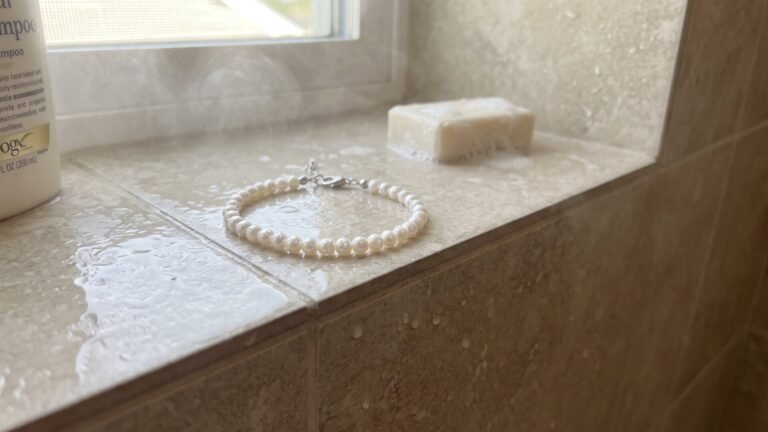
Occasional contact with clean water is not the same as safe daily showering. A splash is nothing. Repeated exposure to water, shampoo, conditioner, and body wash is a slow chemical and moisture assault on nacre, silk, and adhesive. If you want the stone-by-stone picture of water exposure across gemstones, the guide to showering with gemstone jewelry covers where pearls sit relative to other stones.
Avoid hard contact, too. Countertops, metal clasps, rough fabric, and other jewelry all scratch nacre. A pearl necklace worn against a diamond pendant will lose that fight. For more on how cosmetics and chemicals damage stones over time, see can gemstones be damaged by perfume, lotion, and hairspray.
Storage that prevents new damage
Store pearls separately, in a soft pouch or a lined compartment – not loose in a box with diamonds, metal chains, or hard gemstone jewelry. Separation is the whole point.
Two opposite storage mistakes are common. The first is an airtight plastic bag or a very dry environment for long periods; pearls are a biogenic material and are generally happier with some ambient moisture than in a desiccated safe. The second is a damp bathroom or humid storage, which affects thread, metal, and adhesives. Aim for a soft pouch in a normal, dry room.
Lay strands flat, or store them in a way that avoids sharp bends and tension. Do not hang a wet or weakened necklace, and do not hang a strand long-term in a way that puts the silk under constant load. If you want a complete system for separating and protecting a whole jewelry collection, how to store birthstone jewelry without scratching or damaging it covers the wider setup.
When cleaning is not the right solution
Some conditions call for a jeweler or pearl specialist rather than a cloth. The signs:
- Peeling or flaking nacre
- Deep scratches
- Cracks
- Severe yellowing
- Loose pearls
- Broken, stretched, or frayed thread
- Damaged clasps
- Pearls that have separated from their settings
Professional cleaning is not a way to reverse nacre loss. What a specialist can actually do is assess condition, restring a necklace, tighten a setting, replace a clasp, and tell you honestly whether restoration is realistic or whether the piece should be worn gently and left alone.
When you hand over a piece, ask what cleaning method will be used, and make sure the professional knows it contains pearls – especially if the item combines pearls with diamonds or other gemstones. A shop that runs everything through the ultrasonic by default needs to hear the word pearl out loud.
Choosing Pearl-Safe Cleaning and Care Products
You need less than the market wants to sell you. Four things cover almost every household:
- A dedicated soft pearl cloth – clean, lint-free, and used for nothing else
- A mild, unscented soap for occasional controlled cleaning
- A breathable soft pouch for storage
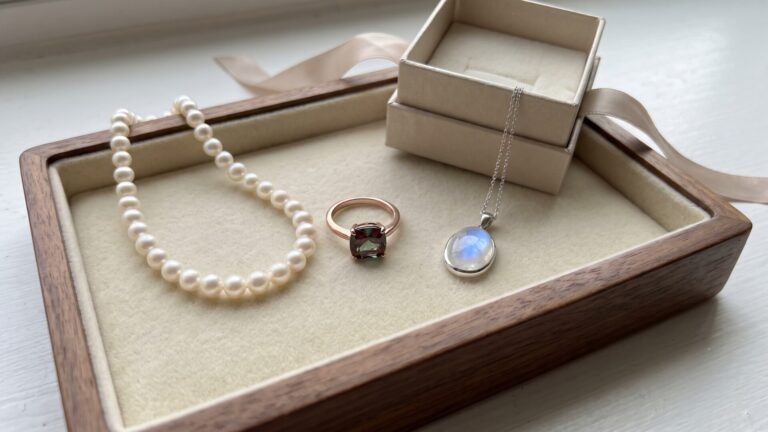
- A shallow lined jewelry tray to keep pieces separated
If you want a ready-made cleaner, commercial pearl products exist and some are genuinely fine – Hagerty makes a pearl cleaner, for example – but only use one if the current label specifically confirms pearl compatibility and the directions do not call for soaking or ultrasonic use. Otherwise, a soft cloth and mild soap will do the job with less risk. The chemical cleaner is convenience, not necessity.
Before buying any cleaner or cloth, run this checklist:
- Lint-free texture. Loose fibers trap grit against nacre.
- No polishing compound. Treated cloths are for metal.
- Dye-free or colorfast fabric. Dyes can transfer, especially when damp.
- Individually packaged storage. A pouch per piece prevents clasp-on-pearl contact.
- Verifiable ingredients and returns. If you cannot find out what is in it, do not put it on an heirloom.
Where I would spend money, in order: the cloth, the pouch, the tray, and then – far down the list – a commercial cleaner. [Affiliate: pearl-safe cleaning cloths and lined storage pouches] are the purchases that actually change outcomes.
The Long-Term Care Decision: Home Cleaning or Professional Service?
The framework is simpler than it looks.
- Clean at home when the pearls have light surface residue, intact nacre, secure settings, and no visible structural problems.
- Pause and inspect when the piece is vintage, inherited, unusually valuable, visibly worn, or strung on silk that has not been replaced in years.
- Use a professional when there is nacre damage, a loose setting, stretched thread, a broken clasp, or a need for restringing.
| Care option | Best for | Main benefit | Main risk | Buyer decision |
|---|---|---|---|---|
| Soft dry cloth | After every wear | Lowest-risk residue removal | Will not remove heavy buildup | Best default routine |
| Damp cloth with mild soap | Occasional light grime | More cleaning power without soaking | Excess moisture or harsh soap | Suitable for intact pieces |
| Pearl-safe commercial cleaner | Readers who want a ready-made product | Convenient directions | Formulas and instructions vary | Verify pearl compatibility |
| Professional jeweler or pearl specialist | Damage, heirlooms, restringing | Condition assessment and repair | Costs more than home care | Best for valuable or fragile pieces |
The hidden cost of choosing wrong is not the price of the cleaner. It is permanence. A cheap cleaner or a single long soak can reduce luster in a way that no later restoration recovers, and it makes a sentimental heirloom harder for the next generation to wear. The money you save on a $12 product is not the number that matters.
Frequently Asked Questions About Clean Pearl Jewelry Without Damaging It
Can I clean pearl jewelry with soap and water?
A small amount of mild soap on a lightly dampened cloth is appropriate for intact pearls. The jewelry should not be soaked, scrubbed, or left wet. If the cloth drips, it is too wet.
Can I wear pearl jewelry in the shower?
Regular showering is not recommended. Water, soap, shampoo, heat, and repeated moisture exposure all work against nacre, silk, and adhesives. A splash is fine. A daily habit is not.
Can I use a jewelry polishing cloth on pearls?
Many polishing cloths contain compounds intended for metal, and those compounds can scratch or dull nacre. Use a clean, soft cloth reserved for pearls instead.
How do I clean a pearl necklace without damaging the string?
Keep moisture low: a barely damp cloth, one pearl at a time, immediate patting dry, and flat drying. Never hang a wet strand. If the silk is stretched, frayed, stained, or loose, have the necklace professionally restrung.
Can yellowed pearls be restored at home?
Natural body-color variation and age are not the same as removable dirt. Yellowing, peeling, or surface deterioration should be assessed by a pearl specialist. Do not treat it with bleach or abrasives – both cause permanent damage.
Is an ultrasonic cleaner safe for pearl jewelry?
No. Vibration and moisture can damage pearls, loosen settings, and affect adhesives. Keep pearls out of ultrasonic cleaners entirely.
How often should pearl jewelry be professionally cleaned?
Frequency depends on wear, construction, and condition, not a universal calendar. Routine wiping matters more than scheduled cleaning. Professional inspection makes sense for heirlooms, frequently worn strands, and any piece showing structural wear.
The safest pearl-cleaning verdict
Wipe pearls after each wear. Use controlled low-moisture cleaning only when necessary. Keep chemicals, heat, and soaking away from them. Store them separately, flat, and dry. A dedicated soft cloth and careful storage will protect a piece better than any powerful cleaning machine or aggressive chemical kit.
The caveat is this: if the pearls are already damaged – flaking, cracked, deeply scratched, or strung on tired silk – home cleaning will not fix them, and more cleaning will make it worse. At that point the right purchase is not a product. It is an hour with a jeweler who knows pearls.
A strand bought today may be worn by someone not yet born. What you are preserving now is not just the surface. It is the luster, the stringing, and the wearability that let it be handed on at all.