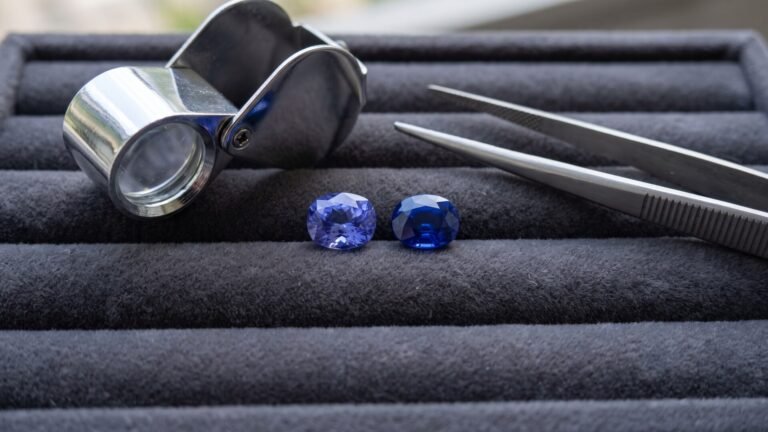
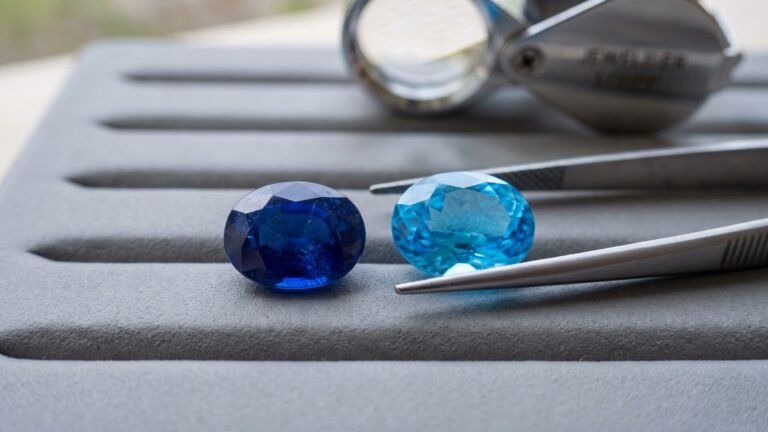
Blue Zircon vs Blue Topaz: Price, Brilliance and Durability
When a customer asked to see the blue zircon, I made the mistake of reaching for the cubic zirconia tray. She corrected me before I got there, and I have been grateful for that correction ever since, because blue zircon is one of the few stones in a jewelry store that genuinely earns the fuss made over it. It is also one of the most commonly confused.
Here is the practical answer. Blue zircon is the brighter, rarer stone, and it costs more. Blue topaz is the cheaper, more available one, sold in large sizes and dependable blue shades. Both make attractive jewelry. Neither is a sapphire, and neither should be sold to you as one. The decision comes down to what you are buying: brilliance and scarcity, or size and price.
The cautions matter as much as the verdict. Most blue topaz on the market is treated, and the seller should tell you so. Blue zircon has nothing to do with cubic zirconia, despite the name.
The Quick Verdict: Blue Zircon or Blue Topaz?
| Buying factor | Blue zircon | Blue topaz | Better choice |
|---|---|---|---|
| Typical price | Higher, especially for attractive natural material | Usually lower | Blue topaz for budget |
| Brilliance | High fire and strong brilliance | Good brilliance, usually less lively | Blue zircon |
| Color | Often blue-green to vivid blue; may vary | Often treated sky, Swiss, or London blue | Depends on preferred shade |
| Hardness | About 6 to 7.5 on the Mohs scale, with variation | 8 on the Mohs scale | Blue topaz for scratch resistance |
| Toughness | Can be vulnerable to impact and abrasion | Hard but can cleave if struck | Neither is risk-free |
| Rarity | Comparatively uncommon in fine blue material | Widely available | Blue zircon |
| Treatment | May be heat treated; disclosure matters | Most blue topaz is treated | Blue zircon generally has stronger rarity appeal |
| Best use | Pendants, earrings, special-occasion rings | Affordable everyday-style jewelry with care | Depends on setting and wear |
Two terms in that table do a lot of work, and buyers mix them up constantly. Hardness measures resistance to scratching. Toughness describes resistance to breaking or chipping. A stone can be hard and still fragile. Diamond is the hardest natural gemstone and will still split along a cleavage plane if you hit it right.
So the early recommendation splits three ways. If you want rarity and sparkle, blue zircon. If you want size and affordability, blue topaz. If you want a ring you never take off, neither stone is the careless answer, and I will explain why in the durability section.
Price moves a great deal with color quality, clarity, cut, treatment, origin claims, and how the piece is built. A $40 stone in a $400 setting is still a $440 purchase, and the setting is often the part that fails first.
What Blue Zircon and Blue Topaz Actually Are
Blue zircon
Zircon is a naturally occurring mineral, and a genuinely old one. Some zircon crystals are among the oldest material ever dated on Earth, which is a fact I mention only because it makes the name confusion worse: this is a real mineral, not a laboratory product.
Its optical properties are what sell it. Zircon has a high refractive index, meaning it bends light strongly, and strong dispersion, meaning it splits that light into flashes of color. Those two numbers together are why a good blue zircon looks alive in a way most blue stones do not. If you want the broader picture of how these optical measurements separate gemstones from one another, the full gemstone guide covers the fundamentals.
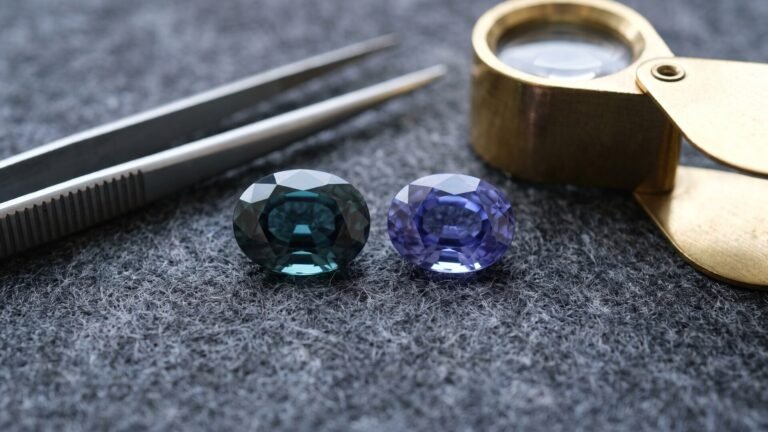
Blue zircon runs from pale blue to a strong blue-green, and the teal-leaning material is not a defect. It is the stone’s character. Color varies between individual stones more than it does in topaz, so buy the specific stone, not the name.
Heat treatment may be used to improve or create the blue color. That should be disclosed. It usually is, by anyone reputable.
Blue topaz
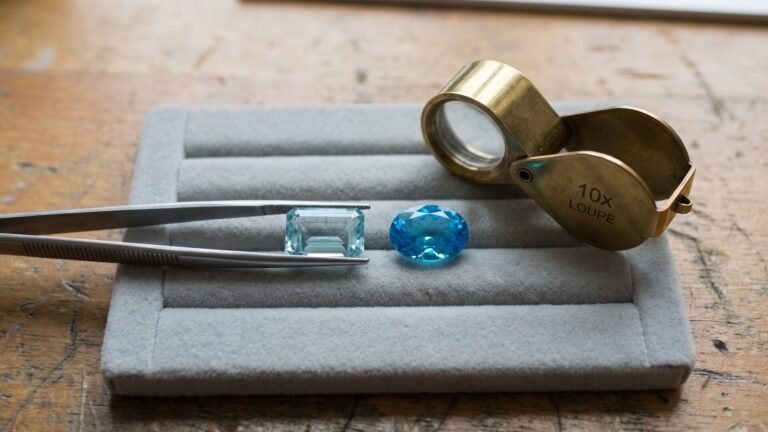
Topaz is also a natural mineral. The catch is that most blue topaz in jewelry did not start out blue. It began as colorless or lightly colored material and was treated to produce the color, typically through irradiation followed by heating. That is a normal, lawful, and extremely common process. It is also the single biggest reason blue topaz is cheap.
The trade names you will see, sky blue, Swiss blue, and London blue, are commercial color descriptions, not laboratory grades. No standards body enforces them. Sky is the palest, Swiss is a bright medium blue, London is the deepest and slightly gray-leaning. Two sellers can use "London blue" for stones that look noticeably different.
Treated blue topaz is not inferior. But the treatment history should be stated accurately, and the price should reflect the fact that this material is abundant. For a deeper look at the species, the topaz guide goes through varieties and treatments in more detail.
The name confusion buyers should avoid
Zircon and cubic zirconia are not related. Cubic zirconia is a laboratory-created diamond simulant, cheap to make, and sold by the carat for a few dollars. Zircon is a natural mineral with a completely different chemistry. The names are one letter apart and the stones are not in the same category of object.
If a listing leans on "brilliant like a diamond" to sell you blue zircon, read carefully. Zircon is brilliant. It is not a diamond substitute, and the seller who frames it that way is usually about to overcharge you.
Watch for two more phrases. "Rare blue topaz" with no explanation of what supposedly makes it rare. And "natural blue" with no statement about whether the color is natural or the material is natural but the color is not.
Blue Zircon vs Blue Topaz: Price and Value
| Stone and quality level | Approximate loose-stone price | Main price drivers | Value profile |
|---|---|---|---|
| Commercial blue topaz | Often around $10-$50 per carat | Color, cut, size, treatment, clarity | Affordable size and color |
| Fine blue topaz | Often around $50-$150 per carat | Saturation, cut, clarity, larger calibrated sizes | Good visual value, limited rarity |
| Commercial blue zircon | Often around $50-$150 per carat | Color, clarity, cut, treatment, origin | More distinctive than topaz |
| Fine blue zircon | Often around $150-$500 or more per carat | Vivid color, brilliance, clarity, size, provenance | Scarcity and appearance premium |
| Exceptional blue zircon | Can exceed typical ranges | Strong color, clean appearance, attractive cut, rarity | Collector-oriented purchase |
Those are broad estimates, not market prices. Loose-stone pricing moves with the parcel, the seller, and the day.
The reason for the gap is simple supply. Blue topaz is abundant, treatable in huge quantities, and available in large clean sizes, so a 10-carat stone is unremarkable. Attractive blue zircon is not abundant. Fine blue material in large, clean, well-cut stones is genuinely uncommon, and the price reflects that. If you want to understand how zircon’s value factors work beyond the blue variety, the zircon guide lays them out.
Do not confuse loose-stone value with finished-jewelry price. Metal, craftsmanship, brand markup, setting quality, and retail margin can easily exceed the difference between the two stones. A blue topaz ring in 18-karat gold with hand-set melee can cost more than a plain blue zircon solitaire. You are buying a piece of jewelry, not a carat weight.
A budget framework that holds up in practice:
- Under $150. Blue topaz earrings, pendants, or modest rings are the sensible buy. You get visible color and size.
- Around $150-$500. Fine blue zircon accents or better-cut blue topaz jewelry come into range. Spend the money on cut, not carat.
- Above $500. Prioritize documented stone quality, written treatment disclosure, craftsmanship, and independent verification. Do not simply buy a bigger stone.
Blue zircon has stronger rarity appeal, and I will say plainly that this is not the same as investment value. Most commercial gemstones have thin resale liquidity. A dealer will buy your stone back at wholesale, if at all.
Brilliance, Color, and Visual Appeal
Why blue zircon often looks more lively
Brilliance is the amount of white light a stone returns to your eye. Dispersion, or fire, is the flashes of spectral color that come off the facets. Zircon scores well on both, and a well-proportioned cut with clean material turns that into a stone that looks lit from inside.
The trade-off is real. High brilliance is unforgiving. Inclusions, a window (a see-through area in the middle of the stone where light leaks out instead of reflecting back), and sloppy facet symmetry all show more clearly in a bright stone. A dull stone hides its faults. A lively one does not.
This is why blue zircon appeals to a particular buyer: someone who wants a gemstone that looks energetic rather than merely blue. If sparkle is what pulled you toward zircon in the first place, the comparison with diamond is the honest next read, because diamond is the benchmark those buyers usually have in mind.
Why blue topaz remains visually effective
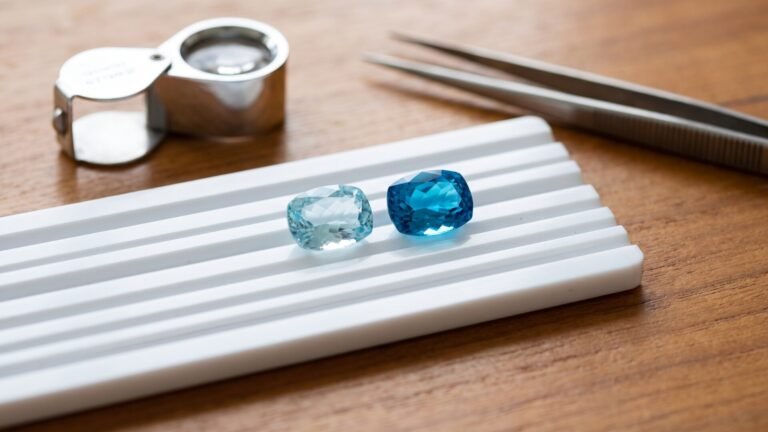
Topaz does not have zircon’s fire, but it has something else: consistency. The material is usually clean, the color is even, and the stones come large. A 9 by 7 millimeter oval in London blue looks like a serious piece of jewelry, and it costs a fraction of what a comparable zircon would.
The three commercial shades read very differently in person. Sky blue is soft and reads almost pale in daylight. Swiss blue is the crowd-pleaser, bright without going dark. London blue is the most sophisticated and the one most likely to look grayish in poor indoor light. None of these names is standardized, so judge the stone, not the label.
A well-cut blue topaz will beat a badly cut blue zircon every time. I have seen plenty of both.
Color and cut decision framework
Judge in this order: cut quality, transparency, symmetry, face-up appearance, then color name. A color label on a badly cut stone is marketing.
Warning signs, in plain terms:
- A gray or overly dark center that goes black under indoor light.
- A visible window you can read through.
- Uneven color, patchy saturation, or a stone that looks lifeless away from the display lamp.
- Excessive extinction, the dark areas where a stone returns no light at all.
Blue zircon’s blue-green or teal character is more individual. Blue topaz gives you more predictable blue. Neither is better; they are different purchases.
The viewing test that actually works: ask to see the stone under daylight, under ordinary indoor lighting, and in indirect light. Listing photographs are lit and edited to sell. A stone that only looks good under a jeweler’s lamp will look like a different stone in your kitchen.
Durability: Which Stone Is Safer to Wear?
Hardness is only one part of durability
The Mohs scale ranks minerals by relative scratch resistance, from talc at 1 to diamond at 10. It is a ranking, not a linear measurement, and it says nothing about whether a stone will survive being dropped on tile.
Blue topaz sits at about 8, which is genuinely good. It resists the everyday scuffs that dull softer stones. Zircon is commonly described around 6 to 7.5, and that variation is not sloppiness in the reference books. Zircon’s hardness differs depending on which direction you test it, a property called directional hardness, and heavily metamict material can be softer still. Practically, zircon is meaningfully softer than topaz and its facet edges will abrade over years of wear.
Hardness does not make topaz safe. More on that below.
Toughness, cleavage, and setting risk
Topaz has perfect cleavage, meaning it splits along a plane of structural weakness. A sharp blow at the wrong angle can take a chunk out of a stone that will happily resist years of scratching. This is the fact most blue topaz listings leave out. Hard and brittle is a real combination.
Zircon does not cleave the same way, but it chips and abrades. Facet junctions, the culet (the point at the bottom of the stone), and exposed corners are where damage starts. An abraded facet edge shows as a white line, and it cannot be polished out without recutting the stone.
For either stone, choose a protective setting. Rounded or mixed cuts with no sharp corners. Secure prongs, checked annually. A bezel setting, where metal wraps the girdle, protects more than talons do.
Pendants and earrings are safer than rings for both stones, because they take fewer impacts and less surface abrasion. That is not a marketing line. It is the reason so much vintage zircon jewelry survives in pendants and so little of it survives in rings.
Best jewelry applications
| Jewelry type | Blue zircon | Blue topaz | Practical recommendation |
|---|---|---|---|
| Pendant | Excellent | Excellent | Safe application for both |
| Earrings | Excellent | Excellent | Strong choice for either |
| Occasional ring | Suitable with protective setting | Suitable with protective setting | Remove during impact-heavy activities |
| Daily ring | Higher care requirement | Still requires caution because of cleavage | Choose only with robust setting and realistic habits |
| Bracelet | Riskier due to knocks | Riskier due to knocks | Usually not the first choice |
The buy-this-if framework:
- Buy blue zircon if the wearer values rarity and will actually protect the piece.
- Buy blue topaz if you want an affordable large blue stone and understand the treatment.
- Avoid either for rough daily wear if the wearer will not remove jewelry for exercise, manual work, or household tasks. Be honest about this. Most people say they will remove it and then do not.
Treatments, Disclosure, and Buying Protection
Treatment expectations
Most commercial blue topaz is treated. That is the central fact of its price and availability, and any seller who glosses over it is either uninformed or hoping you are.
Blue zircon may also be heat treated, particularly when heating improves or produces the blue color. Treatment does not make a gemstone worthless. Undisclosed treatment, or inflated "untreated" language attached to a stone that was treated, is the serious warning sign.
Ask the seller, in writing, whether the color is natural, treated, or unknown. A good seller answers without flinching.
What documentation should show
For a higher-value blue zircon, where origin, treatment, or natural color materially affects the price, get an independent report from a respected gemological laboratory. GIA is the name most buyers know, and its colored-stone reports identify the species and state treatment findings. Other reputable laboratories exist, and your seller should be able to tell you which one they used.
Understand what a jewelry appraisal is not. An appraisal estimates value for insurance purposes. It is not an identification and treatment report. Plenty of buyers discover this only when they try to sell.
The report or documentation should give you the species or variety, treatment disclosure, weight, measurements, and any stated origin. Origin claims in particular need laboratory support. A story about a mine is not documentation.
Marketing claims that deserve skepticism
- "Rare blue topaz" with no explanation of what makes it rare. Usually nothing does.
- "Investment-grade" blue zircon with no provenance, no laboratory report, and no evidence anyone wants to buy it from you.
- "Natural untreated blue" when the seller has not specified whether the color is natural.
- Photographs with heavy saturation, blue lighting, or aggressive editing. If the background looks blue-tinted, the stone probably is too.
What Most Buyers Get Wrong
Assuming higher hardness means total safety. Blue topaz is harder than blue zircon and can still be split by a sharp impact. Hardness protects against scratches, not against gravity and tile floors.
Treating all blue gemstones as interchangeable. Blue zircon, blue topaz, aquamarine, and sapphire differ substantially in rarity, treatment, durability, and market value. They are not versions of each other at different prices.
Buying by carat weight alone. A deep stone faces up smaller than its weight suggests. A shallow stone looks large and shows a window with washed-out color. Face-up size and cut quality matter more than the number on the tag.
Assuming treated means fake. Treatment is normal in this market. The real issues are honest disclosure and a price that reflects what you are actually getting.
Confusing retail price with investment value. Blue zircon’s scarcity does not guarantee easy resale. Inexpensive blue topaz is a beauty purchase, full stop.
Ignoring the setting. The same stone is reasonably wearable in a pendant and poorly protected in an exposed ring. The setting is half the durability story and buyers rarely ask about it.
Which Stone Still Makes Sense in Three Years?
Choose blue zircon when long-term satisfaction depends on individuality
Blue zircon suits the buyer who wants a less predictable blue, stronger brilliance, and a stone with genuine natural-gemstone rarity. Its appeal is more likely to come from owning something distinctive than from resale growth. Plan for a protective setting and a jewelry form that limits impact. Keep the treatment documentation and purchase details with the piece, so a future owner or appraiser knows what they have.
Choose blue topaz when practical value matters most
Blue topaz suits the buyer who wants a large, attractive blue gemstone at a modest price. Its strongest advantage is visual scale and affordability, not scarcity. It works best in earrings, pendants, and occasional rings where the wearer understands cleavage risk. Treated blue topaz is an honest and sensible purchase when it is priced and described accurately. If color and affordability are your priorities and you are still weighing options, the aquamarine comparison covers another blue stone in the same budget territory.
Consider a different stone when the brief is daily-wear security
If you need maximum daily-wear durability and strong resale recognition, compare both of these with sapphire. Corundum at Mohs 9 with no cleavage is a different category of object, and it is priced accordingly. the sapphire comparison is where that conversation belongs, because topaz is not a sapphire equivalent and should not be framed as one.
Choosing zircon or topaz because it costs less is sensible. Believing you are getting sapphire durability for less money is how buyers end up disappointed in year four.
How to Buy the Better Stone
Start with use. A pendant or earrings give you freedom. A ring demands stricter attention to setting, wear habits, and maintenance.
Look at the loose stone, or a clear video, before you judge color. Check cut, transparency, windowing, facet symmetry, and visible damage first. Color is the last thing to assess, because a beautiful color on a badly cut stone is a waste of money.
Confirm treatment in writing. "Enhanced" on its own means nothing. Ask what was done.
Compare finished jewelry on stone quality, metal, setting protection, return policy, warranty, and independent documentation. Not on carat weight alone.
Prefer sellers who provide clear photographs, written treatment disclosure, a real return period, and care instructions that acknowledge the stone’s limits. A seller who tells you a blue topaz ring is fine for everyday wear with no caveats is telling you something about themselves.
For an heirloom purchase, keep the receipt, the laboratory report, the treatment information, and the appraisal separately from the jewelry. In thirty years, the paperwork is what tells your granddaughter what she is holding.
Frequently Asked Questions About Blue Zircon Vs Blue Topaz
Is blue zircon more expensive than blue topaz?
Usually, yes. Attractive blue zircon is less common and its brilliance adds demand, so it typically runs several times the per-carat price of commercial blue topaz. Blue topaz is widely available in large sizes, so it generally gives you more visible stone for the money.
Which is rarer, blue zircon or blue topaz?
Blue zircon is generally the rarer material, especially in attractive blue colors and larger clean stones. Most blue topaz is abundant in the jewelry market and commonly treated to produce its color.
Is blue zircon more brilliant than blue topaz?
Usually. Zircon’s refractive index and dispersion produce stronger brilliance and more visible fire. Cut quality still decides the outcome, and a well-cut blue topaz can look better than a poorly cut zircon.
Is blue topaz durable enough for an engagement ring?
It can be used in a ring, but it is not damage-proof. Its hardness resists scratching, while its cleavage means a sharp impact can cause serious damage. A protective setting and realistic wear habits are essential.
Is blue zircon safe for everyday wear?
Blue zircon is better suited to earrings, pendants, or occasional rings than to rough daily wear. Its lower and variable hardness makes it more vulnerable to abrasion, and exposed settings increase the risk of chipping.
Is treated blue topaz worth buying?
Yes, when the treatment is disclosed and the price reflects the stone’s availability. Treatment is a normal part of the blue topaz trade. Undisclosed or misleading treatment claims are the concern, not the treatment itself.
Which is a better investment, blue zircon or blue topaz?
Neither should be bought primarily as an investment. Blue zircon has stronger rarity appeal, but resale can still be difficult and dealers buy at wholesale. Blue topaz is a beauty purchase with limited investment potential.
Can I wear blue topaz in a bracelet?
You can, but a bracelet takes more knocks than any other jewelry form. Given topaz’s cleavage, a bracelet is usually not the first choice for either stone.
Final Recommendation
The customer who corrected me that day bought the blue zircon. A small pendant, modest setting, nothing flashy. She wore it for years and told me once that people asked about it constantly, because it did not look like anything else in the case.
That is the whole case for blue zircon. Not investment, not status. Individuality, brilliance, and a real mineral with real rarity behind it. Buy it for a pendant or a pair of earrings, protect it, and keep the paperwork.
Blue topaz earns its place differently. It puts a large, clean, saturated blue stone on a buyer’s neck for the price of a dinner out, and there is nothing dishonest about that as long as the treatment is disclosed and the price reflects it. For most first-time buyers, that is the right purchase.
Either way, the stone you choose today will likely outlive the reason you bought it. Someone not yet born may wear it to a graduation or a wedding, and they will not care what it cost. They will care that it was chosen with some care, described honestly, and kept safe. Buy the well-cut stone with the clear disclosure. That is the one worth handing on.