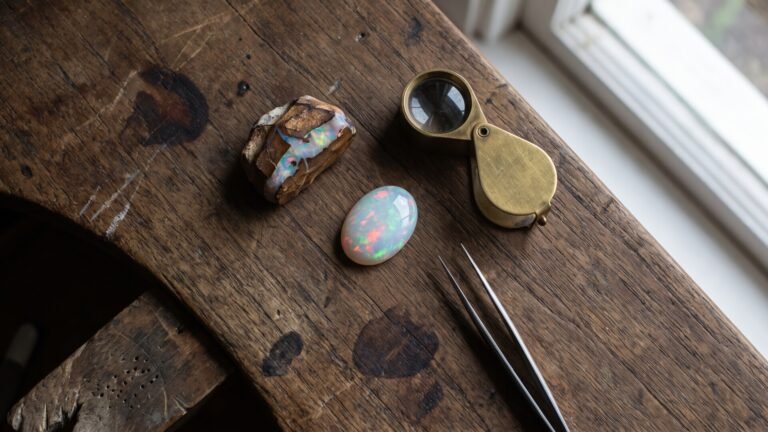
How to Clean Opal Jewelry Without Causing Damage
If you own an opal and you are about to clean it, stop and identify what you actually have first. The default advice you will find online – a soft cloth, mild soap, lukewarm water – is written for durable stones and it is not safe for every opal. Some opals will shrug it off. Others will absorb the water, cloud over, or separate at a glued seam, and you will not know which one you own until it has already happened.
The word "opal" covers a solid Australian stone, a porous Ethiopian opal, and an assembled doublet or triplet, and those three tolerate moisture very differently. So the rule that actually protects you is this: until you know the construction and treatment, keep the piece dry. A soft microfiber cloth, no water, no soap. That is the whole answer for a lot of readers, and I will show you how to work out whether you can safely go further.
The safest way to clean opal jewelry at home
For a sound solid opal, the default routine is short and repeatable. Inspect the piece in good light first. Lift loose dust with a dry microfiber cloth. If a smudge remains, wipe gently with a barely damp cloth – barely, as in wrung out until it feels almost dry – then dry immediately with a separate lint-free cloth.
Pressure is the thing to watch. Opal measures around 5.5 to 6.5 on the Mohs scale, where hardness is resistance to scratching; that is soft enough to scratch, chip, or fracture under a fingernail or a ring worn next to it. A damp cloth cleans the surface without pushing liquid into settings, seams, or porous areas, and without the abrasion a brush or polish would add.
On supplies, plain is better:
- Clean microfiber or another non-abrasive lint-free cloth. Two of them, one for damp work and one for drying.
- Lukewarm water. Not hot, not cold.
- A very small amount of mild, unscented soap, only when a dry or damp wipe has not worked, and only on an opal you know is solid and sound.
Skip paper towels, which leave lint and can carry grit; skip rough polishing cloths; skip old toothbrushes; skip any abrasive paste. If you want the general principles behind at-home gemstone cleaning, how to clean gemstone jewelry at home covers them – just read this article’s opal-specific restrictions on top of that, because opal is stricter than most.
One stop rule governs everything below. If the opal looks cloudy, develops a visible line, changes color, loosens in its setting, or shows a seam you had not noticed, stop cleaning and take it to a qualified jeweler. Cleaning cannot undo those, and continuing can make them worse.
What changes depending on the type of opal
The cleaning rule follows construction and porosity far more than color or price. This is where most generic advice falls apart, so it is worth knowing which of these you own.
Solid Australian opal
A solid opal is a single piece of opal material – no backing, no cap, no glue line. That makes it the most straightforward to care for. It does not make it waterproof, and it does not make it immune to cracking.
Black, white, crystal, and boulder opals look very different and are valued very differently, but the cleaning method is governed by the setting, the condition, and any treatment, not by the body color. A solid stone gets brief surface wiping, not soaking.
The specific risk with solids is thermal. Sudden temperature change can contribute to cracking, and to crazing – a network of fine internal fractures that can appear across the stone. Do not move an opal from a cold car into hot water, and do not put it near a heater to dry.
Ethiopian opal
Many Ethiopian opals are more porous than typical Australian material, and they can absorb water, oils, and soap. Absorption can temporarily change how the stone looks, and it can complicate drying and the stability of any treatment. Some of these stones are hydrophane, meaning they can take on water and change transparency as a result – a striking property that is also a warning about cleaning.
Clean dry first. Use a very lightly damp cloth only when the seller or a qualified jeweler has confirmed it is appropriate for that specific stone. Strong play-of-color – the flashing spectral display that makes opal desirable – tells you nothing about durability or water resistance. A brilliant Ethiopian opal can be one of the thirstiest stones in the case.
For more on how these two origins differ in practice, Ethiopian versus Australian opal is worth reading before you buy another piece.
Doublets, triplets, and assembled opals
A doublet is a thin layer of opal glued to a backing. A triplet is an opal layer with a protective cap bonded on top, usually quartz or glass. Both are assembled, and the joins and edges are where they fail.
Liquid can enter around the layers and cause separation, cloudiness, or a permanent change in appearance. These pieces should not be soaked and should not be held under running water. Dry wiping is the safest default. If you can see an edge, a seam, a lifting layer, or a cloudy patch, have a jeweler look at it before you touch it again.
If you are not sure which category your stone falls into, the broader guide to opal meaning, properties, and value explains the varieties and how they are described in the trade. That context makes the construction question easier to ask.
What most owners get wrong when cleaning opals
The single most common mistake is assuming mild dish soap is automatically safe. It is mild for your hands. That says nothing about a glued seam or a porous stone. Even a gentle cleaner causes problems when liquid gets into a doublet, sits around a setting, or soaks into an opal that absorbs it.
The old toothbrush is the next one. Bristles and the grit they trap can scratch an opal’s surface, catch on a weak seam, and – with any brushing pressure – loosen a stone in its setting. I have seen a "quick clean" turn into a re-setting job more than once.
Then there is cloudiness. Owners see a cloudy opal and reach for something stronger, assuming it is surface dirt. Cloudiness can come from absorbed moisture, surface residue, a change in a treatment, or structural damage, and polishing cannot safely fix all of those. Some of them get worse with polishing. Treat cloudiness as a symptom to diagnose, not a stain to scrub.
Finally, "natural" and "chemical-free" do not mean harmless. Vinegar, lemon juice, baking soda, essential oils, and homemade pastes can be acidic, abrasive, or hard to remove from behind a stone. A lemon-juice soak is a bad idea for reasons that have nothing to do with whether it is natural.
Cleaning methods and products to avoid
| Cleaning method or product | Why it is risky for opal | Especially risky for | Safer alternative |
|---|---|---|---|
| Ultrasonic cleaner | Vibration can worsen fractures, loosen settings, or separate assembled layers | Doublets, triplets, cracked or treated opals | Gentle surface wiping |
| Steam cleaner | Heat and pressure stress the stone and setting | All opals, especially damaged pieces | Room-temperature cloth cleaning |
| Soaking in water | Liquid enters porous material, seams, or settings | Ethiopian opal and assembled opals | Barely damp cloth |
| Abrasive polish or powder | Scratches the surface and alters the finish | Any opal | Clean microfiber cloth |
| Bleach, ammonia, acids, strong jewelry cleaner | May attack treatments, adhesives, metal, or porous areas | Treated and assembled opals | Mild soap only if appropriate, removed at once |
Ultrasonic and steam cleaning are no-go methods for opal jewelry, full stop – even when a retailer markets the machine as suitable for "fine jewelry." Fine jewelry is a marketing category, not a gemological one. It includes emerald, pearl, opal, and tanzanite alongside sapphire, and those stones do not share a cleaning method.
Commercial jewelry cleaners deserve their own warning. A dip or solution may be perfectly safe for the metal in your ring and unsafe for the stone mounted in it. The label tells you about the metal. It does not establish opal safety. If you want to understand which stones genuinely tolerate ultrasonic cleaning and why opal does not, which gemstones are safe to clean with an ultrasonic cleaner lays out the reasoning.
How to clean different opal jewelry types
The stone is the same; the exposure is not. A ring and a pendant live very different lives, and the cleaning routine should reflect that.
Opal rings
Rings collect lotion, soap, and grit faster than anything else, and they take more impacts and more repeated wetting. That combination is the problem. The stone that needs the most cleaning is also the one most exposed to the things that damage it.
Take the ring off before bathing, swimming, cleaning, gardening, and any activity that brings grit or chemicals. When you do clean it, check under the setting by eye – do not force cloth into gaps or reach for a tool. Buildup beneath a stone, or a setting that has started to lift, is a jeweler’s job, not a home one.
Opal earrings and pendants
These see less abrasion than rings, but hooks, bails, and prongs trap residue. Wipe the opal and the metal separately, then dry every join and attachment point before the piece goes back in storage. Moisture sitting in a bail is moisture sitting against your stone.
Pendants worn against the skin pick up cosmetics, perfume, sunscreen, and body oils, so they may need gentle wiping more often. More often means more frequent light wiping, not stronger cleaning. That distinction is the whole game with opal.
Opal bracelets and watches
Bracelets meet sweat, hand lotion, and constant movement, and opal components need wiping after wear. Keep them out of prolonged moisture.
Do not drop an opal bracelet into a cleaning bath with other pieces. Contact between jewelry in a bath causes scratches, and any agitation can loosen components. While you wipe, inspect the elastic, the clasp, and the settings – a failing mount is a bigger loss risk than a smudge, and it is the thing owners never check.
How to prevent damage after cleaning
Prevention beats repeated cleaning, every time. Put opal jewelry on after cosmetics and fragrance have dried, and take it off before water exposure, household chores, sports, and sleep.
Temperature is the risk owners underestimate. Do not move an opal straight from very cold conditions into intense heat, hot water, a sauna, or a heated cleaning device. Thermal shock is one of the few ways to crack a perfectly good solid stone at home. protecting gemstone jewelry from heat and temperature changes goes deeper on that.
Store each piece individually in a soft fabric pouch or a separated compartment, so opal never rubs against harder gemstones – a diamond or sapphire neighbor will win that contest every time. how to store birthstone jewelry without scratching or damaging it covers the practical setup.
And watch the residue cycle. Lotion, perfume, hairspray, and cleaning chemicals build up on the surface, which makes owners clean more aggressively, which is where the damage happens. whether gemstones can be damaged by perfume, lotion, and hairspray explains which exposures matter. The fix is to reduce the exposure, not to scrub harder afterward.
When home cleaning is not enough
Some signs mean stop and hand the piece to someone qualified:
- Visible crazing or a new crack
- Lifting on a doublet or triplet
- Persistent cloudiness
- A loose stone
- Missing material
- Any sudden change after water exposure
A jeweler or gemologist should identify whether the piece is solid, assembled, treated, or porous before recommending soaking, polishing, repair, or refinishing. If your opal already shows crazing, the safest way to clean an opal birthstone ring with crazing risk deals with that specific situation, because a crazed stone needs a different level of caution again.
When you buy an unfamiliar opal – especially an Ethiopian stone, or one with a suspiciously uniform appearance – ask for treatment and construction disclosure in writing. A seller who cannot or will not tell you whether a stone is a doublet is telling you something.
One last distinction: professional cleaning is not automatically ultrasonic cleaning. Ask exactly what method will be used. If repair is needed, ask whether the opal will be removed from its setting first, because that changes the risk to the stone.
A practical opal-cleaning decision framework
Run your piece through this before you pick up a cloth.
- Known solid opal, sound setting, light surface dirt: dry microfiber cloth, then minimal damp wiping if needed.
- Ethiopian opal, unknown porosity, or visible treatment: keep it mostly dry and ask a jeweler before using water at all.
- Doublet, triplet, visible seam, or loose setting: do not soak, brush, steam, or ultrasonically clean. Get professional advice.
- Cracks, crazing, cloudiness, or color change: stop cleaning and arrange an inspection.
The "clean now or leave alone" rule follows from that. A small amount of surface dust is less dangerous than aggressive cleaning done without knowing the stone’s construction. If in doubt, leave it.
The long-term tradeoff is the one worth internalizing. The best care routine for opal is usually less frequent cleaning, more careful wearing, and early repair – not heroic efforts to restore a stone after moisture or impact has already done its work. For most owners, a soft dry cloth and cautious spot wiping are the safest choices. Assembled, porous, damaged, or unidentified opals deserve professional handling, and no cloth at home substitutes for it.
Frequently Asked Questions About Cleaning Opal Jewelry Without Causing Damage
Can I clean opal jewelry with soap and water?
Usually, use only a very small amount of mild soap on a barely damp cloth, not a soaking bath. Avoid this method for unknown, porous, doublet, triplet, cracked, or treated opals unless a qualified jeweler confirms it is suitable.
Can I wear an opal ring while washing my hands?
Occasional handwashing is less concerning than bathing, swimming, or prolonged soaking, but repeated exposure can still affect assembled or porous opals and trap residue around the setting. Removing the ring when practical is the safer habit.
Can I use an ultrasonic cleaner on an opal ring?
No. Ultrasonic vibration can worsen fractures, loosen the setting, or separate a doublet or triplet. A professional should use an opal-appropriate cleaning method instead.
Why did my opal turn cloudy after getting wet?
Water or another liquid may have entered a porous opal, a seam, or an assembled layer. Cloudiness can have several causes, so do not heat, polish, or scrub the stone in an attempt to correct it. Let a professional assess it.
How can I tell whether my opal is a doublet or triplet?
A side view may reveal a backing, a thin opal layer, or a cap, but visual inspection is not always conclusive. A jeweler or gemologist can identify the construction without risking damage.
How often should I clean opal jewelry?
Clean only when surface residue is visible, using the gentlest method that works. Wiping after wear and preventing contact with cosmetics and chemicals is safer than frequent deep cleaning.
Can a jeweler polish a scratched opal?
Sometimes, but polishing removes material and may not be suitable for a thin assembled stone, a damaged opal, or a piece with important surface features. The jeweler should identify the opal and assess its condition before recommending repair.
The safest opal-cleaning habit
Clean opal jewelry gently, on the surface, and keep it away from soaking, heat, chemicals, steam, and ultrasonic vibration. Treat any unknown or assembled opal as especially vulnerable until someone qualified tells you otherwise.
The reason to be this careful is not the smudge you are trying to remove today. It is the piece itself. An opal bought now may be worn by someone not yet born, and the setting and construction you protect this year are what make that possible. A slightly brighter surface is worth very little next to a stone that is still intact in forty years.
If you are still working out what you own before you clean it, the next question is usually about the stone itself – which variety you have, how it was treated, and what it is worth. That is covered properly in the full guide to opal meaning, properties, and value, and it is the right place to go before you buy or clean another piece.