Almandine vs Pyrope Garnet: Color, Composition and Value
I spent a season selling a stone I should not have sold, and the customer taught me the lesson.
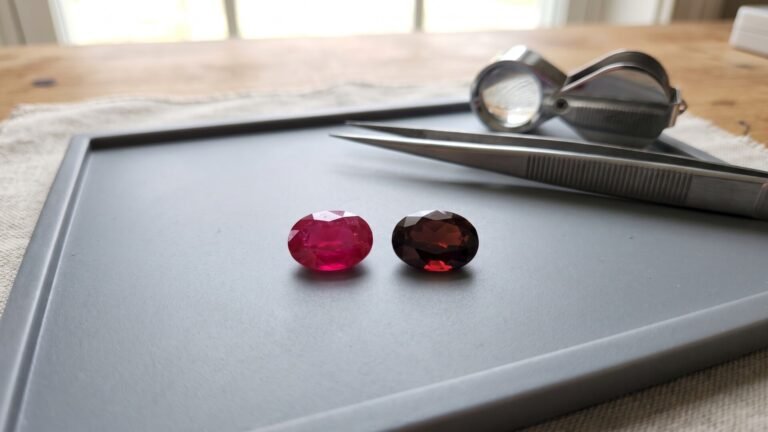
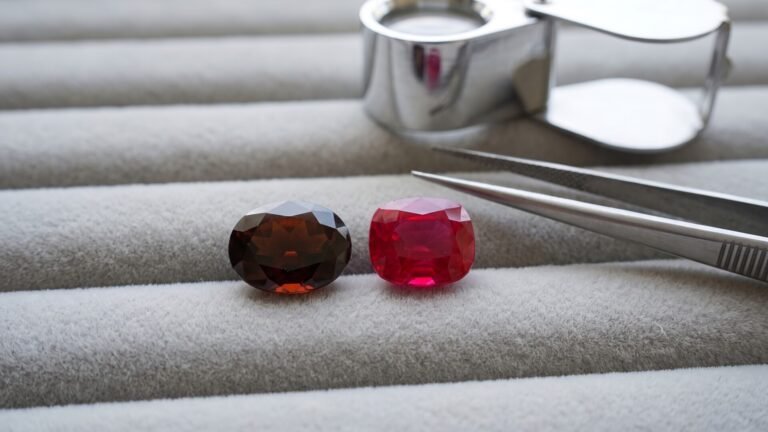
She wanted a garnet pendant for her mother’s birthday. Deep red, January, the usual. I showed her two stones in the case. One was a rich, dark wine color, almost opaque in the middle, priced modestly. The other was brighter, a cleaner red, and cost about twice as much. She picked the dark one. It looked richer, she said. More like a real garnet.
Two weeks later she came back. Indoors, in her mother’s kitchen, the stone had gone nearly black. Not burgundy. Black. She had paid for a gemstone and gotten a pebble that only came alive under my store lights. I gave her the exchange, but the lesson stuck: the stone that looks like the most garnet is not always the better garnet, and the trade knows it.
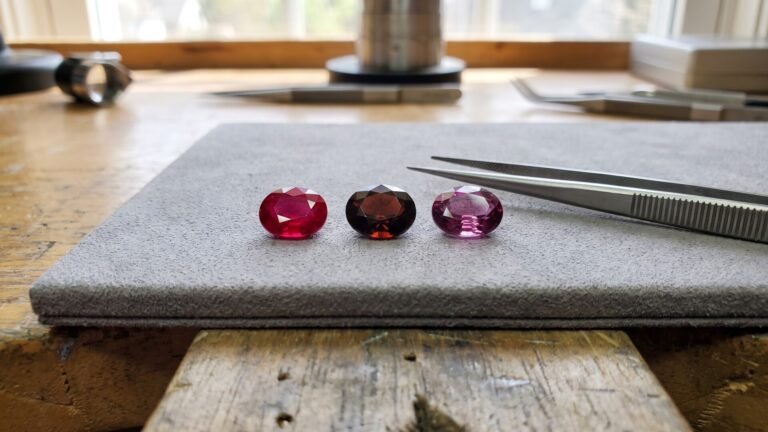
That dark stone was almost certainly almandine. The bright one was closer to pyrope. The names matter less than what they do on the hand.
The Short Verdict: Which Garnet Is Better?
Almandine is the iron-rich garnet. It is common, affordable, and tends toward deep wine, burgundy, or brownish-red. Pyrope is the magnesium-rich garnet. It is less common as fine gem material, tends toward brighter red, and can cost more when the color and clarity are strong.
Neither is "better" in the abstract. The question is what you are buying it for. If you want a large, dramatic, dark red stone at a controlled budget, almandine is the sensible choice. If you want a bright, lively red and will pay for it, look for pyrope. If you want the best balance of both, look for a well-cut mixed garnet and do not worry what the seller calls it.
Here is the decision at a glance:
| Factor | Almandine garnet | Pyrope garnet | Best choice for |
|---|---|---|---|
| Typical color | Deep red, reddish-purple, wine, or brownish-red | Vivid red, purplish-red, or orangey-red | Almandine for darker tones; pyrope for clean bright red |
| Composition | Iron-rich garnet end member | Magnesium-rich garnet end member | Readers interested in mineral identity |
| Typical availability | Generally more common | Less common as a pure, attractive gem variety | Budget-conscious buyers may prefer almandine |
| Typical price | Often lower to moderate | Moderate, higher for fine color and clarity | Almandine for value; pyrope for color |
| Jewelry use | Rings, pendants, earrings with reasonable care | Similar uses, especially when well cut and protected | Both, depending on setting and wear |
| Main drawback | Can look too dark in small or poorly cut stones | Fine bright material is harder to find and costs more | Depends on whether darkness or availability is the concern |
The verdict by buyer type is straightforward. Choose almandine for a dramatic, wine-red garnet at an accessible price. Choose pyrope for a purer, livelier red when brightness matters more than budget. Do not pay a premium for a variety label without inspecting the actual stone.
One more thing before the details. Most commercial garnets are not pure end members. They are mixtures, and a laboratory may describe them as a species series or a blend rather than a simple category. The seller’s label is a starting point, not a verdict. If you want the broader context on what garnet is and how it is used, start with the full garnet guide.
What Almandine and Pyrope Are Made Of
Almandine: the iron-rich end member
Almandine is the iron-rich garnet end member, usually written as iron aluminum silicate. That iron is what gives it the deep, saturated red that most people picture when they hear the word garnet. It is also what makes it dark. Push the iron content and the stone can tip from wine red into near-black.
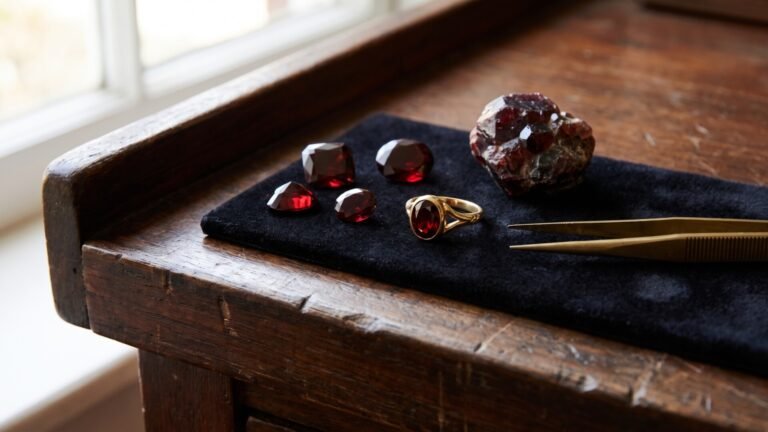
Common does not mean inferior. Some of the most beautiful antique garnet jewelry in museum collections is almandine, and a large, well-cut almandine can be genuinely handsome. The problem is not the species. The problem is excessive darkness, especially in small stones or stones cut too deep, where the color overwhelms the light return and the stone goes flat.
Pyrope: the magnesium-rich end member
Pyrope is the magnesium-rich end member, usually written as magnesium aluminum silicate. Its chemistry tends toward cleaner, brighter red and purplish-red, though the actual appearance depends on trace elements, clarity, cut, and how much almandine is mixed in.
Here is where buyers get tripped up. A stone sold as "pyrope" may contain substantial almandine or other garnet components. Pure pyrope is relatively rare in the gem trade. Much of what is marketed as pyrope is a blend, and the name is used loosely. Composition matters to a gemologist identifying the stone. It should not replace your eyes when the purchase is primarily aesthetic.
Why real garnets are often mixtures
Garnet varieties blend chemically. The mineral group forms what geologists call a solid solution, meaning the different end members can mix in varying proportions, producing stones that sit between the classic categories. This is not a defect. It is the norm.
The best-known example is rhodolite, a trade name for purplish-red garnet with a composition between almandine and pyrope. Rhodolite is not a separate mineral species. It is a convenient label for a color and a composition range, and it is often the most attractive red garnet in the case.
A seller’s informal variety name is not the same as a laboratory identification or a universally enforced trade grade. Ask what the stone actually is. Ask about treatments. For an unusually expensive, rare, or origin-sensitive stone, ask for an independent report.
Color, Brilliance and Appearance: What You Actually See
Color names are not guarantees. Almandine tends toward deep red, burgundy, reddish-purple, and brownish-red. Pyrope tends toward vivid red, purplish-red, and sometimes warmer red tones. Mixed almandine-pyrope material may show the raspberry, cranberry, or wine-red appearance often associated with rhodolite. If you want to see how these fit alongside the other garnet colors, the garnet color types guide maps the whole range.
The most common disappointment is the too-dark stone. A garnet can look spectacular under bright jewelry-store lighting and then go nearly black in a dim room. This is not a trick, exactly, but it is a predictable outcome of deep tone combined with the wrong lighting. The stone did not change. It was always that dark. You just could not see it.
Cut matters as much as species. A deep pavilion, the underside of the stone, can intensify darkness by trapping light instead of returning it. Windowing is the opposite problem: light passes straight through the center of the stone instead of reflecting back to your eye, and the middle looks washed out or glassy. Symmetry and facet arrangement influence brilliance more than the variety name does.
Judge a red garnet with a simple routine:
- View it under daylight, diffused indoor light, and a single-point light source.
- Compare the face-up color with the stone held at an angle.
- Look for a bright center, even saturation, and no distracting dark patches, called extinction.
- Never judge from edited product photography alone.
That last point is not a formality. Online garnet listings are routinely photographed under lights that flatter the stone and edited to deepen the red. A seller who will not send a daylight photo, or who will not accept a return, is telling you something.
Value Differences: Why One Stone Costs More Than Another
The factors that matter most
Garnet value is not set by the almandine-versus-pyrope question. It is set by the stone in front of you. The factors that actually move the price, in rough order of importance:
- Color quality and brightness.
- Transparency and clarity.
- Cut precision and light return.
- Carat size and face-up spread, meaning how large the stone looks from above.
- Origin claims, if documented.
- Treatment status and disclosure.
- The strength and originality of the jewelry design, if you are buying a finished piece.
Commercial almandine is affordable and available in larger sizes. Fine pyrope with vivid color, good transparency, and attractive cutting can be more valuable. But the label alone does not justify a major premium. A "pyrope" that is dark, included, or badly cut is worth less than a beautiful almandine, whatever the seller says.
There is a reverse mistake too. A very cheap, dark stone is not a bargain if it is simply too opaque or too poorly cut to show any life. You will not wear it. That is the real cost.
Approximate pricing expectations
Treat these as planning ranges, not a price guide. Garnet prices vary substantially by quality, size, origin, and setting, and finished jewelry adds metal, labor, design, branding, and retail margin on top.
| Quality level | Almandine expectation | Pyrope expectation | What the buyer is really paying for |
|---|---|---|---|
| Commercial loose stones | Usually around $20-$100 per carat | Usually around $30-$150 per carat | Basic color, visible inclusions, commercial cutting |
| Attractive mid-range stones | Often around $100-$400 per carat | Often around $150-$600 per carat | Better brightness, transparency, cut, and face-up appearance |
| Fine or unusual material | Can rise above $400 per carat | Can rise above $600 per carat | Exceptional color, size, clarity, documented provenance, or collector appeal |
A large almandine may cost less per carat than a smaller, brighter pyrope, yet deliver more visual value in a pendant or cocktail ring because size reads at a distance. Do not compare per-carat prices across different sizes and qualities as though they were the same product.
The contrarian point is worth stating plainly. A well-cut, attractive mixed garnet is often a better purchase than a supposedly pure but overly dark almandine or a mediocre pyrope. Buy the appearance. The species is a footnote.
What Most Buyers Get Wrong About Almandine and Pyrope
The first wrong assumption is that darker red means richer or more valuable. It does not. Darkness can hide extinction, inclusions, and poor light return. In a small stone it can hide the stone entirely. Depth of color is only a virtue up to the point where the gem stops returning light.
The second is that "pyrope" automatically means superior. Composition is one part of appearance. A mediocre pyrope can be less attractive than an excellent almandine, and it frequently is.
The third is that every red garnet is untreated and uncomplicated. Garnets are usually sold without the heavy treatment language attached to other gems, but that is not the same as a guarantee. Ask directly whether the stone has been treated, fracture-filled, coated, assembled, or otherwise enhanced. A seller who cannot answer is not a seller you should trust with a significant purchase.
The fourth is that a certificate is unnecessary because garnets are affordable. For a modest commercial stone, a full laboratory report is disproportionate and you should not pay for one. For a high-value loose stone, a claimed rare origin, an unusual color, a large transparent stone, or anything marketed as an investment, an independent report is sensible. Make sure the report describes the actual stone in front of you, not a similar one from the same parcel.
Watch the language, too. "Ethical," "responsibly sourced," and "natural" are used freely and mean little without a supply-chain explanation or supporting documentation. That is greenwashing when it is not backed up. Red garnet is sometimes confused with ruby by optimistic sellers and hopeful buyers; if the price seems too good for the color, read how to tell garnet from ruby before you commit.
Durability, Jewelry Use and Long-Term Ownership
Garnet has a Mohs hardness of roughly 6.5 to 7.5 depending on species and composition. That is respectable but not carefree. Sapphire and ruby sit at 9. Diamond is 10. A garnet will pick up surface wear and small scratches over years of daily wear in a way those stones will not.
Hardness measures scratch resistance, not toughness. A garnet can still chip at an exposed corner, a thin girdle (the narrow edge around the stone’s widest point), or a sharp facet junction. Impact, not scratching, is what usually breaks one.
Practical setting advice:
- Pendants and earrings are forgiving for both almandine and pyrope.
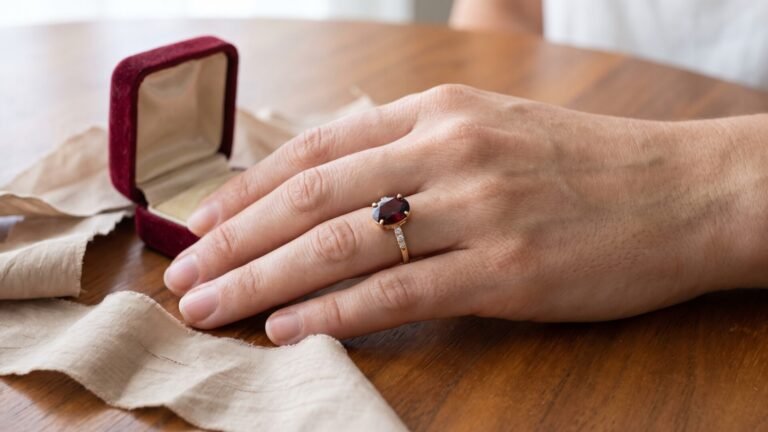
- Rings are reasonable for regular wear with protective prongs or a bezel, and with the ring removed for impact-heavy activity.
- Large center stones with exposed corners need more caution, whatever the species.
The long-term costs are predictable. Expect to re-tip or tighten prongs every few years, pay for professional cleaning and inspection, and possibly recut an edge that chips. A setting that leaves the stone exposed may need replacing if the wearer is hard on jewelry. Budget for maintenance the way you would for a car.
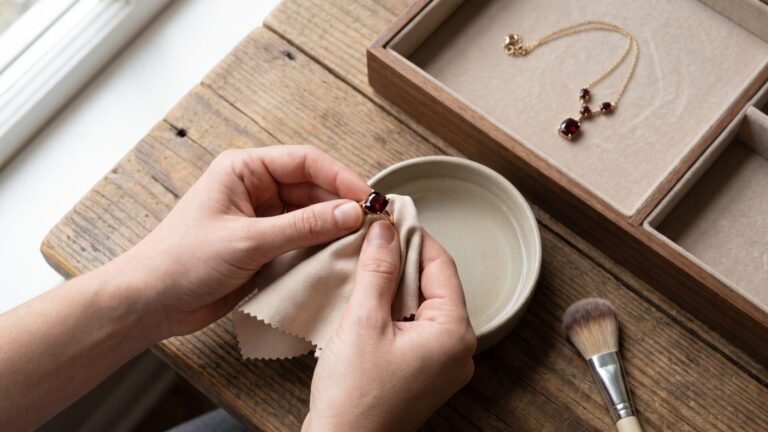
Care is simple. Clean with warm water, mild soap, and a soft brush. Avoid sudden impacts and harsh chemicals. Store garnet separately from harder stones so they cannot scratch it. Ask a jeweler before using an ultrasonic or steam cleaner, particularly if the stone has fractures, inclusions, or any undisclosed treatment. The complete garnet care guide covers the details.
How to Buy the Right One
Buy almandine if…
You want a deep red, burgundy, wine, or reddish-purple appearance. You prioritize a larger stone or substantial-looking jewelry at a controlled budget. The piece is a pendant, earrings, or a protected ring for occasional or moderate wear. You like the antique, dramatic, January-birthstone look and do not need the brightest possible red.
Buy pyrope if…
You want a more vivid, pure-looking red and are willing to compare stones carefully. The stone has strong transparency, lively brilliance, and balanced saturation rather than simply a higher variety label. The purchase is a meaningful gift where brightness and immediate impact matter. You are comfortable paying more for an attractive specimen, but you do not confuse rarity claims with documented value.
Use a five-step inspection checklist
- Confirm the seller identifies the material accurately and discloses known treatments.
- Ask whether the stone is a pure end member, a mixed almandine-pyrope garnet, or a trade variety such as rhodolite.
- Request daylight and indoor photographs, or inspect the stone in person.
- Check the return policy, especially online, where photographs can conceal excessive darkness or windowing.
- For an expensive or unusual stone, obtain an independent report from a respected laboratory and verify it matches the stone being sold.
Match the stone to the jewelry
Brighter pyrope or a lively mixed red garnet works best as a center stone that must stay alive in varied lighting. Almandine suits designs where depth of color is intentional, particularly halo, cluster, vintage, and antique-style settings. White metal tends to emphasize a cooler purplish-red garnet; yellow or rose gold reinforces wine and burgundy tones.
If the piece is a ring, the garnet engagement ring guide covers setting and symbolism. If it is a gift, the garnet jewelry gift ideas will save you a few wrong turns.
Which Garnet Still Makes Sense in Three Years?
Three years from purchase, the differences show up in what you actually wear. Almandine wins on affordability, availability, and the ability to choose a larger stone. Pyrope wins when you found an unusually bright, well-cut example and paid for it. A mixed garnet often offers the strongest balance of color, size, and price when it is honestly identified.
Resale is the part sellers rarely volunteer. Most ordinary garnet jewelry should be bought for enjoyment, not appreciation. Retail markup, jewelry condition, setting style, and buyer demand usually limit what you can get back. Documented rarity, exceptional size, unusual color, and strong provenance can improve collector interest, but they do not guarantee liquidity. A garnet is not a savings account.
The hidden cost of choosing wrong is real. Buyers replace a dark or lifeless stone rather than wear it, which makes the initial bargain more expensive than a carefully inspected mid-range stone. The cheap stone you never wear costs more than the good stone you wear for thirty years.
The decision framework, then:
- Best value for a larger, dramatic red stone: a well-cut almandine.
- Best visual impact when the color is genuinely bright: fine pyrope.
- Best compromise: an attractive almandine-pyrope mixed garnet with transparent disclosure and a strong cut.
The stone should win over the species label. Every time.
Final Recommendation
Choose almandine for budget-conscious buyers who prefer deep color and size. Choose pyrope for buyers prioritizing a brighter red and willing to pay for superior transparency and cut. Choose neither solely because a seller calls it rare. Compare color, light return, durability, documentation, and the total cost of the finished jewelry.
For most buyers, a beautiful, well-cut garnet with honest disclosure is a better heirloom purchase than a technically purer stone that looks dark or lacks brilliance. That stone will be worn, handed down, and reset by someone not yet born, and it will still have its color. A dark stone gets put in a drawer and stays there.
If the purchase is driven by meaning as much as appearance, the history and symbolism of garnet gives you the context behind the January birthstone. If you are still deciding between varieties, start with the main garnet guide and work outward from there.
Back to that customer. Her mother’s pendant, the one she exchanged, was a mixed stone in the end. Brighter than the first, deeper than the second, and it cost less than either. She wore it to the wedding of a granddaughter I never met. The label on the receipt said garnet. That was the only accurate word on it.
Frequently Asked Questions About Almandine Vs Pyrope Garnet
Is almandine more valuable than pyrope garnet?
Usually not as a general rule. Almandine is often more common and affordable, while fine pyrope can command more when it has vivid color, good transparency, and strong cutting. Actual quality matters more than the variety name.
Can almandine and pyrope garnet look the same?
Yes. Their colors can overlap, particularly when the material is compositionally mixed. Visual appearance alone cannot always identify the exact garnet end member, which is why a laboratory is sometimes needed.
Is pyrope garnet always bright red?
No. Pyrope can appear purplish-red, deep red, or something else entirely depending on trace elements, cut, tone, and transparency. A stone labeled pyrope can still be too dark if it is poorly cut or heavily saturated.
Is almandine garnet suitable for an engagement ring?
It can be, with a protective setting and sensible wear habits. Because garnet is more vulnerable to scratching and chipping than sapphire or ruby, a bezel or protective prong design and regular inspection are advisable.
Is rhodolite garnet almandine or pyrope?
Rhodolite is generally a trade name for purplish-red garnet with a composition between almandine and pyrope. It is not normally treated as a separate mineral species.
Do almandine and pyrope garnets need certification?
Routine certification is usually unnecessary for a modest commercial stone. An independent report is worthwhile for a high-value, unusually large, rare-color, origin-claimed, or investment-marketed garnet.
Which is better for a gift: almandine or pyrope?
Almandine is often the better value when the recipient likes deep wine-red color or a larger-looking stone. Pyrope is preferable when a brighter, livelier red is the main priority. The recipient’s color preference should decide more than the label.