Which Birthstones Should Never Be Cleaned With an Ultrasonic Cleaner?
I was eighteen months into the counter when a woman brought in a pearl ring her mother had left her. She had put it through the ultrasonic machine she bought for her wedding band, because the instructions said "all jewelry." The nacre was gone in patches along the crown of the ring, worn down to the bead nucleus in places, and the strand of tiny seed pearls beside it had lost their luster entirely. There is no repair for that. We restrung the strand and reset what could be reset, and she cried in the parking lot.
Here is the short answer, before anything else: pearls and opals should never go in an ultrasonic cleaner, and emeralds, turquoise, moonstone, peridot, tanzanite, and most treated or heavily included stones need inspection first. The longer answer is that hardness is only one of six or seven things that decide whether a machine will hurt a stone, and the machine’s own manual will not tell you the other six.
If you are holding a piece and you do not know its treatment history, its internal condition, or how it is assembled, the ultrasonic is not the tool. Lukewarm water, a drop of mild soap, and a soft brush are. That is the whole article in one line, and the rest is why.
How an ultrasonic cleaner can damage a birthstone
An ultrasonic cleaner works by pushing high-frequency sound waves through a liquid bath. Those waves create millions of microscopic bubbles that form and collapse almost instantly, a process called cavitation. The collapsing bubbles scrub grime off metal and stone at a scale no brush can reach. In a jeweler’s shop, that is exactly what we want for a dirty diamond solitaire.
The problem is that cavitation is indiscriminate. It does not know which part of the piece is durable and which is not. It will lift grease out of a prong setting and, in the same cycle, work at a hairline fracture in an emerald, vibrate a glued side stone free, or push moisture into a porous turquoise cabochon. The energy is small, but it is relentless, and it is applied everywhere at once.
Damage splits into two categories, and buyers usually only think about the first.
Gemstone damage is what happens to the stone itself: a fracture propagates, a treatment is disturbed, a soft surface abrades, a layered stone delaminates, a porous material absorbs liquid and discolors.
Jewelry damage is what happens around the stone: prongs loosen from vibration, a glued component separates, an antique mounting with worn solder fails, a foil backing behind a stone lifts or corrodes. A diamond can come out of an ultrasonic bath perfectly fine while the setting that holds it has been quietly weakened.
Before any machine goes near a piece, run these questions. Is the gem porous? Is it treated, and do I know with what? Are there visible fractures, crazing, or cavities? Is it assembled from layers or glued components? Is the setting antique, fragile, or partly glued? If you cannot answer all five, you are not ready to clean it in a machine.
For the broader vocabulary of stone properties, Gemstones: Your Ultimate Guide to Nature’s Sparkle covers hardness, cleavage, porosity, and treatment in more depth than I can here.
Birthstones that should never go in an ultrasonic cleaner
These are the firm noes. Not "probably avoid" – no.
Pearl
Pearl is the clearest case on the list. The outer layer, nacre, is relatively soft, usually sitting around 2.5 to 4.5 on the Mohs scale, and it is built in thin overlapping layers. Ultrasonic vibration, detergent, and heat can dull it, scratch it, or work at the layers themselves.
The risk is not only the vibration. Drilled pearls have holes where moisture and detergent collect. Strung pearls sit on silk or synthetic thread that dislikes heat and harsh chemistry. Coated or dyed pearls have a surface treatment that can be affected. And many pearl pieces use adhesive somewhere in the construction.
This applies to natural, cultured, freshwater, and saltwater pearls alike. Surface quality and construction vary, but none of them belong in a machine.
Routine cleaning is a soft, barely damp cloth. Heavy grime, restringing, and antique pieces go to a professional. If you wear a pearl bracelet regularly, the question of moisture exposure comes up constantly – Can You Wear a Pearl Birthstone Bracelet in the Shower? handles that properly. For the stone itself, Pearl: Meaning, Properties, Uses & Value is the place to start.
Opal
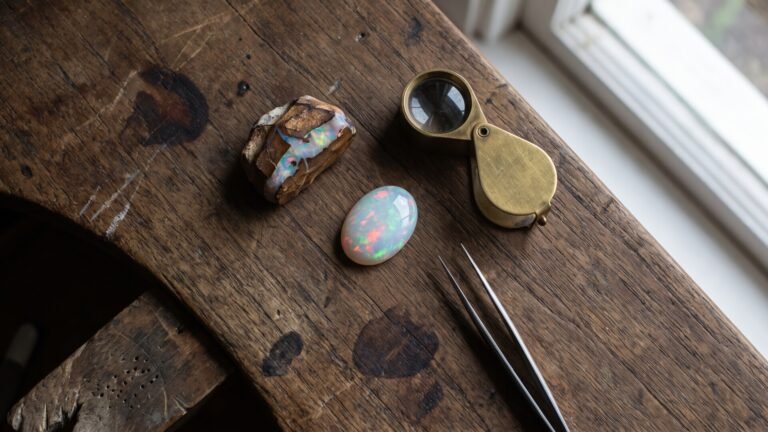
Opal holds between roughly 5.5 and 6.5 on the Mohs scale and contains anywhere from a few percent to around twenty percent water within its structure. That water content is part of what gives it play of color, and it is also part of what makes it fragile.
Crazing is the network of fine surface cracks that develops in some opals as they lose or gain moisture unevenly. A crazed opal is already failing. Ultrasonic vibration, heat, or a rapid change in moisture can accelerate that failure, and there is no repair once it starts.
Doublets and triplets are worse. A doublet is a thin slice of precious opal glued to a backing; a triplet adds a clear cap on top. Both are assembled materials with adhesive and layered components, and both are entirely unsuitable for ultrasonic cleaning. The vibration can work at the glue line directly.
Solid opal with no visible crazing is still a stone I would hand-clean rather than machine-clean. The margin for error is too thin. Opal: Meaning, Properties, Uses & Value covers the material, and Safest Way to Clean an Opal Birthstone Ring With Crazing Risk walks through the specific case of a ring that already shows the warning signs.
Emerald
Emerald is the one that surprises people, because beryl is a reasonably hard material at 7.5 to 8 on the Mohs scale. Hardness is not the issue here. Internal condition and treatment are.
Most natural emeralds contain internal fissures – the trade calls the resulting look jardin, French for garden, because the inclusions resemble foliage. Those fissures are inherent to the stone. On top of that, the overwhelming majority of emeralds on the market have been clarity enhanced, typically with colorless oil or resin drawn into the fractures to reduce their visibility.
An ultrasonic cleaner can do three bad things to an emerald. It can worsen existing fractures. It can remove or disturb the oil or resin filler, which changes the stone’s appearance and can expose a durability problem that was previously concealed. And it can reveal that a stone you thought was clean was actually held together by its treatment.
A clean-looking emerald is not automatically safe. Treatment disclosure and a jeweler’s inspection matter far more than appearance. Before any cleaning, ask directly whether the stone is oil-treated, resin-filled, or fracture-filled. Emerald: Meaning, Properties, Uses & Value covers the treatment landscape.
Turquoise
Turquoise is porous. That single property rules out the ultrasonic bath for most pieces, because a porous material will absorb whatever is in the liquid – water, detergent, oils, dissolved dirt – and it does not always give it back evenly.
The result can be discoloration, surface deterioration, or a change in the stone’s character that no cleaning will reverse. Stabilized turquoise, which has been impregnated with polymer to harden it, adds another layer of risk: the treatment itself can be disturbed. So can the fillers and backing materials used in some assembled pieces.
I would avoid ultrasonic cleaning for valuable natural turquoise and for any turquoise of unknown origin, which includes most vintage and artisan pieces. A dry or barely damp cloth is the routine method. Turquoise: Meaning, Properties, Uses & Value explains the difference between natural, stabilized, and treated material, which is the distinction that decides everything here.
Birthstones that require caution rather than an automatic yes
The stones below are not automatic noes. They are stones where the specific piece decides, and where the default should be hand cleaning until someone qualified has looked at it.
Moonstone
Moonstone sits around 6 to 6.5 on the Mohs scale, but hardness is not the concern. Moonstone is a feldspar, and feldspars have directional weaknesses – planes along which the crystal structure is prone to split. The gemological term is cleavage, and it means a stone can fail along a plane rather than wearing down gradually.
A cabochon-cut moonstone can also hide fractures and surface damage under its smooth dome. You find out about them when the stone is cleaned and the fracture opens, or when a chip appears at the edge that was not there before.
Hand cleaning is the right default. If a qualified jeweler has inspected the specific stone and setting and cleared it, that is a different conversation. Until then, no machine. Moonstone: Meaning, Properties, Uses & Value covers the material.
Peridot
Peridot is around 6.5 to 7 on the Mohs scale and often contains inclusions. It is also vulnerable to thermal shock – sudden temperature change that can crack a stone – and to existing fractures, particularly in larger stones and older jewelry.
I am not going to tell you every peridot is unsafe in an ultrasonic cleaner, because that is not true. Condition, clarity, size, and mounting decide it. A small, clean, well-set modern peridot in a sturdy mounting is a different risk profile from a large, heavily included peridot in a Victorian setting with worn prongs.
Hand cleaning for vintage pieces, heavily included stones, and anything with a loose setting. Professional ultrasonic use only after inspection. Peridot: Meaning, Properties, Uses & Value has the detail.
Tanzanite
Tanzanite is softer and more brittle than sapphire, sitting around 6 to 7 on the Mohs scale, with one-directional cleavage and real sensitivity to sudden temperature change and impact. It is also a stone with genuine investment significance, which changes the calculus on cleaning.
An ultrasonic cleaner is not automatically forbidden for every tanzanite piece. But it is a poor default for valuable, included, damaged, or unusually large stones, and it is a bad idea for any tanzanite whose setting you have not had checked. The cleaning decision connects directly to the stone’s long-term value – Tanzanite: Meaning, Properties, Uses & Value covers why.
Other treated, included, or assembled birthstones
The list of stones that need inspection before machine cleaning is longer than most buyers expect. Treated topaz. Treated or fracture-filled ruby and sapphire. Heavily included garnet. Assembled opal. Composite jewelry of any kind. Anything with glued accents.
The common thread is treatment disclosure. A visually attractive stone may not have the same cleaning tolerance as an untreated one, and you cannot tell by looking. Fracture filling in particular – where glass or resin is drawn into surface-reaching cracks – is common in ruby and can be invisible to the eye.
One more thing that catches people: birthstone jewelry often contains more than one material. The center stone may be a durable sapphire while the side stones are opal, the accents are glued, the metal is plated, or the construction is antique. The piece is only as cleanable as its most fragile component.
Ask the seller for treatment information in writing. And avoid any cleaner, machine or solution, that does not disclose its limitations – a product that claims to be safe for "all gemstones" is telling you it has not thought about this.
Birthstones that are commonly safer, but not automatically safe
Now the other side of the list, with the same caveat attached.
Diamond, ruby, sapphire, and some garnets
These stones are generally more resistant to routine ultrasonic cleaning when they are untreated or appropriately treated, free from significant fractures, and securely mounted. Diamond at 10 on the Mohs scale, ruby and sapphire at 9, and the harder garnets in the 7 to 7.5 range are the stones the machine was designed around.
Here is the contrarian point, and it is the one worth carrying out of this article: hardness alone does not make a piece safe. A diamond can survive the vibration perfectly well while a loose prong beside it cannot. A fracture-filled ruby at 9 on the Mohs scale is a worse candidate for the machine than a clean peridot at 6.5.
The exceptions to flag: fracture-filled or cavity-filled stones, antique settings, heavily included gems, and anything with glued components. Diamond: Meaning, Properties, Uses & Value, Ruby: Meaning, Properties, Uses & Value, Sapphire: Meaning, Properties, Uses & Value, and Garnet: Meaning, Properties, Uses & Value each cover stone-specific durability and treatment where you need it.
For a fuller comparison of which stones tolerate the machine, Which Gemstones Are Safe to Clean With an Ultrasonic Cleaner? is the companion piece to this one.
Amethyst, citrine, aquamarine, and topaz
Quartz and beryl family stones in this group are often considered compatible with ultrasonic cleaning under controlled conditions. Amethyst and citrine are quartz at 7 on the Mohs scale; aquamarine is beryl at 7.5 to 8; topaz is 8.
Treatments, fractures, heat exposure, and setting condition still matter. Heat-treated or irradiated color is not itself proof of danger – a heat-treated aquamarine is not more fragile in the bath than an untreated one – but unknown treatment or visible damage should stop the process.
The rule I would give anyone: if the stone is valuable, inherited, antique, or visibly damaged, get it inspected rather than relying on a generic machine setting. Aquamarine: Meaning, Properties, Uses & Value and Topaz: Meaning, Properties, Uses & Value cover care by stone.
A safer decision framework before using any ultrasonic cleaner
Print this and keep it near the machine. Two lists, and the second one is shorter than most people want.
Do not use the ultrasonic if any of these is true:
- The stone is pearl or opal
- There are visible fractures, crazing, or cavities
- The material is porous
- The treatment is unknown
- The piece has glued, layered, or assembled construction
- A setting is loose or a prong is worn
- The mounting is antique or of uncertain construction
- The jewelry is valuable and undocumented
Possible with inspection if all of these are true:
- The stone is durable and transparent
- There is no visible damage
- The setting is secure and modern
- The treatment has been disclosed
- There is no glue anywhere in the piece
- A jeweler has approved it where the value is significant
When you take a piece to a jeweler, ask specific questions. What is the stone? Is it treated, and with what? Is it fracture-filled or assembled? Is the setting secure? Could cleaning affect the treatment? Is hand cleaning preferable? A good jeweler will answer all six without flinching.
| Birthstone or material | Ultrasonic default | Main concern | Safer approach |
|---|---|---|---|
| Pearl | Never | Soft nacre, coatings, stringing, adhesives | Soft damp cloth |
| Opal | Avoid | Crazing, fractures, layered construction | Gentle hand cleaning |
| Emerald | Avoid unless inspected | Inclusions and oil or resin treatment | Mild soap or professional cleaning |
| Turquoise | Avoid | Porosity and stabilization | Dry or barely damp cloth |
| Moonstone | Caution | Cleavage and hidden fractures | Gentle hand cleaning |
| Tanzanite | Caution | Cleavage and thermal sensitivity | Professional inspection |
| Diamond, ruby, sapphire | Often suitable if inspected | Treatments, fractures, loose settings | Ultrasonic only when confirmed safe |
How to clean unsafe birthstones without an ultrasonic machine
The hand method works for almost everything on the "never" list, with one adjustment for the porous stones. Here is the process.
Use lukewarm water, a small amount of mild dish soap, a soft toothbrush or makeup brush, and a lint-free cloth. Close the drain or work over a bowl – the bowl is not fussiness, it is the difference between a lost stone and a found one. Soak briefly where the stone tolerates it. Brush around rather than aggressively over vulnerable surfaces. Rinse carefully. Pat dry rather than rubbing.
What to avoid, flatly: boiling water, harsh chemicals, bleach, toothpaste, abrasive powders, and steam unless a professional has confirmed compatibility. Toothpaste is the one people reach for most and it is the one that does the most quiet damage to polished surfaces.
The no-soak rule applies to pearls, porous turquoise, glued jewelry, doublets, triplets, and anything of unknown construction. For these, a damp cloth and no immersion at all.
How to Clean Gemstone Jewelry at Home Without Professional Equipment has the full method, and Which Birthstones Should Never Be Exposed to Water? is worth reading if you are unsure whether your stone tolerates even a brief rinse. Heat and drying practice matter too – How to Protect Gemstone Jewelry From Heat and Temperature Changes covers thermal shock and how to dry a piece without creating it.
What most owners get wrong about ultrasonic cleaning
The single most common error is trusting the machine’s marketing. A cleaner that says it is safe for "jewelry" is usually talking about metal, or about a narrow set of durable stones. The instructions often do not mention treatments, porous materials, or assembled construction at all. That is not a lie exactly. It is a scope statement the buyer was never meant to read carefully.
The second error is assuming that because a stone looks fine immediately after cleaning, it is fine. A weakened setting, a disturbed filler, or a developing fracture may not show for weeks. The damage is often done in the bath and discovered later, which is why the counter story at the top of this piece ends the way it does – the pearl ring looked fine when it came out. It did not look fine a month later.
The third error is using the ultrasonic to compensate for poor habits. Lotion buildup, infrequent inspection, and jewelry stored in a tangle all create the grime that makes an aggressive clean feel necessary. Better storage and a wipe-down after wearing reduce the need for the machine in the first place. Gemstone Hardness Scale Explained: What the Numbers Really Mean is worth reading if you want to understand why the Mohs number you see in a listing tells you so little about cleaning safety.
And if the piece is inherited or high-value, document it before any powered cleaner comes near it. Photographs, treatment records if you have them, and a professional inspection. The documentation is what a future owner will need, and it costs you an afternoon.
Frequently Asked Questions About Gemstones Not Safe For Ultrasonic Cleaner
Can pearls go in an ultrasonic cleaner?
No. Pearls should be cleaned with a soft, slightly damp cloth and kept away from ultrasonic vibration, harsh detergents, prolonged soaking, and heat. The nacre is soft and layered, and the stringing and adhesives in a pearl piece are vulnerable too.
Is an opal safe in an ultrasonic cleaner?
Opals should be kept out of ultrasonic cleaners, especially if they show crazing, contain fractures, or are doublets or triplets. Even a solid opal with no visible damage is a hand-clean piece in my book. Valuable opal jewelry should be inspected by a jeweler.
Why are emeralds risky to clean ultrasonically?
Many emeralds contain internal fissures and have been clarity enhanced with oil or resin. Ultrasonic vibration may worsen fractures or disturb the treatment, and it can expose a durability problem the filler was concealing.
Can a diamond birthstone ring go in an ultrasonic cleaner?
Often, but not automatically. The diamond should be checked for significant fractures or treatments, and the setting must be secure. Antique, fragile, or glued mountings should be inspected before any machine cleaning.
Are all soft birthstones unsafe for ultrasonic cleaning?
Not solely because they are soft. Porosity, cleavage, inclusions, treatments, coatings, assembly, and setting condition can matter just as much as hardness. A hard stone with a fracture-filled treatment can be a worse candidate than a softer clean one.
What should I do if I do not know whether my birthstone is treated?
Do not use an ultrasonic cleaner until a jeweler identifies the stone and evaluates its treatment and setting. In the meantime, clean only the surface with a soft damp cloth and no soaking.
Is professional ultrasonic cleaning always safe?
No. A professional can inspect the jewelry and choose an appropriate method, but professional equipment does not eliminate risks created by fractures, treatments, porous materials, or weak settings. The inspection is what makes it safe, not the machine.
The permission to stop worrying about the machine
You do not need an ultrasonic cleaner. That is the thing I would most want you to take away, and it is not a sales pitch in either direction – I am not sending you to a gentler machine instead. A bowl of lukewarm water, a drop of mild soap, a soft brush, and a cloth will keep almost every birthstone piece in this article clean for a lifetime, and none of them can hurt a pearl.
The machine earns its place for a confirmed-safe diamond or a sturdy sapphire in a modern setting, and if you already own one and know exactly what is in your jewelry box, use it for those pieces and nothing else. If you are uncertain about a single item – and inherited, antique, treated, or emotionally important pieces are exactly where uncertainty lives – hand-clean it and have a jeweler look at it once. That is a reasonable place to stop researching and start wearing.